Agentic AI for SEO, Google Ads & Social Media Marketing
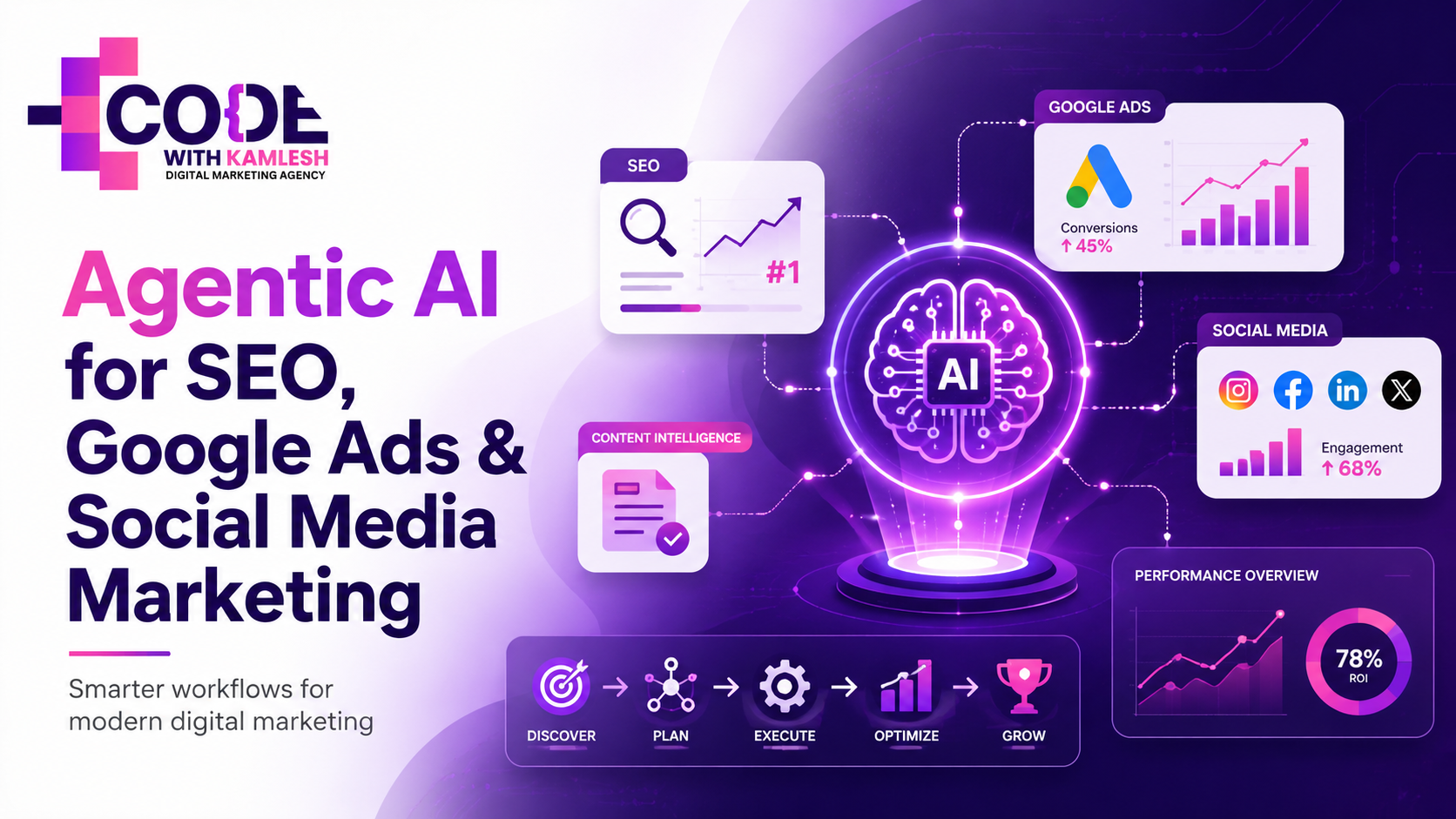
Discover how Agentic AI is transforming SEO, Google Ads, and social media marketing through intelligent automation, real-time analysis, content planning, campaign optimisation, and data-driven decision-making with controlled human supervision.
Artificial intelligence has already changed the way marketers research keywords, write content, design advertisements and analyse campaign performance. However, most traditional AI tools still depend heavily on human instructions. A marketer enters a prompt, receives an answer and then manually decides what to do next.
Agentic AI takes this process several steps further.
Instead of completing only one isolated task, an AI agent can understand a marketing objective, create a plan, access connected tools, perform multiple actions, evaluate the results and decide what should happen next. It functions less like a basic content generator and more like a digital marketing assistant capable of managing an entire workflow.
For example, a standard AI tool may generate ten headlines for a Google Ads campaign. An agentic AI system could potentially examine search-term data, identify weak-performing advertisements, generate new headlines, recommend negative keywords, suggest a more relevant landing page and prepare a performance report for the campaign manager.
This shift is important because digital marketing is becoming increasingly complex. Businesses are managing SEO, Google Ads, social media, email marketing, CRM systems, landing pages, analytics and lead follow-ups across multiple platforms. Marketers do not only need more content. They need better coordination, faster analysis and more intelligent decision-making.
Agentic AI is emerging as a possible solution to this challenge.
What Is Agentic AI?
Agentic AI refers to artificial intelligence systems that can pursue a defined goal by planning and executing a sequence of actions with limited human supervision.
Google Cloud describes agentic AI as an advanced form of AI focused on autonomous decision-making and action. Unlike traditional systems that mainly respond to instructions, agentic systems may set goals, create plans and perform tasks through connected tools.
Consider the difference between these two instructions:
Traditional AI instruction:
“Write a blog about local SEO.”
The AI generates the article, and the task ends.
Agentic AI instruction:
“Improve organic lead generation for our digital marketing agency in Indore.”
To work toward that goal, an AI agent may:
- Analyse the website’s current search performance.
- Identify keywords with business value.
- Audit competing websites.
- Find missing service pages and blog topics.
- Prepare a content calendar.
- create content briefs.
- Check technical SEO problems.
- Recommend internal links.
- Monitor ranking and conversion changes.
- Adjust the plan based on performance.
The key difference is that the system is not merely responding to a prompt. It is working toward an outcome.
Traditional Automation vs Generative AI vs Agentic AI
These terms are often used interchangeably, but they represent different levels of capability.
TechnologyHow it worksMarketing example
Traditional automation
Follows predefined rules
Sends an email when someone submits a form
Generative AI
Creates content from a prompt
Writes an email, advertisement or blog draft
Agentic AI
Plans and performs multiple actions toward a goal
Analyses leads, prepares follow-ups, updates the CRM and prioritises high-intent prospects
Traditional automation is predictable but limited. It follows an “if this, then that” structure.
Generative AI is more flexible because it can create text, images, summaries and ideas. However, it usually waits for human instructions at every important stage.
Agentic AI combines reasoning, planning, memory, tool usage and automation. It can select the next action based on the information available to it.
This does not mean that businesses should allow an AI agent to control their entire marketing operation without supervision. The most practical model is controlled autonomy: the AI manages repetitive and data-heavy work while humans approve strategic, financial and brand-sensitive decisions.
How Agentic AI Works in Digital Marketing
An effective marketing agent usually works through a continuous cycle.
1. The marketer defines the goal
The goal must be specific and measurable.
A weak goal would be:
“Improve our marketing.”
A stronger goal would be:
“Generate 100 qualified leads per month for podcast editing services while maintaining a target cost per lead.”
2. The agent collects relevant information
It may connect with tools such as:
- Google Search Console
- Google Analytics
- Google Ads
- Meta Ads Manager
- Keyword research platforms
- Social media accounts
- CRM software
- Email marketing systems
- Website content management systems
3. It creates a multi-step plan
The agent breaks the main objective into smaller actions. For example, it may decide to improve the landing page, expand keyword coverage, create remarketing audiences and publish educational content.
4. It performs approved actions
Depending on the level of access provided, the system may draft content, generate reports, update spreadsheets, schedule social posts or recommend campaign changes.
5. It evaluates performance
The agent compares the results with the original objective. It may evaluate organic clicks, rankings, conversion rates, cost per lead, engagement or sales.
6. It adjusts the next set of actions
Instead of following the same workflow repeatedly, an agentic system can change its plan when performance data changes.
This feedback loop is what makes agentic AI different from a simple automation tool.
Agentic AI for SEO
SEO requires dozens of connected activities. Keyword research affects content planning. Content quality affects engagement. Technical problems affect crawling and indexing. Internal links affect discoverability. Search performance data influences future optimisation.
Most companies handle these tasks separately. Agentic AI can help connect them into one coordinated workflow.
Automated Keyword and Search-Intent Research
Traditional keyword research usually involves exporting a list of keywords and sorting them by volume or difficulty. This approach often produces hundreds of terms without explaining which ones are commercially useful.
An AI agent can study multiple signals, such as:
- Search intent
- Existing website rankings
- Competitor coverage
- Product or service relevance
- Conversion potential
- Location
- Customer questions
- Content gaps
- Seasonal demand
It can then organise keywords into meaningful clusters.
For a podcast editing company, the system may create separate clusters for:
- Podcast editing services
- Video podcast editing
- Audio cleanup
- Podcast reels and shorts
- Multicamera editing
- Podcast content repurposing
- Podcast editing prices
- Local podcast editing services
The agent could also assign each cluster to the correct page type. A commercial keyword may require a service page, while an informational query may require a detailed blog.
This helps prevent the common mistake of targeting every keyword through blog articles, even when users are searching for a service provider.
Continuous Technical SEO Monitoring
Technical SEO audits are often conducted once every few months. However, websites change regularly. New plugins, theme updates, deleted pages, broken links and publishing errors can create problems at any time.
An SEO agent can continuously monitor:
- Broken internal links
- Missing title tags
- Duplicate descriptions
- Indexing problems
- Redirect chains
- Slow pages
- Missing canonical tags
- Orphan pages
- Sitemap errors
- Structured-data issues
- Pages receiving impressions but few clicks
The agent can prioritise problems based on their likely business impact.
For example, a broken link on an old blog may be less urgent than an accidentally de-indexed service page generating qualified enquiries.
However, high-impact technical changes should still require human or developer approval. Automatically changing canonical tags, robots directives or large numbers of redirects could damage a website when the agent lacks sufficient context.
Content Briefs Based on Real Search Opportunities
Agentic AI can improve content planning by combining keyword data, competitor analysis and business expertise.
Instead of producing a generic brief, it could prepare:
- Primary keyword
- Secondary keywords
- Search intent
- Recommended heading structure
- Questions to answer
- Relevant services to mention
- Internal-link opportunities
- Suggested examples
- Conversion points
- Schema recommendations
- Content that competitors have missed
The resulting article should not simply repeat existing search results. It should include genuine experience, examples, opinions, processes or original data from the business.
Google’s current guidance states that foundational SEO remains relevant for visibility in AI Overviews and AI Mode. It also emphasises unique, valuable and non-commodity content rather than pages that merely reproduce commonly available information.
This is an important limitation of automated content systems. An AI agent can organise research and accelerate production, but it cannot automatically manufacture genuine business experience.
Internal Linking at Scale
Internal linking becomes difficult when a website contains hundreds or thousands of pages.
An agent can analyse the website and identify pages that are contextually related. It may recommend links from high-authority blog posts to relevant service pages or connect supporting articles to a central pillar page.
For example, an article about “How to Improve Podcast Audio Quality” could link naturally to:
- Podcast audio editing services
- Podcast post-production services
- Video podcast editing
- Podcast editing cost
- Podcast content repurposing
The agent can also identify orphan pages and pages with excessive or irrelevant internal links.
Human review is still necessary because internal links should improve the reader’s experience, not merely insert keywords into every paragraph.
SEO for AI Overviews and Generative Search
Search behaviour is expanding beyond traditional lists of blue links. Users can ask longer questions, refine their searches through follow-ups and receive AI-generated responses.
This has increased interest in terms such as Generative Engine Optimization and Answer Engine Optimization. However, Google states that optimising for its generative search experiences remains part of SEO and does not require special AI files or unique markup created exclusively for AI systems.
An SEO agent can still help businesses prepare for changing search experiences by:
- Identifying conversational questions
- Improving content structure
- Adding clear definitions
- Strengthening entity information
- Reviewing structured data
- Improving author and company information
- Adding original examples
- Maintaining accurate product and local business details
- Updating outdated content
- Comparing branded visibility across search platforms
The objective should not be to manipulate an AI answer. It should be to make the website accurate, useful, crawlable and easy to understand.
SEO Reporting and Decision-Making
Most SEO reports show traffic, rankings and impressions without explaining what the business should do next.
An agentic reporting system can move from reporting to diagnosis.
For instance, it may observe that:
- A service page’s impressions increased by 40%.
- Its average ranking improved.
- Its click-through rate declined.
- Its form conversion rate remained low.
The agent could then recommend testing the title, clarifying the offer, improving the call to action and aligning the landing page with the keyword intent.
This turns SEO reporting into an action-oriented process rather than a monthly collection of charts.
Agentic AI for Google Ads
Google Ads already uses machine learning for bidding, targeting, creative combinations and campaign delivery. Agentic AI adds a workflow layer that can connect campaign analysis, creative development, landing-page evaluation and business reporting.
Google’s AI Max for Search campaigns includes enhanced search-term matching, text customisation and final URL expansion. These features are designed to match advertisements and landing pages more closely with a user’s search intent.
However, platform automation and independent agentic workflows are not exactly the same. Google’s systems optimise activity inside the advertising platform, while a broader marketing agent may combine advertising data with CRM quality, website behaviour, sales feedback and profit margins.
Search-Term Analysis and Negative Keyword Recommendations
Search campaigns generate large amounts of query data. Reviewing every term manually can consume considerable time.
An agent can classify queries into categories such as:
- Highly relevant
- Informational
- Competitor-related
- Location mismatch
- Low commercial intent
- Existing customer support query
- Irrelevant
- Potential negative keyword
- New keyword opportunity
For example, a company offering professional podcast editing may target “podcast editing services.” The agent may identify queries such as “free podcast editing app” or “podcast editing course” as low-intent searches for that campaign.
Rather than automatically blocking every term, the system should present recommendations with reasons. A human campaign manager can then decide whether the query should be excluded or targeted through a different campaign.
Creative Testing and Asset Development
An AI agent can examine performance across headlines, descriptions, images and videos. It can identify which themes appear to attract clicks and conversions.
It may discover that advertisements mentioning “multicamera podcast editing” perform better than general advertisements about “professional video editing.”
The agent can then prepare new variations around:
- Turnaround time
- Audio quality
- Reels and short clips
- Multicamera editing
- Monthly packages
- Creator-focused support
- End-to-end post-production
The purpose is not to generate endless random variations. It is to develop creative hypotheses based on actual performance.
Google Ads’ text customisation can generate additional text assets using information from the advertiser’s website and existing campaign materials. Advertisers still need accurate landing pages and clear brand messaging because automated assets depend on the quality of the source information.
Budget and Bidding Monitoring
An agent can monitor spend, conversion value, cost per acquisition and budget utilisation across multiple campaigns.
It could detect situations such as:
- A campaign spending rapidly without qualified leads
- A high-performing campaign limited by budget
- A location producing cheaper but low-quality enquiries
- A campaign receiving conversions that the sales team cannot close
- An advertisement attracting leads outside the service area
- Conversion tracking becoming unreliable
The agent can prepare recommendations or trigger alerts.
Budget changes should generally require approval, especially when campaigns involve significant spending. Cost per lead alone does not represent business performance. A cheaper lead can still be worthless when it does not match the company’s ideal customer profile.
Landing-Page Alignment
Advertising platforms optimise the delivery of advertisements, but they cannot fix a weak offer or confusing landing page.
An agentic system can compare:
- Search query
- Advertisement message
- Landing-page headline
- Page content
- Form length
- Mobile experience
- Conversion rate
- CRM lead quality
Suppose an advertisement promises “Podcast Reels Editing,” but visitors arrive on a general digital marketing page. Even strong targeting may fail because the landing page does not continue the same message.
The agent could recommend a dedicated landing page showing:
- Before-and-after editing samples
- Services included
- Number of clips delivered
- Supported formats
- Turnaround time
- Portfolio
- Process
- Pricing or quotation options
- Clear enquiry form
A Practical Agentic Google Ads Workflow
A controlled workflow might look like this:
- The business defines its target cost per qualified lead.
- The agent imports Google Ads and CRM data.
- It reviews search terms, advertisements, devices, locations and landing pages.
- It separates raw leads from qualified leads.
- It identifies patterns behind successful enquiries.
- It prepares new keywords, negative keywords and advertisement variations.
- A campaign manager reviews and approves the changes.
- The agent monitors the results.
- It compares performance with the earlier period.
- It prepares the next optimisation plan.
This model keeps strategic control with the marketer while reducing repetitive analysis.
Agentic AI for Social Media Marketing
Social media marketing involves much more than publishing posts. Teams must research topics, write content, design creatives, adapt formats, schedule posts, respond to comments, analyse results and maintain a consistent brand voice.
Agentic AI can coordinate these activities across platforms.
Social Listening and Topic Discovery
A social media agent can monitor:
- Customer questions
- Competitor content
- Industry discussions
- Frequently used search terms
- Comments and reviews
- Product objections
- Emerging formats
- High-performing historical posts
It can convert these signals into content ideas.
For a podcast editing company, repeated questions about background noise, turnaround time and editing prices could become:
- Educational Instagram carousels
- YouTube tutorials
- LinkedIn posts
- Frequently asked questions
- Service-page content
- Short video scripts
- Comparison posts
This creates content from actual audience concerns rather than relying entirely on generic trend lists.
Content Repurposing
One of the strongest uses of agentic AI is content repurposing.
A single 45-minute podcast can potentially be transformed into:
- One complete YouTube episode
- Multiple Instagram Reels
- YouTube Shorts
- LinkedIn video clips
- Quote graphics
- A blog article
- An email newsletter
- Social media captions
- A carousel post
- Episode show notes
- Search-optimised timestamps
An agent can identify key moments, create a repurposing plan and prepare drafts for each platform.
Human editors remain important for selecting emotionally powerful moments, maintaining context, removing sensitive information and ensuring that cuts do not misrepresent the speaker.
Platform-Specific Content Planning
A common marketing mistake is publishing the same content everywhere without adapting it.
An agentic system can maintain one central brand idea while changing the format for each platform.
For example:
LinkedIn: A thoughtful post about why founders should use podcasts for authority building.
Instagram: A short visual reel showing the difference between raw and professionally edited audio.
YouTube: A detailed tutorial about editing a multicamera podcast.
Facebook: A customer-focused post explaining a monthly podcast editing package.
The message remains consistent, but the presentation reflects the audience and behaviour of each platform.
Community Management
An agent may classify comments and messages into categories such as:
- General enquiry
- Pricing question
- Technical support
- Complaint
- Spam
- Collaboration request
- High-intent lead
It can draft appropriate replies and route important conversations to the correct team member.
Businesses should avoid fully automating sensitive responses. Complaints, legal issues, refunds, personal information and reputation-related situations require human judgement.
Paid Social Campaign Optimisation
Meta’s Advantage+ suite uses AI and automation to support audience selection, placements, creatives and campaign optimisation. Meta describes Advantage+ as a set of solutions designed to optimise campaign performance in real time and match advertisements with people likely to take action.
An independent marketing agent could combine Meta campaign data with additional information, including:
- CRM lead status
- Sales-call outcomes
- Customer lifetime value
- Creative-production costs
- Landing-page conversions
- Organic content performance
The agent may identify that a reel performing strongly organically should be adapted into a paid advertisement. It could then prepare different hooks, captions and calls to action for testing.
Again, the agent should support strategic decisions rather than blindly increasing budgets based on platform-reported conversions.
Benefits of Agentic AI in Digital Marketing
Faster Execution
Agents can reduce the time required for repetitive research, reporting, classification and content preparation.
Better Coordination
SEO, paid advertising and social media data can be analysed together rather than in separate dashboards.
Continuous Optimisation
An agent can monitor performance more frequently than a team conducting weekly or monthly reviews.
Greater Personalisation
Campaigns, landing pages and follow-ups can be adapted based on audience behaviour and customer stage.
Improved Use of Marketing Data
Many companies collect large amounts of data but do not convert it into decisions. Agentic systems can identify patterns and recommend actions.
Scalable Operations
Agencies can manage more campaigns and content workflows without increasing manual work at the same rate.
Risks and Limitations
Agentic AI also creates genuine risks.
Incorrect Decisions
An agent may misunderstand the objective, work with incomplete data or optimise the wrong metric.
Brand Inconsistency
Automatically created advertisements and posts may sound generic or conflict with the company’s tone.
Data and Privacy Concerns
Marketing agents may access analytics, customer information, advertising accounts and CRM systems. Access must be restricted and monitored.
Excessive Content Production
Businesses may use AI agents to publish large quantities of low-value content. Google warns that generating many pages without adding meaningful value may violate its scaled content abuse policies.
Overdependence on Platform Metrics
An advertising platform may report successful conversions even when the sales team considers those leads unqualified.
Lack of Accountability
When an automated system makes a poor decision, businesses still need a human owner responsible for reviewing the outcome.
How to Implement Agentic AI Safely
Businesses should not begin by giving an AI system complete access to every marketing platform.
A safer implementation model includes five stages.
Stage 1: Observation
Allow the agent to read data and prepare reports without making changes.
Stage 2: Recommendations
The agent suggests keywords, content topics, advertisement variations and optimisation actions.
Stage 3: Human Approval
The agent prepares changes, but a marketer approves them before execution.
Stage 4: Limited Automation
Low-risk actions, such as report generation, content classification and alert creation, can run automatically.
Stage 5: Controlled Autonomy
The agent may perform approved actions within clearly defined limits, budgets and permissions.
Every workflow should include:
- Access controls
- Approval rules
- Spending limits
- Brand guidelines
- Data-quality checks
- Activity logs
- Rollback options
- Human ownership
- Regular performance reviews
The Future of Agentic AI in Marketing
Agentic AI is unlikely to remove the need for SEO professionals, media buyers, content strategists or social media managers.
It will change what these professionals spend their time doing.
Marketers may spend less time exporting reports, sorting keywords, rewriting similar posts and checking dashboards. They may spend more time defining strategy, understanding customers, developing offers, approving creative direction and improving business outcomes.
The most valuable marketer will not necessarily be the person who performs every task manually. It will be the person who knows:
- Which objective should be prioritised
- Which data can be trusted
- Which tasks should be automated
- Which decisions require human judgement
- How to evaluate AI recommendations
- How marketing performance connects with revenue
Agentic AI should therefore be viewed as a capability multiplier, not a replacement for strategy.
Conclusion
Agentic AI represents the next stage of digital marketing automation.
Traditional tools help marketers complete individual tasks. Agentic systems can connect those tasks into complete workflows built around measurable goals.
In SEO, agents can support keyword research, technical monitoring, content planning, internal linking and performance analysis. In Google Ads, they can evaluate search terms, advertisements, budgets, landing pages and lead quality. In social media marketing, they can coordinate listening, content creation, repurposing, scheduling,
engagement and paid campaign insights.
However, successful implementation requires more than connecting an AI tool to multiple platforms.
Businesses need accurate data, clear objectives, restricted permissions, strong approval processes and experienced marketers who can evaluate the agent’s decisions.
The future of digital marketing will not be completely manual or completely autonomous. It will be a partnership in which AI handles repetitive analysis and execution while humans provide strategy, creativity, context and accountability.
Companies that build this partnership carefully will be able to move faster without sacrificing quality, trust or control.
Frequently Asked Questions
1. What is Agentic AI in digital marketing?
Agentic AI in digital marketing refers to AI systems that can understand a marketing goal, create a multi-step plan, use connected tools, perform approved actions and adjust the workflow based on results.
2. How is Agentic AI different from generative AI?
Generative AI mainly creates content such as text, images or ideas after receiving a prompt. Agentic AI can coordinate multiple tasks and decide what action should happen next in order to achieve a defined objective.
3. Can Agentic AI perform SEO?
Agentic AI can support keyword research, technical auditing, content briefs, internal linking, competitor analysis and SEO reporting. Strategic decisions and high-impact technical changes should still be reviewed by an SEO professional.
4. Can Agentic AI rank a website automatically?
No system can guarantee rankings. An AI agent can improve SEO workflows and identify opportunities, but rankings depend on competition, technical accessibility, content quality, relevance, authority and many other factors.
5. Can Agentic AI manage Google Ads campaigns?
It can analyse campaign data, classify search terms, generate creative variations and recommend budget or targeting changes. Businesses should retain human approval for significant spending and strategy decisions.
6. Is Google Ads AI Max an Agentic AI system?
AI Max is an AI-powered set of Search campaign features that improves query matching, text customisation and landing-page selection. It contains advanced automation, but a complete agentic marketing workflow may also use CRM, website, sales and profitability data outside Google Ads.
7. How can Agentic AI help social media marketing?
It can research topics, create content plans, repurpose long-form content, adapt posts for different platforms, classify messages and analyse performance.
8. Will Agentic AI replace digital marketers?
It is more likely to replace repetitive tasks than complete marketing roles. Marketers will still be required for strategy, creativity, positioning, customer understanding, approvals and accountability.
9. Is Agentic AI suitable for small businesses?
Yes, but small businesses should begin with limited workflows such as reporting, content planning, lead classification or campaign alerts. They should avoid granting unrestricted access to advertising budgets or customer information.
10. What data does an AI marketing agent require?
Depending on the workflow, it may use website analytics, search performance, advertising data, CRM information, sales outcomes, social media performance and content data.
11. What is the biggest risk of Agentic AI?
The biggest risk is allowing an agent to act on incorrect data or optimise the wrong objective without sufficient supervision.
12. How should a company start using Agentic AI?
Start with one measurable workflow. Allow the agent to observe data and make recommendations first. Add automation only after the recommendations have been tested and proper approval rules are in place.
© 2026 Code With Kamlesh. All Rights Reserved.
Kamlesh Singad
Founder, Code With Kamlesh. Helped 200+ businesses scale through SEO, Google Ads & Social Media. 8+ years of digital marketing experience.
Comments (0)
No comments yet. Be the first to comment!