Search Volume Explained: What It Is, How It Works, and Why It Matters for SEO
Learn what search volume is, how it works, and why it matters for SEO. This complete guide by Code With Kamlesh explains keyword search volume, monthly searches, Google Keyword Planner, search trends, and practical strategies to find the right keywords, improve organic visibility, and drive relevant website traffic.
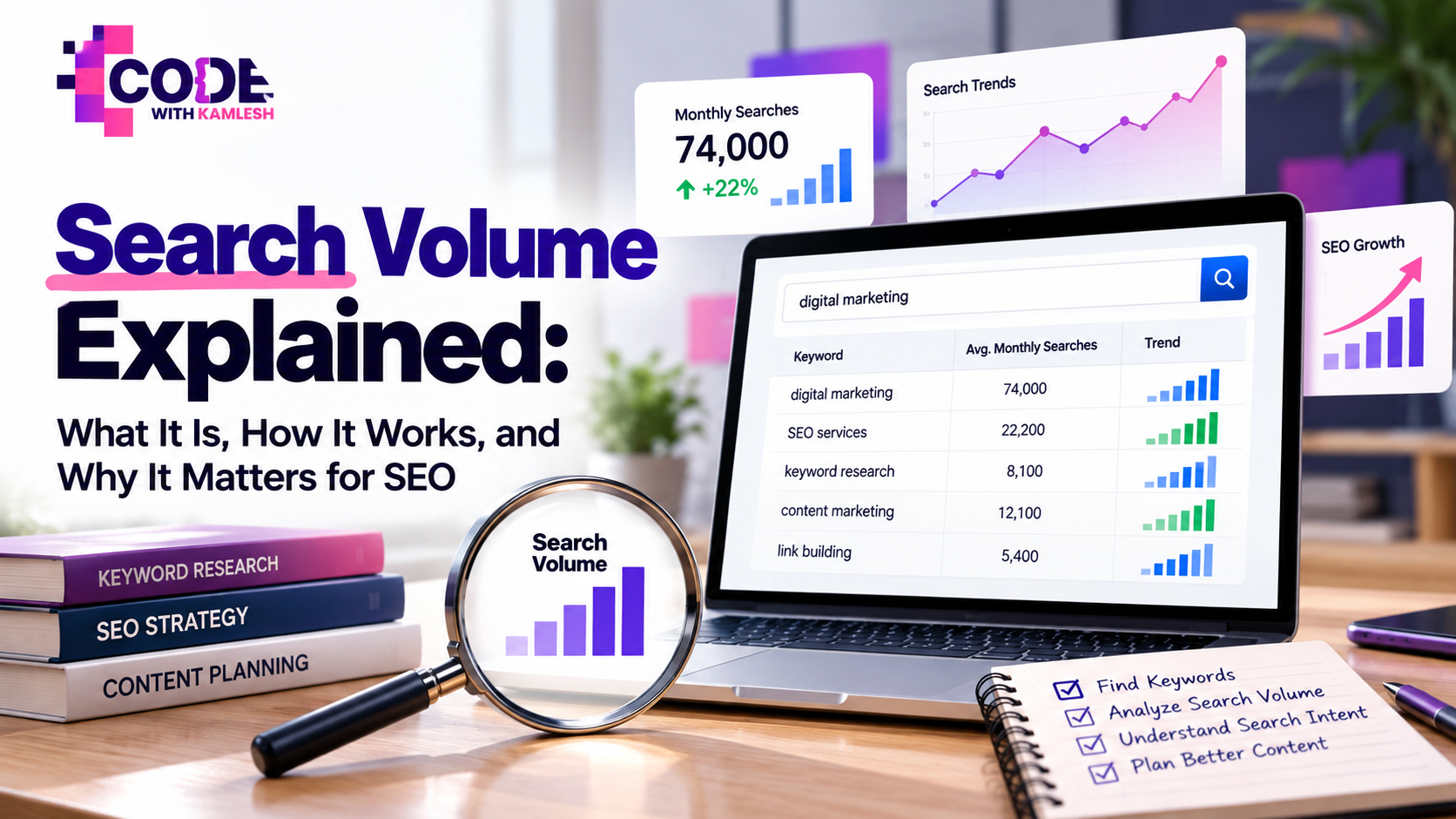
A keyword can look promising in a research tool and still bring very little value to a website. Another phrase may receive fewer searches but consistently attract people who need the services a business provides. Understanding the difference starts with search demand. In this guide, Search Volume Explained means looking beyond a monthly number to understand what people search for, where they search, and whether that activity represents a useful opportunity.
Search volume is an essential starting point for keyword research, content planning, and SEO investment decisions. But it is not a prediction of how many visitors your website will receive.
Search intent, competing results, geography, timing, and page quality all influence the outcome. Whether you manage a digital marketing agency, publish articles, or run a small business website, interpreting the metric correctly helps you focus on topics worth serving rather than chasing impressive figures on a dashboard.
What Is Search Volume in SEO?
Search volume is an estimate of how often a particular query is entered into a search engine during a defined period, usually expressed as average monthly searches. When a tool reports keyword search volume, it generally refers to searches in a selected country or market, not necessarily worldwide demand.
Consider the phrases “SEO” and “SEO consultant in Indore.” The first addresses a broad subject; the second describes a location-specific service need. Their audiences, competitive environments, and likely outcomes differ even before you compare their monthly activity. Higher demand does not automatically mean greater commercial value.
Search volume measures searches, not individual searchers. Someone researching an agency might search several times during the same month. A monthly estimate also does not tell you whether those searches produce clicks. It is one indicator of audience interest, not a complete assessment of an SEO opportunity.
How Does Keyword Search Volume Work?
Keyword research platforms combine available search data with their own processing methods to estimate frequency. Some use advertising-platform historical data as an input; others apply additional models, clickstream information, or trend adjustments. As a result, two reputable tools can display different values for the same phrase.
The familiar monthly figure often represents an average across a historical period. For a simple illustration, imagine a hypothetical keyword receiving 1,200 searches across twelve months. Its mathematical average would be 100 searches per month, even if one month brought 300 and another brought 40. Those illustrative figures are not measurements of any real keyword.
Google's Keyword Planner defines average monthly searches using a selected date range, location, and search-network settings. Its figures can include close variants and are rounded. Therefore, a displayed value should be interpreted as directional evidence rather than a perfectly precise count. The tool's official explanation of historical keyword metrics clarifies these conditions.
Why Is Search Volume Important for SEO?
Demand estimates help marketers answer a practical question: is there evidence that people actively look for this subject? Without that information, teams may publish large amounts of content based mainly on assumptions or internal terminology that customers rarely use.
In keyword research for SEO, this metric helps identify recurring questions, compare related subjects, and allocate limited writing or optimization resources. It can also reveal gaps between a company's services and the language customers use. For example, a website development company might emphasize “responsive architecture” while prospects search for help fixing mobile usability problems.
Search volume analysis becomes most useful when combined with business relevance. An educational article may introduce visitors to your expertise, while a service page can address people ready to enquire. Both matter, but they support different stages of the customer journey. The objective is to connect genuine demand with pages that answer the corresponding need.
Different Types of Search Volume
Average monthly searches. This is the standard figure displayed by many keyword research tools. It offers a convenient comparison across phrases but can hide variation between individual months. Check the date range before assuming the number reflects current demand.
Seasonal search demand. Interest in some services rises predictably during particular periods. For example, businesses may research festive advertising campaigns ahead of major shopping seasons. A yearly average may understate the busiest weeks and overstate quieter ones.
Geographic search demand. A keyword can receive meaningful national attention while attracting limited interest in the city your company serves. Local SEO decisions should consider the target city, nearby service areas, and the wording people use there. National and city-level estimates are not interchangeable.
Historical and emerging demand. Trends over several months or years indicate whether interest is stable, growing, declining, or reacting to a temporary event. New terminology can show low historical volume simply because people have only recently started using it. This makes trend context especially valuable for developing services and changing technology.
How to Check Keyword Search Volume
Start with a seed phrase that describes a real customer problem, such as “WordPress website maintenance.” Record several closely related alternatives before opening a research platform. That prevents you from treating one phrasing as the entire market.
Google Keyword Planner helps discover related terms and examine historical search estimates. Within Google Ads, open Keyword Planner, use “Discover new keywords” or “Get search volume and forecasts,” and enter your phrases. Select the intended location, review the average monthly searches column, and examine the historical breakdown where available. Access to some functions requires completing Google Ads account setup. Remember that its competition column describes advertiser competition, not organic SEO difficulty.
Google Trends is useful for comparing relative interest across locations and periods. Enter a topic, select the geography and time range, and inspect the direction of interest rather than treating the chart as a search-count report. The official Google Trends data explanation describes its normalized 0–100 scale. A score of 100 indicates the peak relative popularity within the selected comparison, not 100 searches.
Established SEO platforms can provide keyword ideas, regional demand estimates, difficulty indicators, ranking-page analysis, and broader topic opportunities. Evaluate their numbers consistently: keep geography and date settings aligned, and do not mix results from different tools without acknowledging differences.
Finally, review the actual search results. Are the leading pages guides, agencies, product listings, or comparison articles? This quick inspection reveals the type of content users expect, something a volume figure cannot explain on its own.
High Search Volume vs Low Search Volume Keywords
High search volume keywords represent broad or frequently expressed demand. They can help brands reach a larger audience, especially when a website already has useful topical coverage and strong competitive visibility. However, broad terms often combine several intentions. Someone searching “digital marketing” may want a definition, a course, career information, or an agency.
Low search volume keywords usually reflect narrower interests or specific problems. Phrases such as “technical SEO audit for WordPress website” may attract a smaller audience but provide clearer context for a relevant service. These searches can also be underserved by existing results.
Neither category is automatically easier to rank for, and there is no universal numerical threshold separating them. A specialized query may have strong competitors; a broader topic may occasionally offer an attainable niche. For a newer website, a collection of well-matched, specific pages can be a sensible way to build useful coverage without depending entirely on highly competitive head terms.
Search Volume vs Keyword Difficulty
Search volume describes estimated demand. Keyword difficulty describes how challenging it may be to earn prominent organic visibility for a query. Many SEO tools calculate difficulty scores using their own models, so a score from one platform should not be treated as equivalent to another.
A popular keyword may be difficult because established websites already satisfy the query well. Yet popularity and difficulty are not directly linked in every situation. Some low-demand searches have excellent, authoritative results; others have weak pages that leave useful questions unanswered.
Examine the current search results, competing page formats, content depth, topical authority, and the relevance of your own website. Also distinguish organic difficulty from paid advertising competition: a “High” competition label in an advertising planner does not automatically mean the organic results are hard to enter.
Search Volume vs Search Intent
Search intent explains what a person hopes to accomplish. Informational queries seek answers; commercial queries compare possible solutions; transactional queries suggest readiness to act; and navigational searches aim to reach a particular brand or website.
Compare “what is local SEO” with “local SEO services for small business.” Both relate to the same discipline, but one calls for education and the other may require a service page with scope, process, and contact information. A lower-volume service query can be more relevant to lead generation than a broad educational term.
Before assigning a keyword to a page, ask what would genuinely satisfy the searcher. Trying to force a sales page into a results page dominated by tutorials, or a generic blog into a service-oriented results page, creates a mismatch that better wording alone cannot solve.
Search Volume vs Organic Traffic Potential
Monthly searches do not equal visits. Your page must become visible, earn a click, and compete with other results for attention. Paid listings, maps, featured information, and answers displayed directly on search pages can all affect how people interact with the results.
An individual page may also rank for multiple related queries, so its combined traffic opportunity can exceed the volume associated with one target phrase. Conversely, a keyword with substantial demand may deliver little traffic to a page ranking poorly or receiving a low click-through rate.
Estimate organic traffic potential by examining relevant ranking pages, related query families, likely click behavior, and realistic visibility. Use Google Search Console to monitor your own impressions and clicks after publication. Its impressions measure appearances of your property's results under reporting rules; they do not measure every search conducted for a keyword across Google.
Factors That Influence Keyword Search Volume
Seasonality is one obvious factor, but demand changes for several other reasons. New services create unfamiliar search language. Industry announcements can generate short-lived interest. Economic conditions influence what businesses research before investing. Changes in consumer habits may shift searches from general descriptions toward specific solutions.
Location and language matter as well. A phrase popular among English-speaking audiences nationally may not reflect how customers describe a service in a particular Indian city. Searches can also vary by device or platform, while a tool may report only a defined search network or database.
Finally, measurement itself changes. Research providers update models, group close variants differently, and work with delayed information. A sudden shift in a dashboard could represent changing public interest, an updated dataset, or both. Verify notable movements against another time period and supporting evidence before rewriting your content plan.
How to Choose Keywords Based on Search Volume
Begin with business fit rather than numerical popularity. Define the audience, service, location, and problem your page is intended to address. A website offering SEO consulting should not prioritize a loosely related, high-demand topic simply because its estimated searches look attractive.
Next, identify intent. Does the visitor need a definition, a detailed comparison, a practical tutorial, or a provider? Choose the matching page format. Search volume becomes more meaningful once you compare terms serving similar needs.
Then assess realistic competition. Study current results for quality, coverage, freshness, and specificity. Consider whether your website has relevant experience, supporting pages, and the ability to produce something more helpful. If not, a narrower entry point may be a better initial investment.
Review demand patterns and geography before committing. A keyword that performs well nationally may be unsuitable for a local landing page. A growing query deserves a different approach from one that peaks briefly each year.
Finally, prioritize using a simple qualitative framework: business relevance first, search intent second, attainable visibility third, and demand fourth. Adjust that order when the purpose is broader education or brand awareness. Your keyword research fundamentals guide provides the wider context for turning these judgments into a repeatable selection process.
Common Mistakes When Analyzing Search Volume
One mistake is sorting a spreadsheet from highest volume to lowest and treating that order as a content calendar. It ignores the relationship between a query and what your business actually offers. Another is rejecting specific long-tail questions because a tool shows very little activity. Such queries can still reveal meaningful problems or form part of a broader topic cluster.
Marketers also confuse search estimates with Search Console impressions, assume every search produces a website visit, or interpret advertising competition as organic ranking difficulty.
These metrics answer different questions and should remain separate in reporting.
Other errors include using global figures for a city-focused business, ignoring seasonality, comparing inconsistent tool settings, and presenting estimated values as exact facts. Avoid creating separate thin pages for every minor wording variation; closely related queries often belong together in one comprehensive resource. Good judgment begins with understanding what the number can and cannot establish.
How Search Volume Helps Build an Effective SEO Content Strategy
A useful content strategy organizes demand into related subjects instead of treating every keyword as an isolated assignment. A broad pillar page might explain keyword research, with supporting articles addressing search intent, keyword difficulty, search volume, and related research methods. Each page should have a distinct purpose and answer a genuinely different question.
Use demand patterns to decide which subjects deserve dedicated pages, which can be combined, and which need updating. Internal links should guide readers from introductory explanations to deeper resources and, where appropriate, relevant services. This structure helps visitors continue learning while making the relationship between your pages clearer.
For content production, maintain a simple editorial record of target audience, search intent, primary topic, supporting questions, page type, and publication status. Measure impressions, clicks, enquiries, and content usefulness after launch. The quality of each finished page matters just as much as the keywords used to plan it.
Practical Search Volume Examples for Digital Marketing Businesses
SEO services: “SEO services” may capture broad national interest, while “SEO consultant in Indore” indicates a defined location and provider need. A company serving Indore should assess the local phrase carefully even if its estimated demand is smaller.
Website development: “How to speed up a WordPress website” suggests a tutorial or troubleshooting guide. “WordPress developer for business website” is more service-oriented. Both can support the same company through different page types, provided each delivers what the user expects.
Local SEO: “How to optimize Google Business Profile” is a useful educational topic. “Local SEO agency for small business” suggests comparison or purchase consideration. Their appropriate calls to action will naturally differ.
Google Ads: “What is cost per click” serves a learner, while “Google Ads campaign management service” is closer to a buying decision. Volume should help assess relative interest, not dictate identical content for both.
Digital marketing strategy: A broad topic like “digital marketing for beginners” can support awareness and training-related enquiries. A more specific question about improving poor-quality leads might support consulting. These examples illustrate intent and relevance; no real-world monthly search counts are being claimed.
Best Practices for Search Volume Analysis
Work from a clearly defined market and document the settings used. Compare a consistent set of tools and record the date when figures were checked. For major topics, inspect historical movement before deciding that a single average represents typical demand.
Research groups of related queries rather than judging one phrase in isolation. Check search results manually, identify missing user questions, and select the most suitable format for each topic. Prioritize genuinely helpful explanations, accurate service details, and pages that make the next step clear.
After publishing, revisit results periodically. A page attracting impressions without clicks may need a better title or closer intent alignment; a page earning traffic without enquiries may need more relevant targeting or clearer service information. Treat search volume as a planning input, then use actual website performance to refine the strategy.
Frequently Asked Questions About Search Volume
1. What is a good monthly search volume for SEO?
There is no universal ideal. A useful target depends on your industry, location, website authority, and business goals. A small but relevant audience can matter more than a large, loosely matched one.
2. Is a keyword with zero search volume worth targeting?
Sometimes. Tools may have incomplete data for new or very specific queries. If a term expresses an important customer problem, consider addressing it within a relevant page rather than creating unsupported standalone content.
3. How often should I check keyword search volume?
Review it during initial research and revisit important topics when planning updates or new campaigns. Seasonal businesses benefit from comparing several periods rather than reacting to a single month.
4. Can the same keyword have different search volumes in different tools?
Yes. Data sources, estimation methods, geographic databases, and update schedules vary. Compare trends and relative opportunities, not just the apparent precision of individual figures.
5. Does a high-volume keyword guarantee more website traffic?
No. Ranking position, click behavior, search-result features, and intent all influence visits. Search demand indicates opportunity, not an assured number of visitors.
6. Is Google Trends a keyword volume checker?
It is primarily a tool for relative interest and movement over time. Its normalized scores should not be presented as exact monthly search totals.
7. What is the difference between search volume and impressions?
Search volume estimates overall searches for a query in a defined market. Search Console impressions indicate appearances of your site's results under Google's reporting rules. They represent different measurements.
8. Should I target long-tail keywords with low demand?
Yes, when they match a real audience need and your website can answer it well. Related long-tail queries may contribute collectively to visibility, qualified visits, and a stronger topical resource.
Conclusion
Search volume is valuable because it makes audience demand visible, but it is only one part of an effective SEO decision. The strongest opportunities combine relevant searches, clear intent, attainable competition, suitable content, and measurable business outcomes. Use the metric to ask better questions, not to justify chasing the biggest number.
If your business needs a keyword strategy grounded in customer needs and practical growth objectives, explore the SEO services offered by Code With Kamlesh. A carefully researched plan can turn search data into clearer content priorities and better-qualified opportunities.
© 2026 Code With Kamlesh. All Rights Reserved.
Kamlesh Singad
Founder, Code With Kamlesh. Helped 200+ businesses scale through SEO, Google Ads & Social Media. 8+ years of digital marketing experience.
Comments (0)
No comments yet. Be the first to comment!