Evergreen Content: The Complete Guide to Creating Content That Ranks for Years
Learn how evergreen content helps your website rank for years, bring consistent organic traffic, build authority, and generate long-term leads through smart SEO and content marketing strategy.
In digital marketing, trends come and go very fast. One month, everyone is talking about a new social media feature. Next month, a new AI tool becomes popular. Then suddenly, a platform update changes the way people create, publish, and promote content. In this fast-moving environment, businesses often make one big mistake: they keep chasing temporary traffic.
Temporary traffic is not bad. News-based articles, trending posts, event updates, and seasonal campaigns can bring quick attention. But the problem is that their life is usually short. Once the trend is over, the traffic also drops. This is where evergreen content becomes powerful.
Evergreen content is the type of content that stays useful, relevant, and searchable for a long time. It does not depend completely on a trend, date, festival, event, or current news cycle. It answers questions that people keep asking again and again. When created properly, evergreen content can rank on Google for months or even years and continuously bring organic traffic, leads, authority, and brand trust.
For businesses, bloggers, SEO professionals, coaches, educators, SaaS companies, agencies, and creators, evergreen content is one of the smartest long-term content investments. It is like building a digital asset. You create it once, improve it regularly, and it keeps working for your website in the background.
This complete guide will help you understand what evergreen content is, why it matters, how to create it, how to optimize it for SEO, and how to keep it ranking for years.
What Is Evergreen Content?
Evergreen content is content that remains relevant and valuable for a long period of time. The word “evergreen” comes from evergreen trees, which stay green throughout the year. In the same way, evergreen content stays useful across seasons, months, and years.
For example, an article like “How to Start a Blog” can remain useful for years if it is updated from time to time. People will always search for basic blogging guidance. On the other hand, an article like “Top Blogging Trends for 2026” may perform well for a limited time, but after 2026, its value will reduce.
Evergreen content usually focuses on fundamental topics, common problems, step-by-step guides, beginner education, product usage, definitions, comparisons, tips, checklists, and practical solutions.
Some examples of evergreen content include:
“How to Write SEO-Friendly Blog Posts”
“Complete Guide to Digital Marketing”
“What Is Local SEO and Why Is It Important?”
“Beginner’s Guide to Google Ads”
“How to Improve Website Speed”
“Email Marketing Best Practices”
“Content Marketing Strategy for Small Businesses”
These topics do not become useless quickly because people constantly search for them.
What Evergreen Content Is Not
To understand evergreen content clearly, it is also important to understand what it is not.
Evergreen content is not breaking news. It is not a festival sale announcement. It is not a product launch update that becomes outdated in a few weeks. It is not a temporary trend-based post that depends on current hype.
For example:
“Google Algorithm Update June 2026: What Changed?
”
“Best Diwali Offers on Digital Marketing Courses”
“Instagram’s Latest Feature Explained”
“Top Marketing Trends This Month”
These topics can bring traffic, but they are not evergreen in nature because their relevance depends on time.
This does not mean trending content is useless. In fact, a healthy content strategy should include both evergreen and trending content. Trending content helps you capture immediate attention. Evergreen content helps you build long-term authority.
Why Evergreen Content Is Important for SEO
SEO is not just about ranking one article. It is about building a website that keeps attracting relevant visitors without paying for every click. Evergreen content supports this goal beautifully.
When you create a strong evergreen article around a topic people continuously search for, that page can become a stable traffic source. Once Google starts trusting the page, it can keep ranking for many related keywords.
For example, a guide on “How to Choose the Best CRM Software” may rank for keywords like:
best CRM software guide
how to choose CRM
CRM for small business
CRM features checklist
CRM buying guide
This means one evergreen article can capture traffic from many search queries.
Another major benefit is compounding growth. In paid ads, traffic stops when the budget stops. In evergreen SEO content, traffic can continue even after the article is published. Over time, the page may get backlinks, social shares, internal links, and better engagement signals. This helps it become stronger.
Evergreen content also improves topical authority. When your website has detailed, useful, and well-connected articles around one niche, search engines start understanding your expertise. This can help your entire website perform better.
Benefits of Evergreen Content for Businesses
Evergreen content is not only useful for SEO. It also supports sales, branding, lead generation, and customer education.
The first major benefit is consistent traffic. A well-written evergreen blog can bring visitors every month without requiring daily promotion.
The second benefit is lead generation. You can add lead magnets, contact forms, newsletter forms, consultation CTAs, or product links inside evergreen content. Since the content keeps getting traffic, it can keep generating leads.
The third benefit is trust building. When a potential customer reads a helpful guide on your website, they start seeing your brand as knowledgeable and reliable. This is especially useful for service-based businesses.
The fourth benefit is content repurposing. One evergreen guide can be converted into social media posts, reels, carousels, email newsletters, YouTube scripts, LinkedIn posts, and lead magnets.
The fifth benefit is lower long-term marketing cost. You may invest time and effort once, but the content can keep producing results for years.
Types of Evergreen Content That Perform Well
Not every content format performs equally. Some formats naturally work better for evergreen topics.
Content TypeWhy It WorksExample
How-to guides
Solves practical problems
How to Create a Content Calendar
Complete guides
Covers a topic deeply
Complete Guide to SEO
Beginner guides
Helps new learners
Beginner’s Guide to Email Marketing
Checklists
Easy to follow and save
Website SEO Checklist
FAQs
Answers common questions
Digital Marketing FAQs
Comparison articles
Helps decision-making
SEO vs PPC
Tutorials
Shows step-by-step process
How to Set Up Google Analytics
Best practices
Gives reliable advice
Content Writing Best Practices
Glossary pages
Explains industry terms
SEO Terms Explained
Resource lists
Collects useful tools or ideas
Best Free SEO Tools
These formats work because they match real search intent. People go to Google because they want answers, solutions, explanations, and decisions. Evergreen content gives them exactly that.
How to Find Evergreen Content Ideas
The foundation of evergreen content is topic selection. If you choose the wrong topic, even the best writing will not bring long-term results.
Start by thinking about problems your audience will always have. For example, if your niche is digital marketing, your audience will always want to know how to get traffic, generate leads, rank on Google, run ads, improve conversion, create content, and measure results.
You can also find ideas from customer questions. If your clients, students, or audience repeatedly ask the same questions, those questions can become evergreen blog topics.
For example:
“How much does SEO cost?”
“How long does SEO take?”
“Which is better, SEO or Google Ads?”
“How can small businesses get leads online?”
“What should I post on Instagram?”
These questions are excellent because they come directly from real users.
You can also use keyword research tools to find evergreen topics. Look for keywords that have consistent search demand over time. Avoid topics that are only popular because of a current trend.
Another simple method is competitor research. Check what type of guides are ranking on top websites in your niche. Do not copy them. Instead, understand the topic, search intent, structure, and gaps. Then create something better, clearer, and more useful.
Understand Search Intent Before Writing
Search intent means the reason behind a user’s search. If you want your evergreen content to rank for years, you must match search intent properly.
For example, when someone searches “what is content marketing,” they are looking for an explanation. They are not ready to buy immediately. So your content should educate them clearly.
When someone searches “best content marketing agency,” they are closer to making a decision. They may want service providers, pricing, case studies, and proof.
When someone searches “how to create a content strategy,” they want a practical step-by-step process.
Before writing any evergreen article, ask yourself:
What does the reader want to learn?
Are they a beginner or advanced user?
Do they need a definition, guide, checklist, comparison, or solution?
What should they be able to do after reading this article?
When your content satisfies search intent better than competitors, your chances of ranking improve.
Choose Keywords with Long-Term Value
Keyword research is important, but for evergreen content, you should not focus only on high-volume keywords. You should focus on long-term relevance and business value.
A keyword with 500 monthly searches but strong buyer intent can be more valuable than a keyword with 10,000 searches but no clear business connection.
For example, “content marketing” may have high search volume, but it is very broad. “Content marketing strategy for small business” may have lower volume, but it is more specific and easier to target.
A strong evergreen article usually includes:
One primary keyword
Several secondary keywords
Long-tail keyword variations
Related questions
Semantic keywords
Natural phrases users actually search
Avoid keyword stuffing. Search engines are smarter now. They understand meaning, context, and quality. Your goal should be to write naturally while covering the topic completely.
Create a Strong Content Outline
A good evergreen article needs structure. Without structure, even useful information can feel confusing.
Before writing, create a clear outline. Start with the main topic, then divide it into sections that answer the reader’s questions in a logical order.
For example, if your topic is “Complete Guide to Evergreen Content,” your outline may include:
What is evergreen content?
Why is it important?
Examples of evergreen content
How to find evergreen topics
How to do keyword research
How to write evergreen content
SEO optimization tips
How to update old content
Common mistakes
FAQs
This type of structure helps both readers and search engines. Readers can scan the article easily. Search engines can understand the depth and relevance of your content.
Write Like a Human, Not Like a Machine
One of the biggest problems with modern content is that many blogs sound robotic. They are technically correct but boring to read. Evergreen content should be informative, but it should also feel natural.
A human-style blog has flow. It explains concepts simply. It uses examples. It avoids unnecessary jargon. It speaks to the reader’s real problems.
Instead of writing:
“Evergreen content is a long-term strategic asset that facilitates organic visibility.”
Write:
“Evergreen content works like a long-term asset because it keeps bringing traffic even after months or years.”
The second version is easier to understand.
Good evergreen content should feel like a helpful expert is explaining the topic, not like a textbook. Keep sentences clear. Use simple words. Add practical examples. Explain why something matters, not just what it is.
Add Original Value
To rank for years, your content should not just repeat what everyone else is saying. Google already has thousands of generic articles. Your content needs a reason to exist.
Original value can come from:
Your personal experience
Client examples
Unique frameworks
Practical checklists
Real mistakes you have seen
Better explanations
Visual tables
Industry-specific advice
Actionable templates
For example, instead of only saying “update your content regularly,” explain exactly what to update: outdated stats, screenshots, tools, pricing, examples, internal links, CTAs, and FAQs.
This makes your article more useful and more trustworthy.
Make the Introduction Strong
The introduction decides whether the reader will continue or leave. Many blogs fail because they start with generic lines.
A good introduction should quickly show the reader that you understand their problem.
For example:
“Most businesses publish blog after blog, but after a few weeks, the traffic disappears. Evergreen content solves this problem by creating pages that stay useful, searchable, and profitable for years.”
This introduction works because it directly talks about the pain point.
Avoid long, slow introductions. Readers want value quickly. Tell them what the topic is, why it matters, and what they will learn.
Use Clear Headings and Subheadings
Headings are important for readability and SEO. Many users do not read a blog word by word. They scan it first. If your headings are clear, they can understand the article quickly.
Good headings should be descriptive. Instead of writing “Importance,” write “Why Evergreen Content Is Important for SEO.” Instead of writing “Tips,” write “Tips to Keep Evergreen Content Ranking for Years.”
Clear headings also help search engines understand page structure.
Use H2 for major sections and H3 for smaller points. Keep the flow logical. Do not add headings only for design. Add them to improve understanding.
Optimize On-Page SEO
Evergreen content needs strong on-page SEO. This does not mean forcing keywords everywhere. It means making the page easy for search engines and users to understand.
Your primary keyword should appear naturally in:
Add Examples Wherever Possible
Examples make content easier to understand. A reader may not remember theory, but they will remember a simple example.
For example, when explaining evergreen versus trending content, you can write:
Evergreen topic: “How to Create a YouTube Channel”
Trending topic: “New YouTube Monetization Update 2026”
The evergreen topic will stay relevant longer because people will always search for YouTube setup guidance. The trending topic may lose value once the update becomes old.
Examples also make your blog feel more human and practical.
Keep the Content Comprehensive but Not Complicated
Evergreen content usually performs better when it covers a topic deeply. But deep does not mean complicated.
Your goal is to answer the reader’s main question completely. Cover the topic from all important angles. But do not add unnecessary information only to increase word count.
A complete evergreen guide should feel useful from start to finish. Every section should have a purpose. If a paragraph does not help the reader, remove it.
Quality matters more than length. A 2,000-word useful article can perform better than a 5,000-word article full of repetition. However, for competitive topics, longer and more detailed content often helps because it answers more questions.
Use Visual Elements
Evergreen content becomes more useful when you add visual elements. These can include tables, charts, screenshots, diagrams, checklists, infographics, and comparison boxes.
Visuals help readers understand information faster. They also improve engagement and time on page.
For example, in an article about evergreen content, you can add a table comparing evergreen content and trending content.
FactorEvergreen ContentTrending Content
Relevance
Long-term
Short-term
Traffic Pattern
Consistent
Sudden spike, then drop
SEO Value
High over time
Limited after trend ends
Best Use
Authority and organic growth
Quick attention
Update Need
Occasional
Frequent
This type of table makes the concept clear within seconds.
Include FAQs
FAQs are very useful for evergreen content. They help answer common questions and can capture long-tail search traffic.
For example, an evergreen content guide can include FAQs like:
What is evergreen content?
How long does evergreen content last?
How often should I update evergreen content?
Is evergreen content good for SEO?
What are examples of evergreen content?
FAQs also make the article more complete. They help readers who have specific questions but do not want to read the full guide.
Add Strong Internal Links
Internal linking is one of the most ignored parts of content strategy. When you publish evergreen content, connect it with other relevant pages on your website.
For example, if you write a guide on evergreen content, you can internally link to:
SEO checklist
Content marketing strategy
Blog writing tips
Keyword research guide
On-page SEO guide
Internal links help users spend more time on your website. They also help search engines discover and understand related pages.
Use natural anchor text. Instead of writing “click here,” write descriptive anchor text like “complete SEO checklist” or “content marketing strategy guide.”
Build Backlinks Naturally
Backlinks are still important for SEO. Evergreen content has a better chance of earning backlinks because it provides long-term value.
People are more likely to link to complete guides, original research, useful templates, data pages, checklists, and resource articles.
To attract backlinks, make your content genuinely useful. Add original insights, examples, downloadable resources, or clear explanations.
You can also promote your evergreen content through guest posts, LinkedIn, newsletters, communities, and outreach.
Do not depend only on publishing. Even the best content needs promotion in the beginning.
Update Evergreen Content Regularly
Evergreen does not mean “publish and forget.” Even evergreen content needs updates.
For example, a guide on SEO may remain evergreen, but tools, examples, screenshots, and best practices can change. If you do not update the article, competitors may overtake you.
You should review important evergreen pages every few months. Check whether the information is still accurate. Update outdated examples. Add new FAQs. Improve headings. Refresh internal links. Replace weak sections. Add new insights.
Updating old content is often easier than creating new content from scratch. It can also give quick SEO improvements because the page already has history and authority.
Promote Evergreen Content Again and Again
One big advantage of evergreen content is that you can promote it multiple times. Since the topic stays relevant, you do not need to promote it only once.
You can share the same evergreen guide on social media every few months with a fresh angle. You can include it in email newsletters. You can convert it into a YouTube video. You can create short reels from its key points. You can make a LinkedIn carousel. You can use it as a lead magnet.
For example, one blog titled “Complete Guide to Local SEO” can become:
10 Instagram posts
5 LinkedIn posts
1 YouTube video
1 email series
1 checklist PDF
1 webinar topic
1 client education resource
This makes evergreen content extremely valuable for content marketing.
Common Mistakes to Avoid
Many businesses create evergreen content, but they do not get results because they make avoidable mistakes.
The first mistake is choosing topics with no search demand. A topic may be interesting, but if people are not searching for it, it may not bring organic traffic.
The second mistake is writing too generally. If your content says the same thing as every other blog, it will be hard to rank.
The third mistake is ignoring search intent. If the reader wants a step-by-step guide and you only provide basic definitions, they will leave.
The fourth mistake is not updating content. Even strong articles can lose rankings if competitors publish fresher and better versions.
The fifth mistake is weak formatting. Long paragraphs, unclear headings, and no examples make content difficult to read.
The sixth mistake is not adding internal links or CTAs. Traffic is useful only when it leads users toward the next step.
How to Measure Evergreen Content Performance
To know whether your evergreen content is working, track the right metrics.
The most important metric is organic traffic. Check whether the page is getting consistent visitors from search engines.
Next, track keyword rankings. See which keywords the page ranks for and whether rankings are improving.
Also check impressions and click-through rate in Google Search Console. Sometimes a page gets impressions but low clicks. In that case, you may need to improve the title and meta description.
Engagement metrics also matter. Check average engagement time, scroll depth, bounce rate, and conversions.
Finally, measure business results. Is the page generating leads? Are people filling forms? Are they clicking service links? Are they joining your email list?
Evergreen content should not only bring traffic. It should support your business goals.
Evergreen Content Creation Framework
Here is a simple framework you can follow:
Step 1: Choose a topic that will stay relevant for years.
Step 2: Check keyword demand and search intent.
Step 3: Analyze top-ranking competitors.
Step 4: Create a detailed outline.
Step 5: Write clear, helpful, human-style content.
Step 6: Add examples, tables, FAQs, and practical tips.
Step 7: Optimize title, URL, headings, meta description, and internal links.
Step 8: Publish and promote the content.
Step 9: Track performance in analytics tools.
Step 10: Update the content regularly.
This framework keeps your process simple and repeatable.
Best Evergreen Content Ideas for Different Niches
For digital marketing:
Complete Guide to SEO
How to Run Google Ads
Social Media Marketing Strategy for Small Businesses
Email Marketing Guide
Local SEO Checklist
For education:
How to Prepare for Competitive Exams
Best Study Techniques for Students
How to Make Revision Notes
Online Teaching Setup Guide
Classroom Technology Guide
For business:
How to Start a Small Business
Business Website Checklist
Lead Generation Strategies
Branding Guide for Startups
Customer Retention Tips
For technology:
How to Choose a Laptop
Beginner’s Guide to Cloud Storage
Website Security Checklist
How to Improve Website Speed
Software Buying Guide
For health and wellness:
Beginner’s Guide to Fitness
Healthy Meal Planning Tips
How to Build a Morning Routine
Stress Management Techniques
Sleep Improvement Guide
The best evergreen topics are usually based on problems that do not disappear.
Conclusion
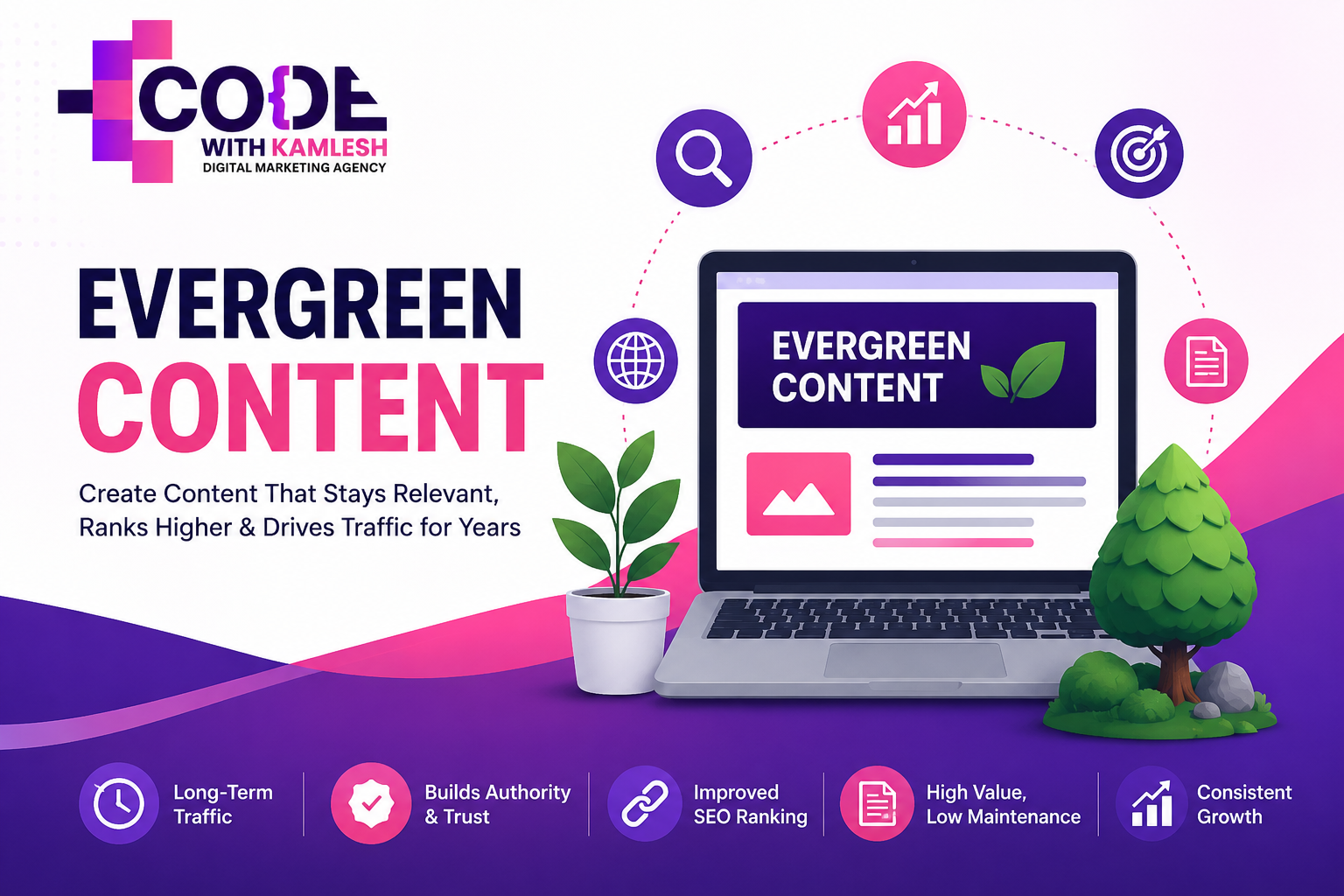
Evergreen content is one of the most powerful assets in digital marketing. It helps your website rank for long-term keywords, attract consistent organic traffic, build authority, educate your audience, and generate leads over time.
Unlike trending content, evergreen content does not lose value quickly. It continues to work because it answers questions people keep asking again and again. But creating evergreen content is not just about writing a long article. It requires smart topic selection, keyword research, search intent understanding, clear writing, strong SEO optimization, useful examples, internal linking, regular updates, and ongoing promotion.
The best evergreen content is simple, practical, complete, and genuinely helpful. It does not try to impress readers with complicated language. It solves their problem clearly.
If you want your content to rank for years, stop creating only short-term posts. Start building evergreen assets that support your brand, SEO, and business growth for the long run.
Evergreen content is not a quick trick. It is a long-term strategy. But when done properly, it becomes one of the most reliable ways to grow organic visibility and build trust online.
FAQs
1. What is evergreen content?
Evergreen content is content that stays useful and relevant for a long time. It answers common questions that people keep searching for again and again, such as guides, tutorials, checklists, tips, and explanations.
2. Why is evergreen content important for SEO?
Evergreen content helps your website get consistent organic traffic for months or years. Once it starts ranking on Google, it can keep bringing visitors, leads, and brand authority without depending on paid ads or trends.
3. What are some examples of evergreen content?
Some good examples are “How to Write SEO-Friendly Blog Posts,” “Complete Guide to Digital Marketing,” “Beginner’s Guide to Google Ads,” “Local SEO Checklist,” and “How to Improve Website Speed.”
4. How often should evergreen content be updated?
Evergreen content should be reviewed every 3 to 6 months. You should update old examples, outdated tools, screenshots, links, FAQs, statistics, and any information that may have changed.
5. Can evergreen content generate leads?
Yes, evergreen content can generate leads if you add the right CTA, contact form, service links, newsletter signup, downloadable checklist, or consultation button inside the blog. Since the content keeps getting traffic, it can also keep producing leads over time.
Copyright © 2026 CodeWithKamlesh
Kamlesh Singad
Founder, Code With Kamlesh. Helped 200+ businesses scale through SEO, Google Ads & Social Media. 8+ years of digital marketing experience.
Comments (0)
No comments yet. Be the first to comment!