How to Start Digital Marketing Career from Home in 2026
Learn how to start digital marketing career from home in 2026 with skills, tools, roadmap, portfolio tips, freelancing strategy, and job guidance
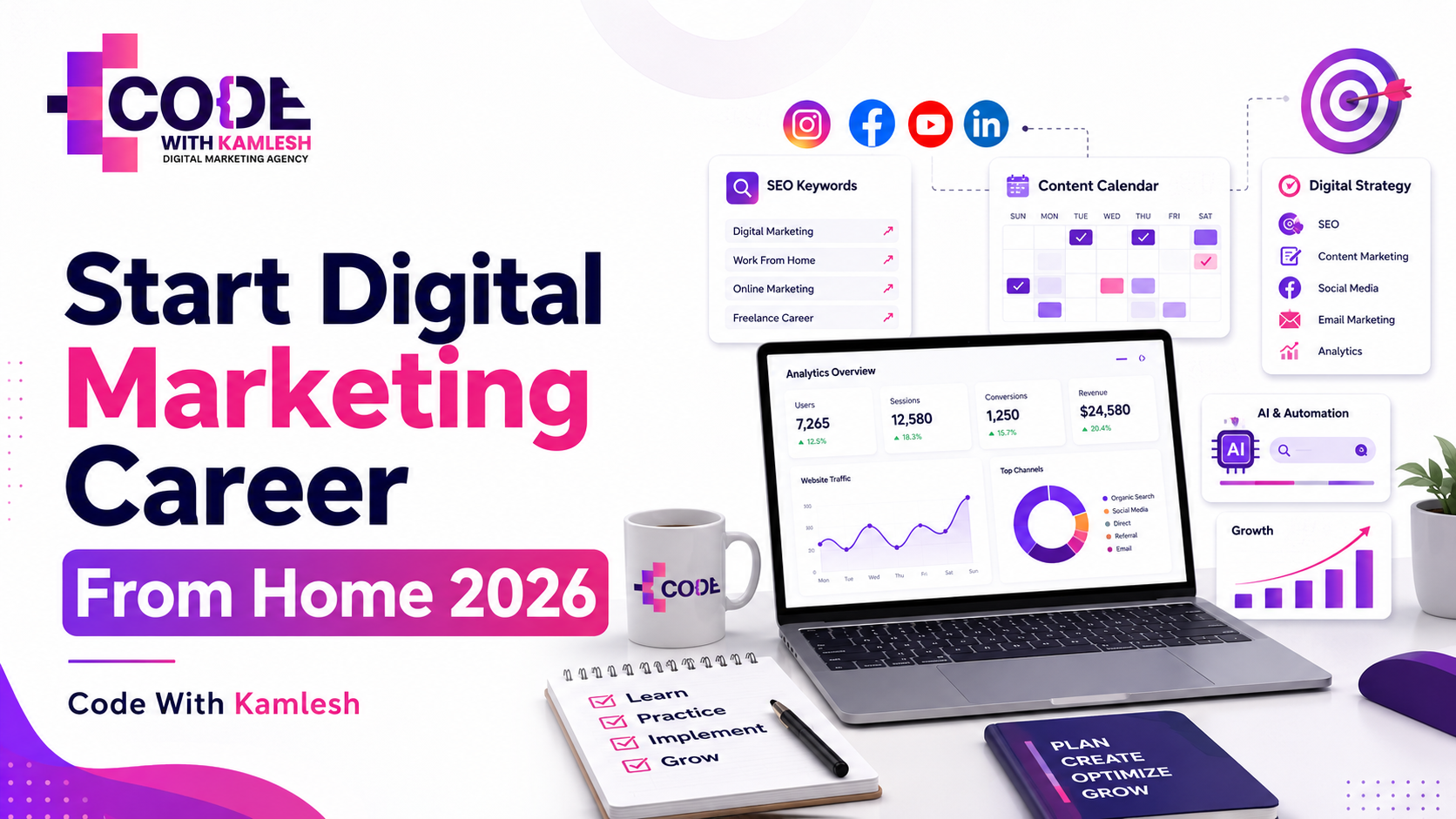
Starting a digital marketing career from home in 2026 is one of the most practical career decisions for students, freelancers, housewives, working professionals, small business owners, and anyone who wants to build an income using a laptop and internet connection.
The best part is that you do not need a big office, expensive degree, or huge investment to begin. You need the right skills, daily practice, real project experience, and the patience to learn how online marketing actually works.
Digital marketing is not just about posting on Instagram or running ads. It is the complete process of helping a business get visibility, traffic, leads, sales, and brand trust through online platforms like Google, YouTube, Instagram, Facebook, LinkedIn, websites, email, and paid ads.
In 2026, digital marketing has become even more powerful because businesses now depend heavily on online presence. Whether it is a coaching institute, doctor, interior designer, ecommerce brand, jewellery store, real estate company, restaurant, gym, salon, or B2B company, almost every business wants more leads from online channels.
At the same time, AI tools, short-form video, SEO, personal branding, automation, content marketing, and data tracking have changed the way marketing is done. Reports from marketing platforms show that AI is now becoming a regular part of content creation and marketing workflows, while Google still recommends strong website quality, useful content, and search-friendly structure for better visibility.
So if you are thinking, “Can I start digital marketing from home in 2026?” the answer is yes. But you need to start in a structured way.
What Is Digital Marketing?
Digital marketing means promoting a product, service, brand, or business through online channels. The goal can be different for every business. Some businesses want leads. Some want sales. Some want website traffic. Some want brand awareness. Some want followers. Some want app downloads. Some want walk-in customers.
A digital marketer understands the business goal and then uses different online platforms to achieve that goal.
For example, if a local coaching institute wants students, a digital marketer can help through Google Ads, SEO, Instagram Reels, YouTube videos, landing pages, and lead forms. If an ecommerce brand wants sales, digital marketing can include product SEO, Meta ads, Google Shopping ads, email marketing, influencer marketing, and retargeting.
This is why digital marketing is a skill-based career. The more you understand platforms, content, customer behavior, and data, the better results you can generate.
Why Digital Marketing Is a Good Career from Home in 2026
The biggest reason digital marketing is suitable for work from home is that most of the work happens online. You can research keywords, create content plans, run ads, design posts, analyze data, write blogs, manage social media, build landing pages, and communicate with clients from home.
Businesses do not always care where you are sitting. They care whether you can bring results.
Another reason is flexibility. You can start part-time. You can learn after college or office hours. You can work as a freelancer, join an agency remotely, become a specialist, start your own agency, or build your own brand.
In 2026, companies are also focusing more on platform-specific content, AI-supported marketing, short-form video, and authentic brand communication. Social media trend reports also show that video and AI-generated workflows are becoming more common in marketing.
But remember one thing clearly: AI can help you work faster, but it cannot replace your understanding of audience, offer, positioning, creativity, and strategy. A beginner who learns only tools will struggle. A beginner who learns thinking plus tools will grow faster.
Skills You Need to Start Digital Marketing from Home
You do not need to learn everything on day one. Digital marketing has many areas, and each area can become a full career. But as a beginner, you should first understand the basics of all major skills.
The first important skill is SEO. SEO means Search Engine Optimization. It helps websites rank on Google and get organic traffic. You should learn keyword research, on-page SEO, technical SEO basics, content optimization, internal linking, local SEO, and Google Business Profile optimization.
The second skill is content marketing. Content is the base of digital marketing. Blogs, reels, ads, captions, emails, landing pages, YouTube scripts, and website copy all come under content. If you can write clear, useful, and conversion-focused content, you will always have an advantage.
The third skill is social media marketing. This includes creating content calendars, post ideas, captions, reels strategy, engagement planning, competitor analysis, and platform-specific execution for Instagram, Facebook, LinkedIn, and YouTube.
The fourth skill is paid advertising. Paid ads include Google Ads, Meta Ads, YouTube Ads, LinkedIn Ads, and other platforms. As a beginner, start with Google Ads and Meta Ads basics. Learn campaign objectives, targeting, budget, creatives, landing pages, cost per lead, conversion tracking, and reporting.
The fifth skill is analytics. Many beginners ignore this, but data is what separates a serious marketer from a content poster. You should learn Google Analytics, Search Console, ad dashboards, UTM tracking, conversion rates, click-through rate, cost per lead, and return on ad spend.
The sixth skill is AI tool usage. In 2026, digital marketers should know how to use AI for content ideas, ad variations, keyword clustering, competitor research, email drafts, content repurposing, and reporting. But never depend blindly on AI output. Always edit it with human understanding.
The seventh skill is communication. If you want to work from home with clients, communication is very important. You must know how to explain work, share reports, ask for approvals, discuss strategy, and handle feedback professionally.
Best Digital Marketing Career Options in 2026
Digital marketing gives you many career options. You can choose based on your interest.
If you like writing and research, you can become an SEO content writer, blog writer, copywriter, or content strategist. If you like numbers and campaigns, performance marketing can be a good option. If you like creativity and trends, social media marketing or reel strategy can suit you. If you like technical work, SEO and analytics can be strong career paths.
Some popular roles are Digital Marketing Executive, SEO Executive, Social Media Manager, Google Ads Specialist, Meta Ads Specialist, Content Writer, Email Marketing Executive, YouTube SEO Specialist, Local SEO Specialist, Marketing Automation Executive, Performance Marketer, Digital Marketing Analyst, Freelance Digital Marketer, and Digital Marketing Consultant.
For work from home, the most beginner-friendly services are social media management, blog writing, SEO, local SEO, Google Business Profile management, YouTube SEO, basic website SEO audit, Meta ads support, and content calendar creation.
Step-by-Step Roadmap to Start Digital Marketing Career from Home
Now let’s come to the practical part. If you want to start from zero, follow this roadmap.
Step 1: Understand the Basics First
Do not directly jump into advanced courses, paid ads, or automation tools. First understand what digital marketing is and how different channels work together.
Learn how a customer journey happens online. A person may first see a reel, then visit a profile, then search the brand on Google, then read reviews, then visit the website, then submit an inquiry. Digital marketing is about managing this journey properly.
Spend your first few days learning the basics of SEO, social media, paid ads, content marketing, email marketing, and analytics. Watch beginner-friendly videos, read blogs, and observe how brands are marketing online.
Step 2: Choose One Main Skill
Many beginners make one mistake. They try to learn everything at the same time. Because of this, they become confused and do not become strong in any one area.
After understanding the basics, choose one main skill for your first 60 to 90 days. For example, you can choose SEO, social media marketing, content writing, or Meta ads.
If you are good at writing, start with SEO content writing. If you like Instagram and creative ideas, start with social media marketing. If you like business and numbers, start with paid ads. If you like websites and technical improvement, start with SEO.
Once you become confident in one skill, then add other skills slowly.
Step 3: Create a Learning Schedule at Home
Working from home sounds easy, but without discipline it becomes difficult. You need a daily schedule.
If you are a student or working professional, give at least 2 hours daily. If you are fully focused on career building, give 4 to 6 hours daily.
A simple daily schedule can be:
Morning or first session: Learn one topic.
Second session: Practice that topic.
Third session: Create one small output like a post, blog outline, keyword list, ad copy, or report.
Fourth session: Analyze a real brand or competitor.
Digital marketing cannot be learned only by watching videos. You have to practice daily.
Step 4: Learn SEO Properly
SEO is one of the best skills for long-term digital marketing growth. It helps businesses get traffic without paying for every click.
Start with keyword research. Learn how people search on Google. For example, someone may search “best digital marketing course in Indore,” “interior designer near me,” or “how to start digital marketing career from home in 2026.” These search terms are keywords.
Then learn on-page SEO. This includes title tags, meta descriptions, headings, URL structure, image alt text, internal links, and content optimization.
After that, learn technical SEO basics like website speed, mobile friendliness, indexing, sitemap, robots.txt, broken links, and structured data.
Also learn local SEO because many Indian businesses need local leads. Google Business Profile optimization, reviews, local keywords, service pages, and location-based content are very useful for local clients.
Step 5: Learn Social Media Marketing
Social media marketing is not just posting random creatives. It needs strategy.
You should learn how to create content pillars. For example, a digital marketing agency can post educational content, client results, behind-the-scenes content, service-based posts, testimonials, and offer posts.
Learn the difference between awareness content, engagement content, trust-building content, and conversion content.
Also understand that every platform has a different nature. Instagram is strong for reels, visual content, and community. LinkedIn is strong for professional branding and B2B. YouTube is strong for long-term content and search. Facebook is still useful for local communities, groups, and ads.
In 2026, short-form video is still very important, but brands also need authenticity. People do not want only polished posts. They want useful, real, and relatable content.
Step 6: Learn Paid Ads
Paid ads can bring fast results, but they can also waste money if you do not understand the basics.
Start with Meta Ads because many small businesses use Facebook and Instagram ads for leads. Learn campaign objectives, audience targeting, creative testing, lead forms, WhatsApp campaigns, landing page campaigns, and retargeting.
Then learn Google Ads. Google Ads is powerful because people are already searching with intent. If someone searches “best dentist near me” or “buy office wear earrings,” they may be closer to taking action.
Learn search ads first, then display ads, YouTube ads, and Performance Max basics.
Before running ads for a client, practice with demo campaigns or small budgets. Always learn tracking because without tracking, you cannot judge performance properly.
Step 7: Build Your Portfolio
A portfolio is more important than a certificate. Clients and companies want to see what you can actually do.
If you do not have clients, create sample projects. Pick a local business category like salon, gym, coaching institute, cafe, doctor, interior designer, or jewellery brand. Create a complete digital marketing plan for that business.
Your portfolio can include keyword research, content calendar, Instagram post ideas, sample captions, ad copy, landing page wireframe, SEO audit, Google Business Profile improvement suggestions, and competitor analysis.
You can also create your own Instagram page, blog, or website and use it as a live portfolio. This is the best way to prove your skill.
For example, if you want to become an SEO expert, start a simple blog and try to rank articles. If you want to become a social media manager, grow your own page. If you want to become a content writer, publish sample blogs.
Step 8: Learn Basic Tools
You do not need expensive tools in the beginning. Start with free or affordable tools.
Use Google Search Console for website performance. Use Google Analytics for traffic analysis. Use Google Keyword Planner for keyword ideas. Use Canva for basic design. Use Meta Business Suite for social media scheduling. Use Google Docs and Sheets for content planning and reporting. Use ChatGPT or other AI tools for ideation and drafting. Use Ubersuggest, Ahrefs free tools, Semrush free features, or similar tools for basic SEO research.
Do not become tool-dependent. Tools help, but your thinking matters more.
Step 9: Start with Small Projects
Once you have basic skills and portfolio samples, start taking small projects. Do not wait until you feel 100 percent ready. Nobody feels fully ready in the beginning.
Start with people around you. Talk to local businesses, friends, relatives, small shop owners, coaching centers, and service providers. Offer a small service like Google Business Profile optimization, 15 social media posts, basic SEO audit, 4 blog articles, or one-month social media management.
Keep your first few projects simple. Focus on learning client communication, delivery, revisions, and reporting.
Do not promise unrealistic results like “rank 1 in 7 days” or “100 leads guaranteed.” Instead, promise clear deliverables and honest work.
Step 10: Apply for Remote Jobs and Internships
If you want job experience, apply for internships and remote entry-level roles. Search on LinkedIn, Internshala, Indeed, Naukri, Wellfound, and company career pages.
Your resume should not only mention courses. It should mention projects. Add links to your portfolio, sample work, blog, social media page, or case study.
A beginner resume can include skills like SEO basics, keyword research, content writing, Canva, Meta Business Suite, Google Ads basics, Google Analytics basics, social media planning, and reporting.
When applying, write a short customized message. Do not send the same message to everyone. Mention how you can help their business.
90-Day Plan to Start Digital Marketing from Home
Here is a practical 90-day plan.
In the first 30 days, learn the basics of digital marketing. Understand SEO, social media, content, ads, analytics, and AI tools. Create your learning notes. Study competitors. Follow good marketers. Practice daily.
In the next 30 days, choose one skill and go deeper. If you choose SEO, learn keyword research, on-page SEO, blog optimization, and local SEO. If you choose social media, learn content calendars, reels strategy, captions, and analytics. Create at least 5 to 10 sample projects.
In the last 30 days, build your portfolio and start outreach. Create a simple website or PDF portfolio. Make your LinkedIn profile professional. Share your work online. Contact local businesses. Apply for internships. Offer small services. Try to get your first testimonial.
By the end of 90 days, you may not become an expert, but you will become employable if you work seriously.
How to Get Your First Digital Marketing Client from Home
Getting the first client is usually the hardest part. But it becomes easier when you stop selling “digital marketing” and start selling a clear solution.
Do not say, “I provide digital marketing services.” Say, “I can optimize your Google Business Profile so local customers can find you better.” Or “I can create a 30-day Instagram content plan for your coaching institute.” Or “I can write SEO blogs for your website.”
Start with one clear offer.
Make a list of 50 local businesses. Check their Instagram, website, Google Business Profile, reviews, and content quality. Find small mistakes. Then send a short message with a helpful suggestion.
For example:
“Hello Sir, I checked your Google Business Profile and noticed that your services section and latest posts are not updated. This can affect local visibility. I can help you optimize it with proper keywords, service details, images, and weekly posts.”
This type of message works better because it is specific.
You can also create short audit videos using screen recording. A 2-minute personalized audit can impress a business owner more than a long proposal.
How Much Can You Earn in Digital Marketing?
Income depends on skill level, experience, location, niche, and result quality.
As a beginner freelancer, you can start with small projects from 3,000 to 10,000 rupees depending on the work. Social media management for small businesses can start from 8,000 to 20,000 rupees per month. SEO retainers can start from 10,000 to 25,000 rupees per month for small businesses. Paid ads management can be charged as a fixed fee or percentage of ad spend.
In jobs, entry-level salaries may vary widely based on city and company. But with strong skills in SEO, paid ads, analytics, and content strategy, growth can be good.
Do not focus only on income in the first 3 months. Focus on skill, portfolio, communication, and results. Money follows proof.
Common Mistakes Beginners Should Avoid
The first mistake is learning without practice. Watching 100 videos will not make you a digital marketer. Running campaigns, writing content, analyzing data, and working on real projects will.
The second mistake is trying to become an expert in everything immediately. Start with one skill and build from there.
The third mistake is copying content blindly from AI tools. AI can support you, but human editing is necessary. Add examples, local context, brand tone, and practical insights.
The fourth mistake is ignoring analytics. If you cannot read results, you cannot improve campaigns.
The fifth mistake is undercharging too much. It is okay to start with affordable pricing, but do not work without boundaries. Define deliverables, timelines, and revision limits.
The sixth mistake is not building personal branding. If you are learning digital marketing, share your learning publicly. Post on LinkedIn, Instagram, or your blog. Your content can become your proof.
Best Niche for Beginners in Digital Marketing
Choosing a niche can help you grow faster. A niche means focusing on one industry or one service.
For beginners, good service niches are local SEO, social media management, SEO blog writing, YouTube SEO, Google Business Profile management, Meta ads for local businesses, and landing page copywriting.
Good industry niches are education, coaching institutes, doctors, real estate, interior designers, ecommerce, jewellery, gyms, salons, restaurants, and local service businesses.
When you focus on one niche, you understand customer behavior better. Your proposals become stronger. Your case studies become more relevant.
Is a Digital Marketing Course Necessary?
A course can help, but it is not compulsory. The real value comes from practice. If you join a course, choose one that gives practical assignments, live projects, campaign practice, SEO implementation, ad dashboard training, and portfolio building.
Do not choose a course only because it promises certificates. Certificates are useful, but they are not enough.
You can also learn from free resources, Google documentation, YouTube, blogs, and your own experiments. But if you need structure and mentorship, a good course can save time.
Future of Digital Marketing Career in 2026 and Beyond
The future of digital marketing is strong, but the role of a marketer is changing.
Earlier, marketers mostly executed tasks. Now businesses need marketers who can think strategically, use AI smartly, understand customer psychology, create useful content, analyze data, and connect marketing with revenue.
AI will handle repetitive work. But strategy, creativity, brand understanding, offer positioning, emotional connection, and business thinking will remain valuable. Even marketing leaders in 2026 are talking about the importance of creativity, authenticity, and consumer understanding in an AI-driven environment.
So the best digital marketer in 2026 is not someone who only knows tools. The best digital marketer is someone who understands people, platforms, and business goals.
Final Conclusion
If you want to start digital marketing career from home in 2026, start simple but start seriously. Learn the basics, choose one skill, practice daily, build a portfolio, use AI wisely, work on real projects, and improve through data.
You do not need to wait for the perfect time. You do not need a big setup. You need consistency.
Digital marketing is a career where your growth depends on your learning speed, execution quality, communication, and ability to deliver results. If you can help businesses get attention, trust, leads, and sales, you will always have opportunities.
Start with one skill. Create one sample project. Reach out to one business. Improve one step every day. That is how a home-based beginner slowly becomes a professional digital marketer.
FAQs
1. Can I start a digital marketing career from home in 2026?
Yes, you can start digital marketing from home in 2026 with a laptop, internet connection, and consistent practice. You can learn SEO, social media marketing, content writing, Google Ads, Meta Ads, and analytics from home and then start with internships, freelancing, or small client projects.
2. Which digital marketing skill should I learn first as a beginner?
As a beginner, you should first understand the basics of digital marketing, then choose one main skill. If you like writing, start with SEO content writing. If you like creativity, start with social media marketing. If you like data and campaigns, start with paid ads.
3. How long does it take to learn digital marketing from home?
If you study and practice daily, you can learn the basics in 2 to 3 months. But to become confident and earn from digital marketing, you need real project practice, portfolio building, and continuous learning for at least 3 to 6 months.
4. Do I need a degree to start a digital marketing career?
No, a degree is not compulsory to start a digital marketing career. Skills, practical knowledge, portfolio, communication, and results matter more. However, certificates and courses can help you learn in a structured way.
5. How can I get my first digital marketing client from home?
Start by creating sample work and a small portfolio. Then contact local businesses, check their website or social media, and share useful suggestions. Offer simple services like Google Business Profile optimization, social media content planning, SEO audit, or blog writing to get your first client.
© 2026 Code With Kamlesh. All Rights Reserved.
Kamlesh Singad
Founder, Code With Kamlesh. Helped 200+ businesses scale through SEO, Google Ads & Social Media. 8+ years of digital marketing experience.
Comments (0)
No comments yet. Be the first to comment!