Meta Description SEO Best Practices:
Practical SEO marketing tips, coding tutorials, and digital growth strategies to boost search visibility and organic traffic.
When a searcher scans a search results page, they make a split-second decision before tapping or clicking a single link. They glance at the title, run their eyes over the short block of text right below it, and decide whether that page actually has what they need. That short block of text is the meta description. If the text feels vague, robotic, or disconnected from the question in their head, they scroll right past it to a competitor who gave them a clearer answer.
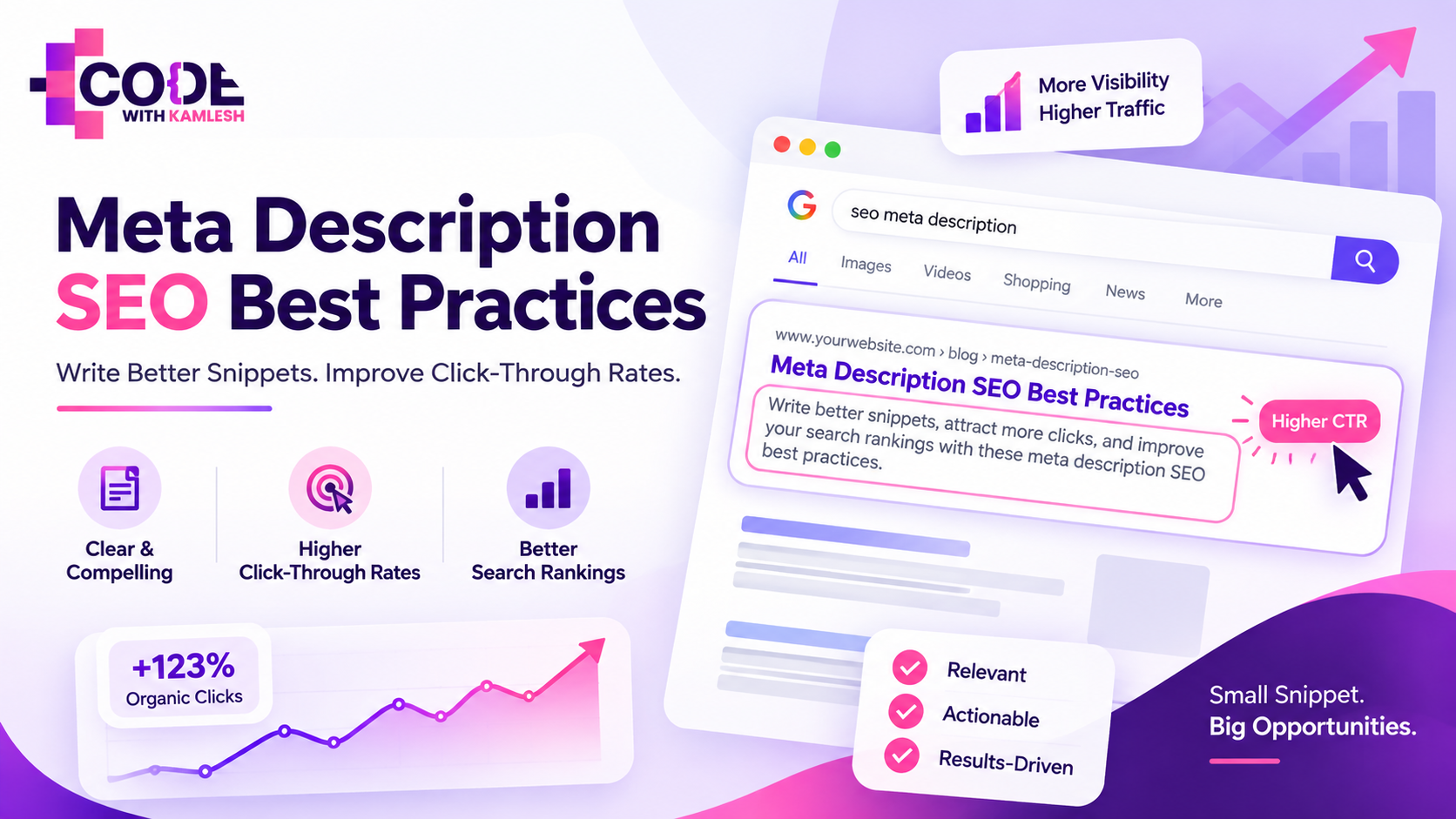
What Is a Meta Description?
A meta description is an HTML attribute that provides an accurate, brief summary of a specific webpage. It lives inside the <head> section of an HTML document rather than within the visible body text of the page. Visitors browsing your site will not see it anywhere on the screen unless they view the underlying page source code.
In plain HTML code, a standard meta description tag looks like this:
HTML
<meta name="description" content="Discover actionable meta description SEO best practices to improve click-through rates, match search intent, and optimize your organic search snippets.">
Search engines read this tag when crawling your page. If Google determines that your written description provides a helpful, accurate summary that matches what the user typed into the search box, it displays your text as the snippet directly below the clickable SEO title.
The visible page content—such as your H1 headings, introductory paragraphs, images, and body copy—serves the user once they arrive on the site. In contrast, the meta description acts as your digital storefront display. It exists primarily to help search engine algorithms understand your summary and to convince real human searchers that your page delivers the exact answer, product, or solution they are actively looking for.
Are Meta Descriptions a Google Ranking Factor?
Google confirmed long ago that meta descriptions are not a direct organic ranking signal. Having a perfectly optimized snippet will not mathematically lift your URL from position eight to position one. Google's core ranking systems do not calculate your page's topical authority or ranking position based on the keywords packed inside the description tag.
However, treating meta descriptions as unimportant because they are not a direct ranking factor is a fundamental SEO mistake. Their primary value lies in their indirect impact on search performance. A well-crafted description directly influences user behaviour on search engine results pages (SERPs). When your snippet communicates relevance and value faster than the results surrounding it, searchers naturally choose your link.
Misleading descriptions create immediate friction. If your meta description makes wild promises that your landing page fails to back up, visitors will click the back button within seconds. While boosting your click-through rate does not automatically guarantee higher rankings on its own, attracting visitors who actually find what they need on your page reinforces your overall topical authority and user engagement signals. Optimization is about setting clear, accurate expectations before the user ever loads your page.
Why Meta Descriptions Still Matter for SEO
Securing a ranking on page one represents only half the battle in modern search marketing. In competitive niches, your page sits alongside nine other organic listings, multiple sponsored ads, video blocks, and rich answer boxes. The meta description is your primary sales pitch in that crowded environment.
+-------------------------------------------------------------------+
|  Example SERP Listing Presentation                                |
+-------------------------------------------------------------------+
|  Title: Learn On-Page SEO Techniques | Code with Kamlesh          |
|  URL:   https://codewithkamlesh.in/on-page-seo-guide               |
|                                                                   |
|  Snippet: Master core on-page SEO techniques to improve organic   |
|  rankings. Learn practical keyword placement, content structure,  |
|  and internal linking strategies that drive measurable traffic.   |
+-------------------------------------------------------------------+
When searchers enter a query, Google often bolds the exact words or close variants of those words within the snippet text. This bolding catches the eye instantly, signaling to the searcher that the content directly answers their query. If your snippet speaks directly to their immediate intent, they feel confident that clicking your link will not waste their time.
Furthermore, a polished snippet builds your brand's authority. Typos, incomplete thoughts, truncated sentences, or generic boilerplate text make a company look careless. Conversely, crisp, professional copy establishes trust before the visitor even lands on your website. When your snippet matches the landing page content seamlessly, you lower bounce rates and encourage visitors to explore your site further.
Recommended Meta Description Length
Search engines do not enforce a rigid character limit on meta descriptions. Instead, Google measures snippets using a pixel width limit. On desktop screens, Google generally truncates snippets that exceed roughly 960 to 990 pixels. On mobile devices, the visual cutoff typically sits around 680 to 750 pixels, depending on screen resolutions and device rendering engines.
Because character widths vary—a capital "W" occupies considerably more horizontal pixels than a lowercase "i"—translating pixel boundaries into an absolute character count is impossible. However, aim to keep your core message within 150 to 160 characters. This range gives you sufficient space to convey real value while minimizing the likelihood of awkward truncation across the vast majority of mobile and desktop browsers.
Writing an excessively long description means Google will slice off the end of your sentence with an ellipsis. If your key differentiator or primary offer gets pushed past the 160-character mark, searchers will never see it. On the other hand, writing a snippet that is only 40 or 50 characters long wastes valuable space. Short descriptions often fail to provide enough context to convince a cautious searcher to click.
Meta Description Type
Suggested Approach
Potential Issue
Very Short (<80 characters)
Add useful context, secondary benefits, or a natural call to action.
May not communicate enough value to win the click against thorough competitors.
Well Optimized (140–160 characters)
Keep it concise, place crucial information early, and address user intent.
Usually displays cleanly across mobile and desktop devices without awkward cutoffs.
Very Long (>170 characters)
Front-load critical points and edit out passive phrases or filler words.
Search engines will truncate the snippet, cutting off sentences mid-thought.
Clarity always takes precedence over reaching a specific mathematical number. If you can summarize a focused topic brilliantly in 135 characters, do not add fluff just to hit 155. If a complex technical topic requires 158 characters to explain its scope accurately, use that space wisely.
12 Meta Description SEO Best Practices
Writing snippets that generate clicks requires a balance between search psychology and technical precision. Applying practical Meta Description SEO Best Practices ensures that every page on your site presents a compelling face to search engines.
1. Match the Search Intent
Every query entered into a search engine carries an underlying goal. Search intent generally falls into four distinct categories: informational, commercial investigation, transactional, or navigational. Your meta description must mirror the exact mindset of the person typing that query.
For an informational query like "how to fix crawl errors," the user wants a direct solution. Your snippet should promise practical steps or troubleshooting advice. For a transactional query like "buy mechanical keyboard switches," the searcher wants products, pricing, and availability. A snippet focusing on the history of typing mechanisms completely misses the point. Always ask yourself what the user hopes to achieve at the exact moment they run the search.
2. Include the Primary Keyword Naturally
Search engines match user queries to relevant text across your webpage, including your snippet tags. When a user sees their search term reflected in your description, it confirms that your page addresses their specific problem. Google also highlights matching search terms in bold, which naturally draws visual attention down the page.
Weave your primary keyword into the sentence organically. Avoid forcing keywords into places where they disrupt the natural cadence of speech. If a sentence sounds awkward when read aloud, rewrite it.
3. Communicate a Clear Benefit
Searchers click on links because they expect a specific payoff. Your description should state clearly what the reader will gain by visiting your page. Will they learn how to fix a technical bug, save money on software, download a free template, or understand a complex concept faster?
Instead of simply describing what the page is, explain what the page does for the reader. Compare "This article talks about website speed optimization" with "Learn practical caching and image compression techniques to make your site load under two seconds." The second version presents a tangible outcome that motivates action.
4. Make Every Important Meta Description Unique
Duplicate meta descriptions create confusion for both search engines and users. When dozens of pages share the exact same snippet, search engines struggle to differentiate the value of one page from another on the SERP. Users face a wall of repetitive snippets that offer no indication of which specific link holds the answer they need.
If you cannot write a unique, tailored description for every single page on a massive site, prioritize your highest-value URLs. Focus your manual writing efforts on your homepage, core service offerings, main category pages, and top-performing blog posts. For secondary or programmatic pages, use intelligent dynamic patterns rather than copying and pasting identical blocks of text.
5. Keep the Most Important Information Near the Beginning
Because search engines truncate snippets based on device viewport widths, front-load your most important context. Place your core topic, primary keyword, and primary value proposition within the first 100 to 120 characters whenever possible.
Front-loading protects your core message against unexpected cutoffs. Even if Google trims the tail end of your description on a smaller smartphone screen, the user still sees the critical context needed to make an informed click. Front-loaded snippets get straight to the point without forcing the searcher to decipher your meaning.
6. Use Natural, Persuasive Language
An organic search snippet should read like helpful guidance, not an aggressive late-night television infomercial. Users develop banner blindness toward exaggerated marketing claims, excessive exclamation points, and pushy sales jargon.
Write in an active voice using clear, persuasive verbs. Words like discover, learn, explore, compare, and build prompt action without feeling manipulative. Keep the tone grounded, authoritative, and helpful. Respect the searcher's intelligence by offering clear facts rather than empty hype.
7. Add a Relevant Call to Action When Appropriate
A subtle call to action guides the user toward the logical next step. While not every informational post requires an aggressive prompt, ending your description with a clear direction often nudges an undecided searcher to click.
Tailor the call to action to the page's intent:
- For informational articles: Read the full guide, Learn how it works, or Explore the steps.
- For commercial comparisons: Compare pricing and features or Find the right fit.
- For transactional pages: Browse the collection, Request a quote, or Get started today.
Ensure the prompt feels like an organic conclusion to the sentence rather than a tacked-on command.
8. Accurately Describe the Page
Never use your meta description to make promises your page cannot keep. Clickbait tactics might earn an occasional initial visit, but they destroy user trust and inflate bounce rates. If your snippet promises a free downloadable checklist, that checklist must be immediately accessible on the page without hidden paywalls.
Aligning expectations with reality protects your brand's reputation. When searchers click through and find exactly what the snippet described, they remain on your site longer, interact with your content, and are far more likely to convert or return in the future.
9. Avoid Keyword Stuffing
Shoving multiple variations of a keyword into a 155-character space produces unreadable spam. Modern search engines rely on sophisticated natural language processing models that understand context, synonyms, and related entities. Repeating the same keyword three times adds zero algorithmic value and actively discourages humans from clicking.
A bad, stuffed example looks like this:
- "Looking for cheap SEO services? Our cheap SEO agency offers cheap SEO packages for small business SEO success. Contact our SEO company today."
An improved, natural version reads:
- "Affordable search engine optimization services tailored for growing businesses. Explore customized packages designed to increase organic visibility and sales."
The improved version shares the core service clearly, sounds professional, and appeals directly to a business owner.
10. Optimize for Humans Before Search Engines
Always remember that algorithms rank pages, but human beings click links and buy products. When you focus solely on satisfying search engine formulas, your writing becomes stiff, repetitive, and uninspiring.
Read your draft aloud before adding it to your content management system. Does it flow naturally? Does it sound like something an experienced professional would say to a client? If it feels mechanical, strip away the jargon and speak directly to the person behind the screen.
11. Review Meta Descriptions When Search Intent Changes
Search intent is not static. A query that once demanded high-level conceptual overviews might evolve over time to require actionable, step-by-step tutorials or interactive tools. When major shifts occur in how Google structures results for your target queries, review your existing descriptions.
Regularly auditing your core pages allows you to refine your messaging. If competitors begin addressing fresh subtopics or modern industry challenges within their snippets, update your descriptions to reflect your page's updated, comprehensive value. Treating meta descriptions as living assets keeps your listings competitive year after year.
12. Test and Improve Important Pages
Meta description optimization should be an iterative process. By monitoring your performance data over time, you can identify pages that earn strong search impressions but lag in their organic click-through rates. These underperforming pages represent prime opportunities for testing new snippet copy.
Experiment with different angles. On one page, testing a direct question might resonate with searchers; on another, leading with a concrete metric or feature might drive better engagement. Update the snippet, allow it to collect data for several weeks, and examine whether the change produces a positive shift in your organic traffic patterns.
Good Meta Description Examples Across Different Page Types
Examining realistic before-and-after scenarios illustrates how subtle adjustments transform weak snippets into compelling search assets.
Blog Post
- Weak Version:
This post is about how to do keyword research for your website. We talk about tools, search volume, and finding keywords for your blog.
- The Problem: It uses passive phrasing ("This post is about") and reads like a generic table of contents rather than explaining the practical value to the reader.
- Improved Version:
Learn how to find low-competition keywords that drive targeted organic traffic. Step-by-step keyword research strategies using free and paid SEO tools.
- Why It Works: It leads with an active verb, focuses on the direct benefit (finding low-competition keywords to drive traffic), and outlines what the reader will learn.
Local Business
- Weak Version:
We are the best plumbing service in Austin. Call us for plumbing, pipes, drain cleaning, water heaters, and emergency repairs in Austin Texas.
- The Problem: It relies on self-serving claims ("the best") and lists services as an uninspired, repetitive string of keywords.
- Improved Version:
Fast, licensed plumbing services across Austin. From emergency leak repairs to water heater installations, our team is available 24/7. Call for a quote.
- Why It Works: It highlights critical local decision factors: licensing, rapid response, specific service capabilities, 24/7 availability, and a clear next step.
SEO Service Page
- Weak Version:
Check out our SEO services. We offer technical SEO, link building, and content strategy to help your website get more traffic from Google searches.
- The Problem: It sounds like every other generic agency snippet on the web, offering no unique selling proposition or measurable outcome.
- Improved Version:
Data-driven SEO services designed to scale qualified organic leads. Discover how our technical audits and content strategies drive sustainable growth.
- Why It Works: It targets business outcomes ("qualified organic leads" and "sustainable growth") rather than merely listing generic tasks.
To learn more about structuring websites for long-term organic growth, explore our comprehensive breakdown of essential on-page SEO strategies to align your titles, headings, and technical elements.
E-Commerce Product Page
- Weak Version:
Buy the Ergonomic Office Chair Pro today. This chair is comfortable, black, has wheels, an adjustable back, and is available in our store right now.
- The Problem: It lists mundane physical traits without addressing the real pain points of the buyer, such as posture support and daily comfort.
- Improved Version:
Work comfortably all day with the Ergonomic Office Chair Pro. Features breathable mesh, adjustable lumbar support, and smooth-glide casters. Free shipping.
- Why It Works: It addresses comfort immediately, highlights specific premium features, and mentions a powerful conversion incentive: free shipping.
Category Page
- Weak Version:
Running shoes category. Look at our collection of men's running shoes and women's running shoes from different brands on sale now.
- The Problem: It wastes valuable characters naming the page category and offers no guidance on product variety or selection criteria.
- Improved Version:
Explore high-performance road and trail running shoes from top athletic brands. Find lightweight cushioning and durable trail grips for every stride.
- Why It Works: It highlights product variety (road and trail), speaks to performance features (cushioning and grip), and appeals directly to dedicated runners.
SaaS Product Page
- Weak Version:
Our project management software helps teams work better. Sign up for the cloud tool that lets you manage projects, tasks, and team communications.
- The Problem: It uses vague platitudes ("work better") that fail to explain what makes the software unique or efficient.
- Improved Version:
Streamline team sprints and eliminate project bottlenecks. Automate routine workflows, track milestones in real time, and collaborate seamlessly. Start free.
- Why It Works: It addresses core productivity bottlenecks, explains specific automation capabilities, and lowers friction with a risk-free "Start free" prompt.
Educational Website
- Weak Version:
Python tutorial for beginners. Learn Python coding on our website with lessons, exercises, and examples about programming fundamentals.
- The Problem: It reads like an automated syllabus outline rather than an engaging educational resource.
- Improved Version:
Master Python programming fundamentals with interactive, hands-on coding exercises. Build real-world projects and write clean code in minutes a day.
- Why It Works: It emphasizes interactive learning, practical application through real projects, and a manageable time commitment.
Bad Meta Description Examples and How to Fix Them
Understanding common writing pitfalls makes it easier to catch flaws before publishing your pages.
Common Anti-Patterns to Avoid:
1. The Keyword Dump  --> "Plumber, plumbing, leaks, Austin plumbing..."
2. The Vague Placeholder --> "Welcome to our page. Click here to learn more."
3. The Caps Lock Yell --> "BUY NOW! BEST DISCOUNTS EVER! CHEAPEST PRICES!"
4. The Run-On Essay   --> 240+ characters chopped off mid-sentence by Google...
1. The Keyword Dump
- Bad: "SEO tools, best SEO software, rank tracker, backlink checker, keyword tool."
- The Fix: "Track keyword rankings, monitor backlinks, and audit site health with an all-in-one SEO toolkit. Start your 14-day free trial today."
- Why: The fixed version translates a disjointed list of software features into an integrated value proposition for a marketing team.
2. The Extremely Vague Placeholder
- Bad: "Welcome to our website. Read our latest blog post to find out more about what we do and how we can help you succeed."
- The Fix: "Discover actionable personal finance strategies to pay off debt, build an emergency fund, and invest intelligently for long-term wealth."
- Why: Vague text forces the searcher to guess what the page contains. The improved version establishes the exact topics covered.
3. Aggressive Clickbait
- Bad: "You will NEVER believe what this secret marketing trick does! The results will blow your mind—click now before it gets banned!"
- The Fix: "Learn how optimizing internal link architecture increased organic traffic by 42% across three niche affiliate websites."
- Why: Hyperbolic clickbait destroys credibility. Specific case study data attracts qualified readers who are genuinely interested in the topic.
4. Excessive Capitalization and Punctuation
- Bad: "HUGE SALE ON SNEAKERS!!! BUY NOW AND SAVE BIG MONEY TODAY ONLY!!!"
- The Fix: "Save up to 40% on select running and training sneakers. Limited-time seasonal pricing with fast delivery and hassle-free returns."
- Why: All-caps text looks untrustworthy and spammy on the SERP. Clean sentence case conveys professionalism.
Should Every Page Have a Custom Meta Description?
On a website with fifty pages, writing a tailored meta description for every single URL is straightforward. On an enterprise e-commerce platform or a real estate portal with half a million URLs, handcrafting individual snippets for every page becomes impractical.
Prioritize your optimization resources based on business value:
+-------------------------------------------------------------+
|               Snippet Optimization Priority                 |
+-------------------------------------------------------------+
| [HIGH PRIORITY]  Manual, Handcrafted Snippets               |
|                  * Homepage, Core Services, Top Category    |
|                  * High-Traffic Blog Articles               |
+-------------------------------------------------------------+
| [MEDIUM PRIORITY] Scalable Dynamic Rules & Templates        |
|                  * Product Detail Pages, Tag Archives       |
|                  * Standard Directory Listings              |
+-------------------------------------------------------------+
| [LOW PRIORITY]   Let Search Engines Generate Snippets       |
|                  * Deep Pagination, Thin Internal Tags      |
|                  * Long-Tail Database Queries               |
+-------------------------------------------------------------+
When managing thousands of programmatic pages, build intelligent dynamic templates. For an e-commerce catalog, a template might follow this structure:
"Buy the [Product Name] in [Color/Style] online at [Brand Name]. Enjoy [Feature 1], [Feature 2], and fast delivery. Order yours today."
For low-value taxonomy archives or deep internal search pages, it is often better to leave the meta description tag completely blank. When no description exists, Google scans the page and extracts a relevant sentence that matches the searcher's query.
Why Google Sometimes Rewrites Meta Descriptions
Even when you follow every guideline and craft a clean meta description, Google may choose not to display it. Research indicates that Google replaces submitted meta descriptions across a significant portion of search queries.
This happens for specific functional reasons:
- Query Relevance: A comprehensive article often ranks for hundreds of secondary, long-tail search queries. If a user enters a specific secondary query that your meta description does not mention, Google will extract a sentence directly from your body text where that exact query appears.
- Poor Description Quality: If a submitted snippet simply lists keywords, repeats boilerplate text, or fails to summarize the page, Google's algorithms will generate an automated snippet based on on-page content.
- Intent Alignment: Google constantly adjusts snippets to match user intent dynamically. For technical context on how Google parses, extracts, and presents web snippets, consult the official Google Search Central documentation on search snippets.
You cannot force Google to display your written description 100% of the time. Your objective is to write snippets so accurate, relevant, and compelling that Google's systems treat them as the best possible summary for primary target queries.
Meta Descriptions for Local SEO
Local search queries carry immediate geographic intent. Users searching for local services want to know three things immediately: who you are, what service you provide, and whether you operate in their specific town or neighborhood.
When optimizing local landing pages, weave your primary service and city name together naturally. Avoid robotic phrasing such as "Dentist Chicago, Chicago Dentist Office, Best Dentist in Chicago."
Consider an agency landing page targeting digital marketing clients in Indore:
- Natural Local Description:
Results-focused digital marketing services in Indore. We help local businesses and growing brands scale with local SEO, PPC campaigns, and web development. Contact us.
This snippet accomplishes multiple goals:
- It states the core service clearly (digital marketing services).
- It includes the exact geographic location naturally (in Indore).
- It outlines specific sub-services (local SEO, PPC campaigns, web development).
- It establishes the target audience (local businesses and growing brands).
Meta Descriptions for E-Commerce SEO
E-commerce websites face unique snippet optimization challenges. A typical store contains thousands of product detail pages and dozens of broad category archives, making manual optimization difficult.
For category pages, emphasize broad selection, brand authority, and buyer incentives:
"Browse our curated selection of leather travel bags and weekend duffels. Handcrafted durability, water-resistant linings, and complimentary nationwide delivery."
For individual product pages, answer immediate buyer questions regarding specifications, compatibility, and availability:
"Shop the Men's Trail Runner 4 in Slate Gray. Features lightweight mesh, reinforced toe caps, and all-weather traction outsoles. In stock now."
Avoid listing dynamic prices in meta descriptions unless your catalog maintains static pricing over long periods. If your snippet promises a product for $49 and the price updates to $65 on the page, returning searchers will feel misled.
Meta Descriptions for Blog Posts
Informational blog posts require snippets that spark curiosity, promise clear utility, and establish immediate credibility. Searchers browsing informational queries want clear answers without unnecessary fluff.
Here are three distinct blog post snippet examples:
- How-To Guide:
"Learn how to conduct a comprehensive technical SEO audit step by step. Identify crawl errors, optimize site architecture, and fix broken redirect chains."
- Opinion / Deep-Dive Analysis:
"Why programmatic SEO fails without editorial oversight. An in-depth breakdown of indexation pitfalls, thin content penalties, and quality recovery steps."
- Curated Resource List:
"Compare the top 10 website monitoring tools for 2026. Explore key features, server response benchmarks, alert integrations, and pricing tiers."
Notice that none of these examples resort to sensationalist clickbait. Each one sets an expectation of what the reader will learn upon clicking through.
If you are expanding your overall digital marketing knowledge, read our practical overview of how digital marketing channels work together to drive brand discovery and organic customer acquisition.
How to Write a Meta Description Step by Step
Follow this structured workflow whenever you create snippet text for a new or updated page:
+------------------------------------------------------------------------+
|                      Step-by-Step Writing Flow                         |
+------------------------------------------------------------------------+
|  [Step 1] Determine Search Intent (Informational vs Commercial)       |
|                                |                                       |
|  [Step 2] Identify Page Topic & Primary Keyword                       |
|                                |                                       |
|  [Step 3] Pinpoint the Core Benefit or Solution                       |
|                                |                                       |
|  [Step 4] Draft a 150-Character Summary (Front-Load Key Terms)        |
|                                |                                       |
|  [Step 5] Review SERP Landscape (Compare Against Ranking Competitors) |
|                                |                                       |
|  [Step 6] Publish, Test, and Monitor in Search Console                |
+------------------------------------------------------------------------+
- Identify the Core Search Intent: Determine whether the searcher wants to learn a skill, purchase an item, compare options, or navigate to a portal.
- Select the Primary Keyword: Pick the primary search phrase targeted by the page so you can position it naturally within the copy.
- Pinpoint the Main Value Proposition: Identify the single strongest takeaway, offer, or solution that sets your page apart from other resources.
- Draft an Unrestricted Sentence: Write a complete sentence that communicates that core benefit clearly without worrying about character counts initially.
- Trim and Refine: Edit out weak words, passive phrasing, and unnecessary filler. Adjust the copy until it sits comfortably between 140 and 160 characters.
- Front-Load Important Context: Ensure your primary topic and primary value proposition sit within the first 100 characters so they stay visible on mobile screens.
- Verify Page Accuracy: Compare the draft against the live content. Ensure the landing page delivers on every detail mentioned in the snippet.
- Check the SERP Context: Search for your target keyword on Google. Look at the snippets used by top-ranking competitors to ensure your text offers a clear, differentiated alternative.
- Publish and Monitor: Add the tag to your page and track its performance in search performance dashboards over the following months.
Meta Description Template Examples
When working across large websites, standardizing your copywriting structure using modular templates saves time while maintaining high editorial standards.
Blog Meta Description Template
Learn [Actionable Skill] with our step-by-step guide. Discover how to [Solve Common Problem], explore [Key Feature or Tip], and download our free [Resource/Checklist].
Service Page Template
Professional [Service Name] designed for [Target Audience]. From [Core Capability A] to [Core Capability B], our team helps you [Achieve Primary Goal]. Get a free consultation.
Local SEO Template
Trusted [Trade/Service] in [City, State]. Providing [Specialty 1], [Specialty 2], and rapid emergency support across [Neighborhood/Area]. Call [Phone/Contact] today.
E-Commerce Product Template
Shop the [Product Name]. Built with [Premium Material/Feature] for [Primary Use Case]. Enjoy [Secondary Benefit], [Warranty/Guarantee], and fast shipping.
Category Page Template
Explore our curated collection of [Category Name]. Compare top designs from [Brand A], [Brand B], and more. Find the perfect fit for [Target Purpose] with free returns.
Homepage Template
[Company Name] helps [Target Audience] [Solve Core Problem] through [Primary Service Offering]. Explore our solutions and discover why [X] clients trust our expertise.
Meta Description SEO Checklist
Before deploying meta tags to production, evaluate your drafts against this quality checklist:
- Does the description match the specific search intent of the page?
- Is the primary keyword included naturally without forced phrasing?
- Is the snippet unique across your entire website?
- Does the copy communicate a tangible user benefit or outcome?
- Is the text written in an active voice using professional, natural language?
- Is the snippet free from keyword stuffing and redundant synonyms?
- Does the content of the landing page deliver on the snippet's promises?
- Is the core topic front-loaded within the first 100 characters?
- Does the total length fall safely within the 140–160 character boundary?
- Is an organic call to action included where appropriate?
Meta Description vs. SEO Title
The SEO title and meta description serve complementary roles on the search engine results page. Writing them together ensures that your search snippet functions as a cohesive, compelling unit.
Element
SEO Title (<title>)
Meta Description (<meta name="description">)
Main Purpose
Defines the primary topic of the page concisely.
Provides an expanded summary of the page's value.
Ranking Importance
Direct, high-weight organic ranking factor.
Indirect factor; influences click behavior and engagement.
Typical SERP Display
Large, blue clickable headline text.
Two lines of regular body text below the URL.
Keyword Usage
Must contain the primary keyword near the front.
Includes keywords naturally to match intent and trigger bolding.
Click Influence
Grabs attention instantly and establishes topical relevance.
Convinces searchers to choose your link over competing titles.
Recommended Approach
50–60 characters; highly focused and brand-tagged.
140–160 characters; descriptive, persuasive, and user-centric.
Treat your title tag as the headline and your meta description as the introductory subhead. When both work in tandem, your organic search listings stand out cleanly in crowded search landscapes.
Common Meta Description SEO Mistakes
Avoiding common optimization mistakes helps protect your organic listings from looking unprofessional or spammy.
1. Writing Exclusively for Search Engine Robots
Targeting algorithms instead of human searchers results in rigid, lifeless sentences. Remember that algorithms evaluate ranking criteria, but individual people decide whether to click. Prioritize natural readability and helpful context above all else.
2. Copying Boilerplate Snippets Across Hundreds of Pages
Using identical snippet copy across product categories or blog archives strips individual listings of their unique value. If two pages share identical descriptions, searchers cannot determine which one holds the specific information they need.
3. Making Exaggerated or Unsubstantiated Claims
Promising "the cheapest software on earth" or "the ultimate guide" when your landing page contains a 200-word promotional overview alienates searchers. Misleading snippets drive high bounce rates, which harm user retention.
4. Ignoring Mobile SERP Truncation
Writing descriptions that place all essential context at the very end leaves mobile searchers stranded. Because mobile viewports truncate snippets sooner than desktop monitors, keep your core message within the first 100 to 120 characters.
5. Leaving Meta Descriptions Static Indefinitely
Publishing a snippet and never revisiting it causes your content to slip behind evolving SERP trends. When page content changes, pricing updates, or user intent shifts, update your descriptions to maintain search relevance.
How to Measure Meta Description Performance
Measuring the practical impact of your meta descriptions requires analyzing user behavior through Google Search Console. While you cannot isolate snippet changes with laboratory precision, evaluating specific search performance metrics provides actionable visibility.
To review your performance metrics:
- Open your Search Console property and navigate to the Performance report.
- Select Search Results to view your organic query and page data.
- Review the relationship between Impressions, Clicks, and Average CTR (Click-Through Rate).
+--------------------------------------------------------------------------+
|  Diagnosing Snippet Opportunities in Google Search Console               |
+--------------------------------------------------------------------------+
|  High Impressions + Low CTR + Position 1-4                               |
|  --> Potential snippet problem. Title or description is not compelling.   |
|                                                                          |
|  Low Impressions + High CTR                                              |
|  --> Content ranks for niche/long-tail terms. Optimization is working     |
|      for intent, but broader keyword reach is limited.                   |
|                                                                          |
|  High Impressions + Low CTR + Position 8-15                              |
|  --> Normal pattern. Lower ranking positions naturally capture fewer      |
|      clicks regardless of snippet quality. Focus on ranking factors.     |
+--------------------------------------------------------------------------+
When evaluating CTR figures, interpret the data carefully. An average CTR of 3% might represent poor performance for a page ranking in position two, but that same 3% could indicate exceptional performance for a page ranking in position nine. External factors—such as Google Ads blocks, Featured Snippets, local map packs, and brand recognition—all influence click behavior. For detailed instructions on analyzing search performance data, refer to the Google Search Console Performance Report Guide.
When Should You Update a Meta Description?
You do not need to rewrite your snippets every month, but specific events call for a targeted update:
- Page Content Has Undergone Major Updates: If you expand an old blog post with new sections, tools, or research, update the snippet to highlight those fresh assets.
- Click-Through Rates Fall Below Expectations: If a page maintains a top-three ranking but its CTR trails industry averages, test new copy to improve click appeal.
- Business Offerings or Pricing Change: If your service structure, shipping policies, or trial models change, update your descriptions to maintain accurate messaging.
- Competitors Upgrade Their Search Presentation: If competitors begin highlighting unique certifications, guarantees, or updated methodologies, refine your snippets to keep your value proposition competitive.
- Search Intent Shifts: If Google begins prioritizing practical step-by-step solutions over high-level conceptual definitions for your target queries, adapt your snippet copy to match that shift.
Final Meta Description SEO Best Practices Checklist
Keep this summary reference handy during your content publishing workflow:
- Target approximately 140 to 160 characters to balance desktop and mobile display limits.
- Match the specific search intent behind your primary query.
- Place your core topic and value proposition within the first 100 characters.
- Write natural, persuasive copy that appeals directly to human curiosity and needs.
- Include your target keyword naturally to trigger bolding in search snippets.
- Craft unique descriptions for all core, high-priority landing pages.
- Ensure your snippet accurately reflects the content found on the page.
- Review performance metrics periodically in Google Search Console to spot underperforming assets.
A well-crafted meta description functions as an organic conversion asset. It acts as the direct handshake between a user's search query and your website's expertise. While meta tags alone will not push an unhelpful article to the top of Google, mastering Meta Description SEO Best Practices ensures that every high-ranking page you build earns the clicks, attention, and traffic it deserves. By writing accurate, human-focused snippets that communicate immediate value, you make your site the clear choice on competitive search engine results pages.
Frequently Asked Questions
What is the best length for a meta description?
A recommended length is between 140 and 160 characters. Search engines measure snippets in pixels rather than exact characters, which means display lengths vary between desktop monitors and mobile devices. Keeping your description within this range ensures that your primary message displays cleanly without being truncated by an ellipsis on smaller viewports.
Are meta descriptions a direct Google ranking factor?
No, Google confirmed that meta descriptions are not a direct ranking signal. Including keywords in your description tag will not directly boost your search rankings. However, they strongly influence organic click-through rates and set user expectations, making them an essential indirect component of a practical SEO strategy.
Does Google always display my written meta description?
Google frequently rewrites or replaces meta descriptions depending on the user's specific query. If a searcher types a long-tail variation that is answered in your page's body text rather than your snippet tag, Google often extracts relevant sentences directly from your content to present a more tailored result.
How do I write a good SEO meta description?
Start by identifying the primary intent of the searcher. Summarize the unique value of your page clearly, place your main topic and primary keyword early in the sentence, use an active voice, and avoid keyword stuffing. End with an organic call to action that encourages the user to explore the page.
Should every page on my website have a unique meta description?
Yes, every important page should have a distinct description. Duplicate descriptions make it difficult for searchers and search engines to differentiate your content. For massive websites with thousands of programmatic pages, use scalable, dynamic metadata templates rather than copying and pasting identical text across multiple URLs.
Can duplicate meta descriptions hurt my website's SEO?
Duplicate meta descriptions will not trigger an algorithmic penalty, but they harm your overall user experience and organic performance. When multiple pages share identical snippets, search engines struggle to present a tailored summary, which can lead to lower click-through rates across your listings.
Should I include target keywords in my meta descriptions?
Include your primary keyword whenever you can do so naturally. When a searcher runs a query containing that keyword, Google highlights matching terms in bold text within the snippet. This bolding draws visual attention to your listing, confirming that your page answers their question.
Why does Google change my meta description on search results?
Google alters snippets when it determines that your written description fails to summarize the page accurately, reads like spam, or does not address the specific search term entered by the user. In those cases, Google extracts body text from the page that aligns more closely with the user's intent.
How often should I update my meta descriptions?
Review your meta descriptions whenever you update on-page content, adjust business pricing, or notice an underperforming click-through rate in Google Search Console. If a page maintains strong rankings but fails to attract clicks, testing fresh snippet copy can help uncover messaging that resonates better with searchers.
What is the difference between a meta description and an SEO title?
An SEO title is a clickable headline that acts as a direct ranking signal, typically limited to 50–60 characters. A meta description is a two-line summary that sits beneath the title on search results pages. It is not a direct ranking factor, but it expands on the title to convince users to click.
2026 CodeWithKamlesh. All rights reserved
Kamlesh Singad
Founder, Code With Kamlesh. Helped 200+ businesses scale through SEO, Google Ads & Social Media. 8+ years of digital marketing experience.
Comments (0)
No comments yet. Be the first to comment!