Off-Page SEO: Complete Guide for Building Website Authority
Building website authority requires signals far beyond your own domain. This comprehensive guide covers how to execute modern Off-Page SEO strategies—from earning high-impact editorial backlinks and leveraging digital PR to optimizing local citations and online reputation for sustainable organic rankings.
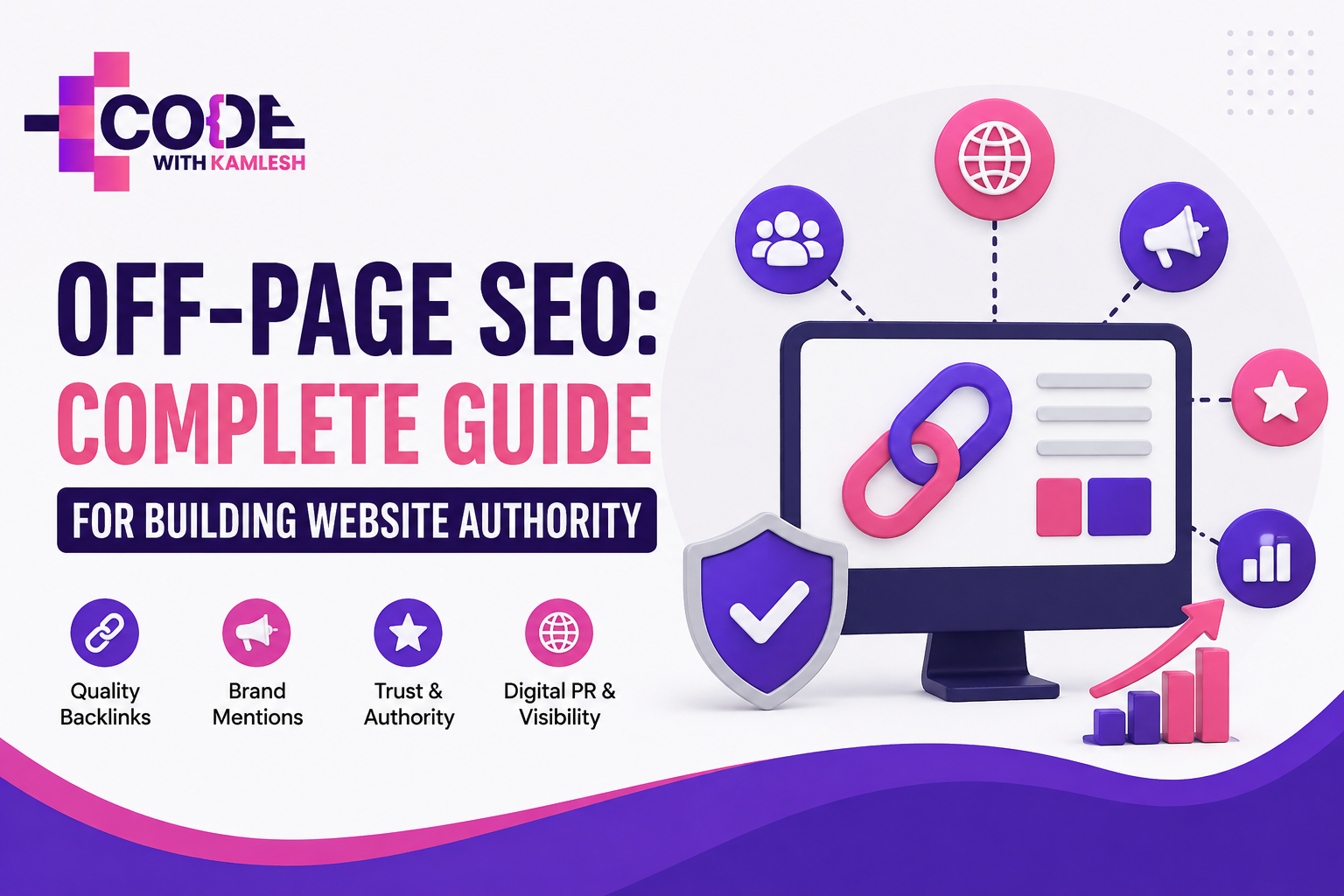
Publishing high-quality content on a technically sound website is fundamental to organic search performance, but on-page optimization alone rarely secures competitive rankings. Search engines aim to serve results that users can trust, and evaluating content in isolation does not provide enough data to determine credibility.
To evaluate trustworthiness, search algorithms analyze signals generated across the wider web. When other reputable platforms reference your site, cite your research, discuss your brand, or review your services, search engines interpret those actions as third-party endorsements. These external signals form the foundation of Off-Page SEO.
This guide provides a comprehensive breakdown of Off-Page SEO. You will learn how modern search engines evaluate external authority signals, how to execute sustainable link-building campaigns, how digital PR and local visibility fit into the broader picture, and how to measure your efforts effectively.
What Is Off-Page SEO?
Off-Page SEO encompasses all actions, signals, and promotional activities that occur outside your own website to influence search engine rankings, perceived authority, and brand recognition.
Many marketers equate Off-Page SEO strictly with link building. While acquiring high-quality backlinks remains a core pillar, off-page optimization encompasses a much broader array of external factors. It includes digital PR campaigns, unlinked brand mentions, local citation management, customer reviews, guest contributions, podcast appearances, and community engagement.
Every instance where your business is cited, referenced, or trusted on an external platform contributes to your overall off-page footprint. The objective is simple: establish your website as a recognized, reliable authority within your specific industry or market vertical.
Why Is Off-Page SEO Important?
Search engines exist to satisfy user intent with accurate, helpful, and reliable information. Anyone can write an article claiming to be an industry leader, optimize title tags, and adjust site architecture. Search engines need an objective mechanism to separate legitimate subject matter experts from unvetted claims.
Off-page signals provide this objective validation in several ways:
- Building Domain and Topical Authority: Search algorithms do not view every domain equally. Websites with extensive track records of authoritative references earn higher algorithmic trust, making it easier for new content on those domains to rank.
- Securing Competitive Organic Visibility: In competitive niches, top-ranking pages often feature comparable content depth and technical optimization. In these scenarios, the breadth and quality of external authority signals frequently determine which page secures the top spots.
- Generating Direct Referral Traffic: Effective off-page campaigns place your brand directly in front of active audiences on relevant platforms, driving qualified visitors straight to your site independent of search rankings.
- Reinforcing Brand Trust and Reputation: Potential customers rarely rely on a single source when evaluating a purchase or partnership. Seeing your company cited in trade publications, recommended on review platforms, and referenced by industry peers builds confidence across the buyer journey.
- Creating a Defensible Competitive Advantage: Technical fixes can be replicated quickly by competitors, but an authoritative external profile built over years through original research, industry relationships, and brand equity is exceptionally difficult to duplicate.
How Does Off-Page SEO Work?
Search engines use web crawlers to discover, index, and analyze web pages across the entire internet. When these crawlers navigate from one site to another via hyperlinks, they collect context about how pages relate to one another.
Historically, algorithms like Google's original PageRank viewed a hyperlink as a simple vote of confidence. The more votes a webpage accumulated, the more authoritative it was considered.
Modern search algorithms are far more sophisticated. Rather than simply counting links, search engines evaluate the contextual framework surrounding external signals:
- Source Authority and Trust: A link from an established, highly vetted publication carries substantially more algorithmic weight than dozens of links from obscure, low-traffic blogs.
- Topical Relevance: Algorithmic systems assess whether the referring website operates within a related vertical. If a medical software company receives an editorial link from a healthcare technology portal, that reference carries direct topical relevance. If that same company receives a link from an unrelated auto repair website, the contextual relevance drops significantly.
- Brand Entity Recognition: Modern search engines construct knowledge graphs consisting of entities (people, places, organizations, and concepts) and the relationships between them. When independent industry websites mention your company name, executive team, or proprietary data, algorithms connect those data points to your brand entity, even without a direct hyperlink.
- Platform Diversity: Natural authority profiles demonstrate a varied mix of references, including editorial news links, industry directory listings, social engagement, podcasts, and customer reviews.
A small collection of topically aligned, editorially given links from respected industry sources will consistently outperform a large portfolio of generic, untargeted web links.
On-Page SEO vs Off-Page SEO
Achieving durable search engine performance requires balancing internal site optimization with external authority development. To organize your marketing priorities, review our detailed On-Page SEO Guide alongside the operational differences outlined below.
Dimension
On-Page SEO
Off-Page SEO
Where Optimization Occurs
Directly on your website and its individual pages.
On third-party websites, external platforms, and digital communities.
Main Activities
Content creation, title tag optimization, internal linking, schema markup, image optimization, search intent alignment.
Digital PR, link building, unlinked brand mention outreach, local citations, review management, industry interviews.
Level of Control
Full control over implementation, updates, and design.
Indirect control; relies on earning third-party coverage, editorial approvals, and publisher interest.
Main Purpose
Help search crawlers understand page content, structure, and user relevance.
Prove credibility, domain trustworthiness, brand authority, and popularity across the web.
Common Examples
Publishing a comprehensive guide, improving page loading speed, optimizing header structures.
Securing coverage in a trade journal, earning editorial references for original research, fixing broken external links.
Typical Results
Clearer indexation, improved user experience, immediate alignment with targeted queries.
Long-term gains in domain authority, top-tier competitive rankings, and increased referral traffic.
A site with flawless technical architecture and comprehensive content will struggle to rank for competitive terms without external authority. Conversely, a website backed by strong off-page equity will fail to convert organic traffic if the underlying pages are slow, thin, or poorly structured. Both disciplines are essential.
Backlinks and Their Role in Off-Page SEO
A backlink is an HTML hyperlink that connects an external website to a page on your domain. Within organic search architecture, backlinks remain among the most influential signals used to evaluate page importance.
Anatomy of an Impactful Backlink
Not all hyperlinks contribute equally to your website's performance. The algorithmic value transferred by a link depends on several structural and editorial criteria:
- Editorial Placement: The strongest links are contextual, appearing naturally within the primary body text of a relevant article because the author felt the resource added genuine value for their audience. Links placed in footers, sidebars, or automated author bios carry less weight.
- Anchor Text Context: Anchor text refers to the clickable words hosting the hyperlink. Natural profiles feature a diverse combination of branded anchors (e.g., Brand Name), generic phrasing (e.g., source, read the study), and descriptive phrases. Search algorithms penalize sites that intentionally accumulate excessive, repetitive, exact-match keyword anchors.
- Link Attributes: Standard HTML links transfer algorithmic equity. Webmasters can append attributes to indicate specific commercial or user relationships:
- rel="nofollow": Directs search engines not to associate the linking site with the target page for ranking purposes. While primarily used to prevent spam, search engines now treat this as a contextual hint.
- rel="sponsored": Applied to links created via paid agreements, advertisements, or sponsored arrangements, ensuring transparency under search quality guidelines.
- rel="ugc": Applied to user-generated content, such as forum discussions, user profiles, or blog comments.
For official documentation on managing how search engines interpret these attributes, refer to the guidelines published on Google Search Central.
What Makes a High-Quality Backlink?
To run an effective off-page campaign, marketing teams must learn to differentiate legitimate authority links from low-value placements.
       High-Quality Links                   Low-Quality Links
┌─────────────────────────────────┐   ┌─────────────────────────────────┐
│ • Relevant industry publication │   │ • Unrelated niche / PBN         │
│ • Contextual body placement     │   │ • Sitewide footer or sidebar    │
│ • Real human readership traffic │   │ • Zero organic search traffic   │
│ • Editorially approved content  │   │ • Unvetted, paid guest farm     │
│ • Indexed page with clean profile│  │ • De-indexed or penalized page  │
└─────────────────────────────────┘   └─────────────────────────────────┘
A high-quality backlink originates from an established website that demonstrates actual organic search traffic, serves real human readers, and maintains strict editorial publishing standards. The linking page should cover a topic directly related to your target page, and the link itself must feel organic within the context of the sentence.
Warning Signs of Low-Quality Links
Avoid pursuing placements characterized by the following red flags:
- The linking site publishes articles across dozens of unrelated topics (e.g., betting, industrial manufacturing, cryptocurrency, and pet care) on a single generic blog.
- The domain openly sells dofollow links with visible "Write for Us" pages advertising instant publication without editorial review.
- The linking domain has minimal organic search visibility or has experienced steep, unrecovered algorithmic penalties.
- The site's backlink profile contains large volumes of spammy, foreign-language anchor text generated through automated tools.
Best Off-Page SEO Techniques
Building authoritative external signals requires deliberate effort, valuable source content, and relationship-driven outreach. The following techniques represent modern, white-hat approaches that yield sustainable results.
1. Digital PR and Newsworthy Campaigns
Digital Public Relations focuses on earning editorial coverage from journalists, major news outlets, and trade publications. Rather than cold pitching an existing product page, digital PR campaigns offer genuine news value:
- Proprietary Data and Industry Reports: Collect and analyze internal user data, anonymized platform metrics, or custom industry surveys. Journalists frequently seek credible data sources to support their reporting.
- Expert Commentary: Make your company's subject matter experts available to comment on emerging industry developments, regulatory shifts, or market trends. Platforms such as Connectively (formerly HARO) or direct media outreach can connect your team with journalists actively writing on tight deadlines.
- Creative Visual Campaigns: Produce complex data visualizations, market maps, or diagnostic frameworks that journalists can embed directly into their articles with an attribution link to your source material.
2. Linkable Asset Creation
A linkable asset is an informational resource deliberately designed to attract citations naturally. Content creators, researchers, and bloggers frequently look for reference material to validate their points.
Effective linkable assets include:
- Curated Statistics Pages: Compile verified industry data with clear citations. Writers often search for statistical verification while drafting content, leading to regular, passive link acquisition.
- Interactive Tools and Calculators: Develop lightweight utilities that solve specific calculations (e.g., mortgage calculators, ROI estimators, code validators).
- Definitive Frameworks and Templates: Free downloadable document templates, compliance checklists, or detailed technical frameworks act as utility resources that other sites naturally reference.
To identify high-demand topics for linkable assets, integrate your research directly with our comprehensive Keyword Research Guide.
3. Competitor Backlink Analysis
Analyzing the backlink profiles of top-ranking competitors reveals existing sites that already cover your vertical and link out to content like yours.
By entering competitor URLs into market intelligence tools like Ahrefs, Semrush, or Moz, you can assess:
- Specific publications that consistently cover your competitors' product launches or executives.
- Broken resources or outdated content competitors previously published that you can improve upon.
- Specialized industry directories, resource hubs, and industry organizations where your company lacks a profile.
You can also cross-reference your own indexing status and external links using the native tools in Google Search Console documentation.
4. Strategic Guest Posting
Guest posting remains an effective strategy when executed with a focus on editorial quality rather than scale. Instead of distributing low-grade articles across hundreds of low-tier blogs, identify 5 to 10 leading publications within your exact industry.
Pitch comprehensive, original perspectives that the host site has not yet covered. Ensure the submission matches their editorial tone and provides practical insights for their audience. Any links back to your domain should point to relevant, educational context rather than transactional landing pages.
5. Broken Link Building
Broken link building involves finding pages on authority sites that contain dead external links (yielding 404 errors), and suggesting your active, high-quality resource as a replacement.
Step 1: Identify authoritative resource pages in your industry.
  │
Step 2: Crawl those pages using link-checker tools to find broken outbound links (HTTP 404).
  │
Step 3: Review the dead content via the Wayback Machine to understand its original scope.
  │
Step 4: Create or identify a superior, updated replacement page on your own domain.
  │
Step 5: Send a concise email alerting the webmaster to the broken link and suggesting your resource.
This strategy succeeds because it provides immediate value to the webmaster by helping them clean up broken links that degrade their user experience.
6. Resource Page Link Building
Many academic institutions, trade associations, and specialized industry portals maintain dedicated resource pages that curate useful tools, articles, and guides.
Search for relevant resource hubs using targeted queries (e.g., "industry" + inurl:resources or "topic" + "useful links"). Review their existing listings to ensure your content fits their editorial criteria, then reach out explaining why your resource offers genuine utility to their audience.
7. Unlinked Brand Mentions
As your company grows, industry blogs, news outlets, and forums will occasionally mention your brand name, products, or founders without inserting an active hyperlink.
Set up continuous alerts using Google Alerts, Brand24, or dedicated SEO suites to catch new brand references. When you identify an unlinked editorial mention:
- Evaluate whether a link contextually benefits the reader.
- Reach out to the author or site editor with a polite note thanking them for the coverage.
- Ask if they would consider adding an active link so their readers can easily locate the official brand source or referenced study.
8. Podcasts and Expert Interviews
Participating in industry podcasts provides exposure to an engaged audience while generating clean, natural authority signals. Most podcast producers publish dedicated show notes on their websites for every episode.
These show notes typically include a summary of the discussion, biographical information about the guest, and links back to the guest’s personal profile, company website, or referenced tools.
9. Communities and Industry Forums
Participating in niche forums, Reddit communities, and platforms like Quora helps establish subject matter authority when done with a helpful mindset.
The objective is never to drop unsolicited links into random threads; community moderators quickly remove spam. Instead, focus on answering complex questions thoroughly. When a link to your in-depth guide or diagnostic tool genuinely clarifies an answer, provide it transparently alongside a self-contained explanation.
10. Social Amplification and Content Distribution
Social media engagement does not directly pass algorithmic search ranking equity. A high number of retweets, likes, or shares will not directly alter a page’s position in Google's index.
However, social media acts as an amplification channel. Distributing original research, infographics, and guides across platforms like LinkedIn, X, and specialized Slack or Discord communities puts your assets in front of journalists, content creators, and industry bloggers. Those creators, in turn, often cite your work in their own content, resulting in genuine backlinks.
Local SEO as an Off-Page Strategy
For businesses serving specific geographic markets, off-page optimization requires a targeted regional approach. Search engines heavily weight geographic signals when delivering localized search results.
                     Core Local Off-Page Signals
                                  │
         ┌────────────────────────┼────────────────────────┐
         ▼                        ▼                        ▼
┌──────────────────┐    ┌──────────────────┐    ┌──────────────────┐
│  Google Business │    │ Consistent Local │    │ Community Links  │
│     Profile      │    │    Citations     │    │   and Reviews    │
│  Optimization    │    │ (Accurate NAP)   │    │  (Local Trust)   │
└──────────────────┘    └──────────────────┘    └──────────────────┘
- Google Business Profile (GBP): Your GBP listing is the most critical off-page local asset. Ensuring your primary category, operating hours, service listings, and address details remain fully updated directly impacts visibility in Google Maps and local map packs.
- Name, Address, and Phone (NAP) Consistency: Maintain consistent business details across core citation platforms (e.g., Yelp, YellowPages, Better Business Bureau, Apple Maps). Inconsistent phone numbers or conflicting street addresses confuse search crawlers and reduce geographic confidence.
- Local Editorial Links: Sponsor local non-profit organizations, partner with neighborhood business associations, collaborate with regional chambers of commerce, and pitch regional news outlets. These regional links provide distinct geographic relevance that national platforms cannot duplicate.
Online Reviews and Reputation Management
Customer reviews on third-party platforms represent significant off-page signals that influence both user conversion rates and search engine trust.
- Review Platforms: Focus on platforms relevant to your industry. For local businesses, prioritize Google, Yelp, and Angi. For B2B software and services, collect reviews on platforms like G2, Capterra, Clutch, and Trustpilot.
- Ethical Review Acquisition: Establish automated post-purchase or post-project workflows that invite satisfied customers to share feedback. Never offer financial incentives or discounts in exchange for positive reviews; doing so violates search engine guidelines and consumer protection regulations.
- Active Professional Responses: Respond calmly and constructively to all reviews, particularly negative ones. Demonstrating accountability shows prospective buyers and automated sentiment analyzers that your business takes customer service seriously.
Brand Mentions and Brand Authority
Off-page optimization has evolved beyond simply tracking physical links. Search engines recognize corporate entities, executive profiles, and proprietary frameworks as independent concepts.
Cultivating broad brand authority requires consistent public positioning:
- Thought Leadership: Publish proprietary perspectives on industry challenges, participate in panel discussions, and contribute expert quotes to trade publications.
- Entity Association: Maintain complete, verified profiles across major professional platforms (e.g., LinkedIn, Crunchbase, Wikipedia/Wikidata where appropriate).
- Co-Occurrence Signals: When your brand name consistently appears alongside specific industry terms (e.g., enterprise cybersecurity or logistics optimization) across independent sites, search algorithms learn to associate your brand with those topics, improving your topical relevance.
Off-Page SEO Strategies to Avoid
Search engine webspam algorithms continuously identify and devalue unnatural link patterns. Engaging in manipulative link schemes can lead to algorithmic devaluation or manual penalties that severely depress organic performance.
Avoid the following tactics:
- Purchasing Bulk Link Packages: Cheap link packages sold on freelance marketplaces or forums deliver low-grade links from hacked websites, comment spam, or automated networks. These offer zero positive value and expose your domain to significant risk.
- Private Blog Networks (PBNs): PBNs are networks of expired domains set up solely to pass link equity to target sites. Search algorithms easily detect footprint commonalities across hosting providers, whois records, link velocity, and content themes.
- Automated Link Building Software: Programs that mass-submit comments, profile links, or low-grade directory submissions create obvious spam footprints that algorithms quickly flag.
- Aggressive Exact-Match Anchor Text: Forcing commercial keywords into anchor text at scale (e.g., cheap car insurance Chicago) looks unnatural. Organic profiles feature balanced, brand-heavy anchor distribution.
- Large-Scale Link Exchanges: Participating in explicit "link to me and I will link to you" networks violates search engine guidelines when scaled artificially.
How to Create an Off-Page SEO Strategy
Building sustainable website authority requires a disciplined, sequential approach. Follow this step-by-step framework to launch an effective off-page campaign.
Step 1: Audit Current Profile ──► Step 2: Competitor Analysis ──► Step 3: Identify Gaps
                                                                        │
Step 6: Execute Outreach     ◄── Step 5: Relationship Building ◄── Step 4: Asset Creation
       │
       ▼
Step 7: Brand & Local Signals ──► Step 8: Monitor & Refine
Step 1: Audit Your Current Backlink Profile
Examine your existing link equity using an SEO platform. Identify:
- The total count of unique referring domains pointing to your site.
- The distribution of anchor text to ensure it remains predominantly branded and natural.
- Any existing toxic, spammy links that warrant monitoring.
Step 2: Analyze Competitors
Identify your top 3 to 5 organic search competitors. Map out where their high-authority links originate, which of their assets generate the most citations, and which industry journalists frequently cover their news.
Step 3: Identify High-Value Link Opportunities
Pinpoint link categories where your competitors have secured traction but your site is missing:
- Broken links on authoritative industry resource pages.
- Editorial hubs, roundups, and annual vendor directories.
- Unlinked brand mentions of your company or executives.
Step 4: Create Link-Worthy Content
Before conducting outreach, ensure your site offers something worth linking to. Build original research reports, actionable diagnostic tools, comprehensive definitions, or visually engaging frameworks that serve as reference points.
Step 5: Build Relationships with Relevant Publishers
Engage with industry creators, journalists, and editors well before pitching them. Comment thoughtfully on their articles, share their publications on social media, and interact with their industry commentary.
Step 6: Run Strategic Outreach Campaigns
Send concise, personalized outreach emails to relevant editors and webmasters. Focus your pitch on explaining how your resource genuinely benefits their audience or helps solve an editorial gap, rather than asking for a link directly.
Step 7: Improve Brand Visibility and Local Signals
Claim, verify, and optimize your business listings across platforms like Google Business Profile, industry directories, and review platforms. Ensure NAP information matches across every external profile.
Step 8: Monitor Backlinks and Refine Strategy
Track link acquisition velocity, review lost links, monitor brand mentions, and evaluate which campaign formats yield the highest return on investment. Adjust your efforts toward the tactics that drive measurable results.
How to Measure Off-Page SEO Performance
Measuring off-page optimization requires looking beyond vanity metrics to evaluate how external signals affect business goals.
- Referring Domains: Track the growth of unique, high-quality domains pointing to your website over time. Acquiring links from 50 distinct authoritative domains delivers significantly more value than acquiring 500 links from a single site.
- Referral Traffic: Monitor analytics platforms to see how many qualified visitors arrive directly through external links, digital PR placements, and directory listings.
- Organic Search Visibility and Keyword Rankings: Assess whether competitive keywords for your target landing pages rise in search results as new authority signals are acquired.
- Third-Party Domain Metrics: Proprietary scores such as Moz Domain Authority (DA), Ahrefs Domain Rating (DR), or Semrush Authority Score (AS) can serve as broad relative benchmarks when comparing your domain against competitors. However, remember that these metrics are third-party approximations, not official Google ranking factors.
- Brand Search Volume: Track increases in the number of users searching for your company or product name directly in search engines, which signals growing offline and off-page brand awareness.
Best Tools for Off-Page SEO
A streamlined tool stack helps you discover link opportunities, track brand reputation, and analyze competitors efficiently:
- Google Search Console: Provides direct data from Google on which external sites link to your domain, your top-linked pages, and the most common anchor text profiles.
- Google Analytics: Tracks referral traffic channels, showing which external links generate actual user engagement, leads, and revenue.
- Ahrefs / Semrush / Moz: Industry-standard SEO suites essential for conducting competitor backlink analysis, running link gap audits, discovering broken links, and monitoring referring domain velocity.
- Google Alerts: A free, lightweight tool that sends email notifications whenever your brand name, competitors, or target industry terms appear in newly indexed web content.
- BuzzStream / Pitchbox: Specialized outreach management platforms that streamline contact discovery, email relationship management, and digital PR campaign tracking.
Off-Page SEO Checklist
Keep this checklist handy to ensure your off-page optimization efforts remain thorough, structured, and effective:
- Conduct a comprehensive backlink audit to identify current referring domains and anchor text distribution.
- Identify your top 3 organic competitors and run a link gap analysis.
- Claim and verify your Google Business Profile (for regional/local organizations).
- Ensure company Name, Address, and Phone (NAP) details are uniform across all core directories.
- Set up alerts to identify unlinked brand mentions across the web.
- Establish an ongoing process to encourage and respond to customer reviews on major platforms.
- Create at least one major linkable asset per quarter (e.g., proprietary study, industry survey, or specialized free tool).
- Identify broken links on 10 to 20 authoritative industry resource pages.
- Connect with industry journalists, editors, and podcast hosts across social and professional channels.
- Pitch 3 to 5 targeted, highly relevant guest contributions to established industry publications.
- Audit your lost backlinks quarterly and run reclamation outreach where appropriate.
- Review anchor text distributions to avoid over-optimizing exact-match commercial keywords.
- Refuse to buy link packages, participate in PBNs, or engage with automated link networks.
Even experienced marketing teams occasionally make critical off-page errors that waste resources or trigger search penalties. Watch out for these common pitfalls:
- Prioritizing Quantity Over Quality: Acquiring hundreds of low-tier links from unvetted sites does not improve rankings and can lead to algorithmic devaluation. A handful of editorially earned links from respected publications offers far greater impact.
- Pursuing Irrelevant Links: Obtaining links from sites that share no topical overlap with your business sends confusing contextual signals to search engines and provides zero value to users.
- Overusing Exact-Match Anchors: Forcing commercial anchor text into every placement looks unnatural. A safe, natural backlink profile consists predominantly of branded and natural conversational phrases.
- Ignoring Lost Links: High-value backlinks can disappear when third-party sites update their content or adjust URL structures. Failing to monitor and reclaim these lost links wastes previously earned equity.
- Relying on Generic, Mass Outreach: Sending copy-pasted outreach emails to hundreds of webmasters yields abysmal conversion rates and damages your brand's reputation with industry editors.
- Expecting Overnight Results: Off-Page SEO is an ongoing process of authority accumulation. Expecting top-tier competitive rankings within days or weeks of a single campaign leads to premature frustration and abandoned strategies.
How Long Does Off-Page SEO Take to Work?
Off-Page SEO requires patience and consistency. Unlike on-page technical fixes, which search engines can crawl and evaluate immediately, external authority signals take time to compound.
Generally, an established website running consistent outreach, digital PR, and link-building campaigns can expect to see measurable movement in organic visibility within 3 to 6 months. For brand-new domains with zero baseline authority, establishing enough external trust to compete in moderately competitive verticals often takes 6 to 12 months of sustained effort.
The timeline depends on several factors:
- The Level of Market Competition: Competing against established industry leaders with thousands of referring domains requires significantly more authority-building than competing in underserved, local niches.
- The Technical and On-Page Health of Your Site: If your site suffers from poor user experience, indexing roadblocks, or low-quality content, off-page signals cannot compensate for those deficiencies.
- The Quality and Velocity of Inbound Links: Earning continuous, high-impact placements from leading industry sites builds momentum far faster than sporadic, low-tier link acquisition.
The Future of Off-Page SEO
Off-page optimization continues to evolve toward assessing genuine brand reputation, expertise, and digital prominence. Search engines constantly refine their ability to identify manipulative link schemes and artificial endorsements.
The future of Off-Page SEO centers on:
- True Digital PR Over Link Mechanics: Algorithms will increasingly reward brands that secure legitimate news coverage, share authentic expert perspectives, and conduct genuine primary research.
- Holistic Brand Authority: Entity-based indexing allows search engines to evaluate a brand's authority through unlinked mentions, customer sentiment across review platforms, executive thought leadership, and platform presence.
- E-E-A-T Validation: External signals will serve as the ultimate validation layer for Experience, Expertise, Authoritativeness, and Trustworthiness (E-E-A-T). Independent third-party validation helps algorithms confirm that a business has real-world experience and industry credibility.
Tactics that rely on cutting corners or manipulating algorithms will continue to decline in effectiveness. Building a respected brand that commands attention across your broader industry remains the most sustainable long-term off-page strategy.
Frequently Asked Questions About Off-Page SEO
What is Off-Page SEO and why does it matter?
Off-Page SEO covers all optimization activities conducted outside your own website to boost search engine visibility and credibility. While on-page optimization shows search engines how your content is structured, off-page factors prove your real-world authority. Signals like backlinks, editorial mentions, reviews, and local citations act as independent endorsements that help search algorithms trust your site enough to rank it competitively.
How does Off-Page SEO differ from On-Page SEO?
On-Page SEO involves optimizing elements directly on your site, such as content depth, page speed, meta tags, and internal link structure. Off-Page SEO focuses entirely on external signals from third-party platforms, such as link building, digital PR coverage, and reputation management. You need both to rank well: on-page optimization ensures relevance, while off-page optimization builds authority.
Are backlinks the only factor that matters in Off-Page SEO?
No. While quality backlinks remain a primary ranking signal, Off-Page SEO encompasses a much wider footprint. Unlinked brand mentions, customer reviews on platforms like Google and Trustpilot, local NAP citations, and brand entity authority all shape how search engines evaluate your credibility. Building an authentic digital brand across industry publications and professional communities is just as vital as earning direct hyperlinks.
What is the difference between a high-quality and a low-quality backlink?
A high-quality backlink comes from an established, topically relevant website with genuine readership and organic search traffic, placed naturally within editorial content. A low-quality backlink typically originates from an irrelevant blog, an automated link directory, or a private blog network (PBN) that publishes thin content across random niches. Low-quality links provide no algorithmic value and can trigger search penalties.
How many backlinks do I need to rank on Google?
There is no fixed number of backlinks required to rank. The volume needed depends entirely on keyword search intent and the competitive landscape of your industry. Ranking for a specific, low-competition query may require only a few topically relevant links, whereas competitive commercial search terms often require continuous, high-authority referring domains earned over months or years. Quality consistently beats sheer quantity.
Do social media shares directly improve Google rankings?
No, social media engagement metrics like likes, retweets, and shares are not direct algorithmic ranking factors. However, social media acts as an effective distribution channel for your content. When you share original data, research reports, or guides across platforms like LinkedIn or X, you place your assets in front of journalists, researchers, and bloggers who can cite and link to your resources.
What is broken link building and how does it work?
Broken link building is an outreach strategy where you identify dead, 404-error links on authoritative industry resource pages and suggest an active, high-quality replacement from your own domain. It works well because it provides immediate value to the webmaster by helping them fix a broken user experience, while earning your site an organic, contextual backlink.
Why is local SEO considered an off-page strategy?
Local SEO relies heavily on signals hosted on external platforms rather than your primary domain. Managing your Google Business Profile, securing consistent Name, Address, and Phone (NAP) citations on business directories, earning local customer reviews, and getting links from regional chambers of commerce all occur off-site. These third-party signals prove to search algorithms that your business operates legitimately within a specific geographic area.
How long does it take for Off-Page SEO to show ranking results?
Off-Page SEO is a long-term process that typically takes between 3 to 6 months to produce noticeable organic traffic gains. New websites with zero baseline trust may take 6 to 12 months of consistent link building, digital PR, and citation management to compete effectively. The exact timeframe depends on your niche's competition, your site’s technical health, and how consistently you earn quality links.
What are the biggest Off-Page SEO practices to avoid?
Avoid buying bulk backlink packages, joining private blog networks (PBNs), using automated link-building software, and participating in large-scale link exchanges. You should also avoid forcing exact-match commercial keywords into your anchor text at scale. Modern search spam algorithms readily detect these artificial patterns, which can lead to severe algorithmic devaluation or manual search penalties.
© 2026 Code With Kamlesh. All rights reserved.
Kamlesh Singad
Founder, Code With Kamlesh. Helped 200+ businesses scale through SEO, Google Ads & Social Media. 8+ years of digital marketing experience.
Comments (0)
No comments yet. Be the first to comment!