Primary vs Secondary Keywords: Differences, Examples & SEO Best Practices
Discover the difference between primary and secondary keywords and understand how they work together in an effective SEO strategy. This guide from Code With Kamlesh covers keyword research, search intent, keyword mapping, real-world digital marketing examples, on-page optimization, and common mistakes. Learn how to organize your content and improve its relevance for organic search.
Publishing content regularly does not automatically mean your website will attract organic traffic. You might spend hours researching a topic, writing detailed articles, and optimizing your headings, yet your pages may struggle to appear for relevant searches.
One common reason is an unclear keyword strategy.
Imagine you are creating a blog about search engine optimization. You choose "SEO" as your main keyword and start adding every related phrase you can find. Your article discusses local SEO, technical SEO, backlinks, keyword research, Google Ads, and website design without establishing a clear purpose.
Although these subjects belong to digital marketing, combining them randomly does not necessarily create helpful content.
A better approach begins with understanding primary vs secondary keywords.
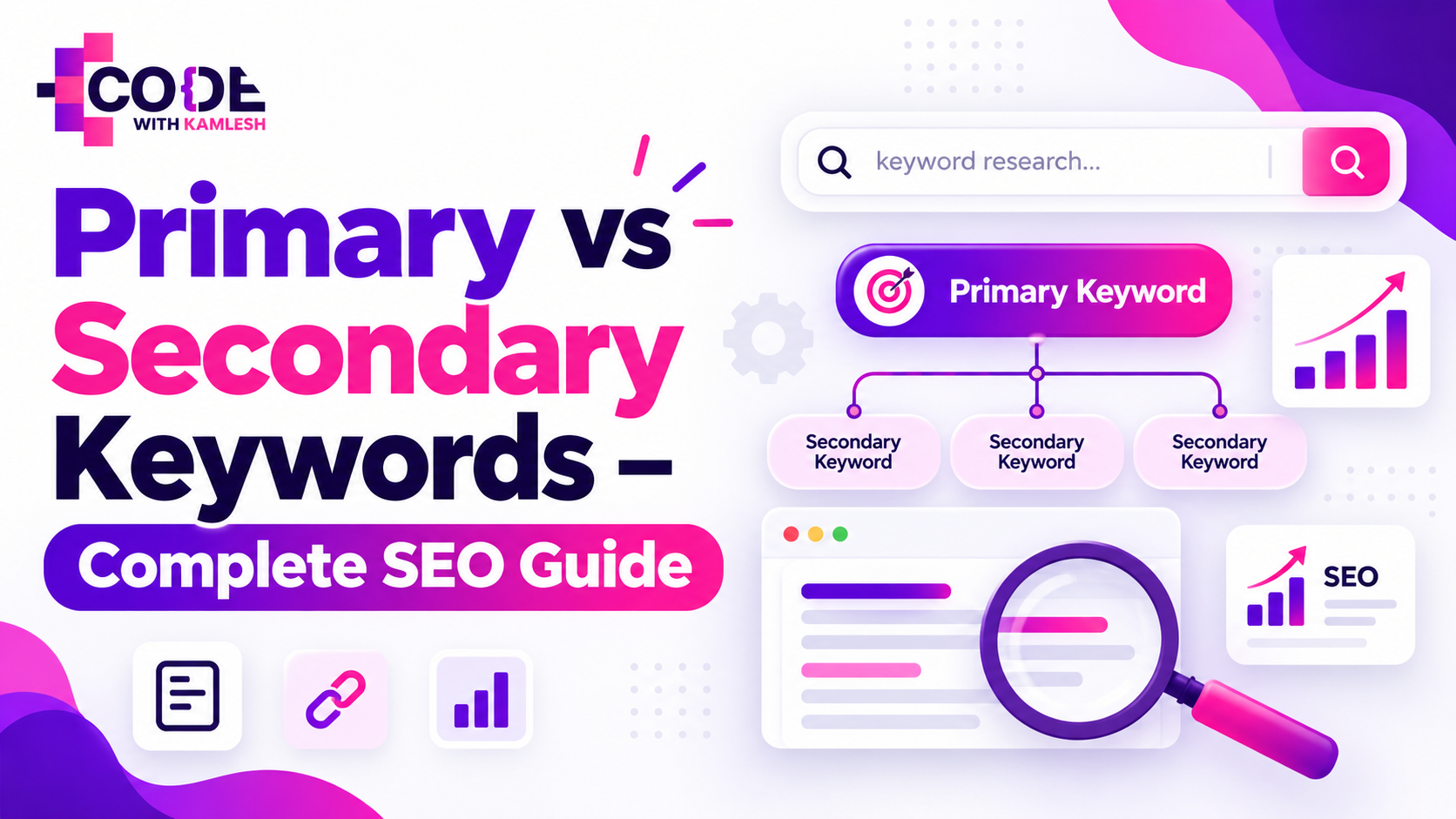
Primary keywords establish the central focus of your webpage. Secondary keywords help you address related questions, search variations, and supporting topics without losing that focus.
Understanding how these keywords work together can improve your content planning, strengthen on-page optimization, and help you create pages that genuinely satisfy search intent.
In this comprehensive guide, we will explain the difference between primary and secondary keywords, explore practical SEO examples, discuss keyword research methods, and share strategies you can apply to your website.
What Are Primary Keywords in SEO?
A primary keyword is the main search term or phrase that a webpage targets.
It represents the central topic of the page and helps establish what visitors should expect to learn, discover, or accomplish.
For example, suppose Code With Kamlesh publishes a guide explaining how businesses can improve their website rankings.
The primary keyword might be "SEO strategies for small businesses."
This phrase identifies a clear topic and audience. The content should primarily explain practical SEO strategies suitable for smaller businesses rather than covering unrelated digital marketing subjects.
Characteristics of a Good Primary Keyword
An effective primary keyword should reflect the webpage's purpose, match audience expectations, and support its business or informational goals.
Topical relevance: The keyword should accurately represent the subject being discussed.
Search intent: The page should provide the type of information or service searchers expect.
Audience relevance: The keyword should attract people interested in the website's expertise or offerings.
Ranking feasibility: Competition, content quality, and the website's existing visibility should be considered.
Business value: For commercial pages, the keyword should relate to a meaningful service or customer requirement.
For instance, "digital marketing" describes a broad subject, while "digital marketing services for small businesses" communicates a more specific need.
Neither phrase is automatically better. Their suitability depends on the intended webpage.
It is also important to understand that primary keywords are SEO planning terms. Google does not officially classify keywords into primary and secondary categories for ranking purposes.
A webpage may appear for multiple relevant queries even when the content team identifies one main keyword.
What Are Secondary Keywords in SEO?
Secondary keywords are related search terms that support the main keyword of a webpage.
They may include alternative phrases, close variations, relevant questions, and related concepts that contribute to the central topic.
Suppose the primary keyword for an article is "on-page SEO."
Potential secondary keywords could include "on-page SEO techniques," "how to improve on-page SEO," "title tag optimization," "internal linking for SEO," and "on-page SEO checklist."
Each term represents a relevant aspect of the larger subject.
Rather than creating a separate article for every variation, you can address compatible queries within one comprehensive resource.
How Secondary Keywords Work
Secondary keywords are useful because people frequently express similar requirements using different language.
One visitor might search for "how to optimize website content." Another may search for "content optimization techniques."
Depending on the search results and user intent, both queries might be satisfied by the same article.
However, the purpose of secondary keywords is not to increase keyword repetition.
Their real value is helping you recognize subjects readers expect the content to explain.
Are Secondary Keywords the Same as Long-Tail Keywords?
No. Although they sometimes overlap, the concepts are different.
A secondary keyword is defined by its supporting role within a page's keyword strategy.
A long-tail keyword generally describes a query belonging to the lower-frequency portion of search demand. Such queries are often specific, but their classification is not determined simply by word count.
For example, "technical SEO audit for WordPress websites" could be the primary keyword for a specialized article.
"WordPress SEO audit checklist" might be a secondary keyword if both searches require substantially similar information.
The relationship depends on content purpose and search intent, not keyword length.
Primary vs Secondary Keywords: Key Differences
Understanding the distinction between these keyword types helps marketers organize content more effectively.
ComparisonPrimary KeywordsSecondary Keywords
Purpose
Define the main page topic
Support the central topic
Priority
Principal target for planning
Supporting targets
Content role
Establish overall direction
Expand relevant coverage
Search intent
Reflect the main user objective
Usually share or support that objective
Placement
SEO title, H1, introduction and relevant content
Supporting headings and paragraphs
Quantity
Usually one main planning target
Multiple relevant variations
Search volume
Can be high or low
Can be high or low
Example
Keyword research for SEO
Keyword research tools, keyword selection
Content strategy
Guides page creation
Guides supporting sections
Primary Keyword vs Secondary Keyword: Simple Example
Consider a webpage targeting "WordPress SEO optimization."
Its main purpose is to help readers optimize their WordPress websites.
Useful supporting topics might include SEO-friendly URLs, WordPress sitemap configuration, image optimization, and technical SEO settings.
These subjects contribute to the primary objective.
However, an extensive tutorial about building an entire WordPress website from scratch would serve a different purpose.
The simplest distinction is this: The primary keyword determines what the page is about. Secondary keywords help determine what relevant information the page should include.
Real-World Examples of Primary and Secondary Keywords
Let's explore how these keywords can be used across different services offered by Code With Kamlesh.
The following keyword combinations are illustrative examples. Actual search demand and ranking difficulty should be verified before targeting them.
CWK Service AreaPrimary KeywordSecondary Keyword Examples
Search Engine Optimization
SEO services in Indore
SEO agency in Indore, SEO consultant in Indore
Website Development
WordPress website development
WordPress developer, custom WordPress websites
Google Advertising
Google Ads management services
PPC campaign management, Google Ads optimization
Social Media Marketing
Social media marketing services
Social media management, social media strategy
Technical SEO
Technical SEO audit
Website crawl audit, indexing issues, technical SEO checklist
E-commerce Development
Shopify website development
Shopify store setup, Shopify development services
Content Marketing
SEO content writing
SEO blog writing, website content optimization
Example 1: SEO Service Page
Suppose Code With Kamlesh creates a service page targeting "SEO services in Indore."
The page should explain available SEO services, technical capabilities, working processes, expected deliverables, and how businesses can request assistance.
Supporting keywords can appear naturally while discussing local SEO, technical SEO, content optimization, and website audits.
The page should not attempt to answer every beginner-level question about SEO. Detailed educational subjects can be covered in relevant blog articles.
Example 2: WordPress Development Article
Imagine publishing a blog titled "How to Improve WordPress Website Speed."
The primary keyword establishes a specific problem.
Supporting keywords could address WordPress caching, image compression, unnecessary plugins, hosting performance, and Core Web Vitals.
These subjects are closely connected to the reader's goal.
The result is a focused article that explains the problem and offers practical solutions.
Example 3: Google Ads Guide
A blog targeting "Google Ads optimization" might address campaign structure, keyword selection, search terms, ad relevance, conversion tracking, and landing page performance.
Each supporting topic helps explain how advertisers can improve their campaigns.
The objective is to deliver a useful optimization guide rather than force every available advertising keyword into the content.
Why Primary and Secondary Keywords Matter for SEO
Primary and secondary keywords help organize SEO work, but their value extends beyond simple keyword placement.
Better Search Intent Alignment
Search intent describes the objective behind a query.
Someone searching for "what is technical SEO" expects an explanation.
Someone searching for "technical SEO audit services" may be evaluating professional assistance.
Choosing an appropriate primary keyword helps determine which audience the page should serve.
Secondary keywords help answer related questions without changing the primary objective.
More Complete Content
A well-developed article addresses the information readers genuinely need.
If you publish a guide about keyword research but never explain search intent, search volume, or keyword selection, readers may struggle to apply the information.
Supporting keyword research can reveal these gaps.
Improved Organic Search Opportunities
Search engines may show one page for multiple related searches.
For instance, an article explaining SEO-friendly website architecture may also be relevant to queries about internal linking and website navigation.
Covering related subjects does not guarantee additional rankings, but it can make the page useful for a broader set of relevant searches.
Clearer Website Structure
Keyword planning helps distinguish service pages, educational blogs, and specialized resources.
This prevents teams from publishing numerous pages that repeat essentially the same information.
A structured website is easier for visitors to navigate and easier for content teams to maintain.
Google's official SEO Starter Guide emphasizes useful content, descriptive organization, and the importance of considering how people search for information.
How to Find Primary Keywords for Your Website
Finding appropriate primary keywords requires more than selecting terms with impressive search volumes.
A useful keyword research process begins by identifying what the website offers and what its audience actually needs.
Step 1: Identify Core Business Topics
Start with the services or subjects your website covers.
For Code With Kamlesh, relevant starting topics include SEO, Google Ads, Meta Ads, WordPress development, Shopify development, and content marketing.
These broad topics are often called seed keywords.
They provide a starting point for discovering more specific searches.
If you are new to the process, our detailed guide on what keyword research is explains how to discover, evaluate, and organize relevant search terms.
Step 2: Generate Keyword Ideas
Enter your seed terms into keyword research platforms.
Google Keyword Planner can help identify related phrases and advertising demand estimates.
Ahrefs and Semrush can provide additional information about organic search volume estimates, competing pages, and keyword difficulty.
Google autocomplete and related searches can also reveal how people phrase questions.
Do not assume that every suggested keyword deserves a separate page.
Step 3: Understand Search Intent
Search for your potential primary keyword and examine the existing results.
If most results are tutorials, an educational guide may be appropriate.
If search results mainly feature service providers, a commercial landing page may better match the query.
Also examine whether users expect quick answers, comprehensive explanations, comparisons, or actionable instructions.
Step 4: Evaluate Business Relevance
A keyword can attract considerable traffic while contributing little to your actual business objectives.
For example, a WordPress development agency may benefit more from attracting relevant website development inquiries than from pursuing unrelated high-volume topics.
Consider the audience's requirements, likely next actions, and relevance to your services.
Step 5: Review Competition
Examine the quality and usefulness of pages already ranking for the keyword.
Identify whether you can contribute better explanations, updated technical information, clearer examples, or a more practical approach.
Keyword difficulty scores are third-party estimates, not official Google measurements.
Step 6: Analyze Search Trends
Search interest can vary by location, season, and changing audience behavior.
The official Google Trends guide explains how to examine changing search interest, related queries, and regional patterns.
Remember that Google Trends shows normalized relative interest rather than exact monthly search volume.
After evaluating these factors, select a principal keyword that accurately represents your planned webpage.
How to Find Secondary Keywords for SEO
Once you have selected the primary keyword, research supporting terms that share or reinforce the same search objective.
Use Google's Search Suggestions
Enter the primary keyword into Google and examine autocomplete suggestions.
Review related searches and People Also Ask questions when available.
For example, researching "local SEO" may reveal questions about Google Business Profile optimization, local rankings, reviews, and location pages.
Review Google Search Console
Search Console is especially useful when improving existing website content.
Open the Performance report, select an individual page, and examine its search queries.
Look for relevant queries generating impressions that your page does not adequately address.
These may reveal opportunities for additional examples, clearer headings, or expanded explanations.
Search Console reports may omit some queries, so combine its insights with other research methods.
Analyze Search Results
Examine relevant competing pages to understand which subtopics consistently appear.
Look for unanswered questions, useful technical explanations, and missing practical examples.
The goal is not to reproduce another article. It is to understand what readers need and identify opportunities to offer something original.
Group Keywords by Search Intent
Organize related queries into clusters.
For a guide about WordPress SEO, one group might cover technical configuration, another content optimization, and another site performance.
If a supporting query requires a substantially different type of page, consider creating a dedicated article instead.
This prevents a single page from becoming unnecessarily broad.
Where to Use Primary and Secondary Keywords
Keyword placement should make content clearer to readers rather than interfere with natural writing.
SEO ElementRecommended Approach
SEO title
Include the primary keyword naturally
H1 heading
Clearly establish the page topic
URL slug
Use a concise, descriptive phrase
Meta description
Explain the page and encourage relevant clicks
Introduction
Establish the subject early
H2 headings
Organize major related topics
H3 headings
Explain specific supporting concepts
Body content
Use relevant terms in natural language
Image alt text
Accurately describe the image
Internal links
Use descriptive, contextually relevant anchor text
SEO Title and H1
A title such as "Technical SEO Audit: Complete Website Checklist" clearly communicates the subject and expected content.
There is no need to repeat multiple keyword variations within the same title.
Introduction and Body Content
Introduce the topic naturally and answer the reader's central question.
Supporting keywords should appear where they fit the explanation.
For instance, a paragraph about improving website visibility may naturally discuss crawlability, indexing, internal links, and content relevance.
Image Alt Text and Internal Linking
Image alt text should describe what an image actually communicates. Keyword repetition should never override accessibility.
Internal links should guide readers toward genuinely useful related pages.
For more guidance on structuring readable search-optimized articles, explore our SEO content writing guide.
There is no universal keyword density percentage that guarantees better Google rankings.
Keyword Mapping and Content Planning
Keyword mapping means assigning relevant search queries to appropriate pages on a website.
It helps teams establish a clear purpose for each URL and recognize unnecessary content overlap.
Consider this simplified content plan for Code With Kamlesh.
Page TopicPrimary KeywordPage Purpose
SEO service page
SEO services in Indore
Attract relevant service inquiries
Keyword research blog
What is keyword research
Explain a core SEO concept
Technical SEO guide
Technical SEO checklist
Provide actionable guidance
WordPress guide
WordPress SEO optimization
Explain website optimization
Google Ads article
Google Ads optimization tips
Educate advertisers
Avoiding Keyword Cannibalization
Keyword cannibalization becomes a concern when several pages overlap so substantially that they lack distinct value or a clear targeting strategy.
Suppose you publish three articles explaining exactly the same keyword research process with slightly different titles.
Maintaining one comprehensive resource may be more useful than managing multiple repetitive pages.
However, related pages are not automatically competing against each other.
An introductory keyword research guide and an advanced keyword mapping tutorial can coexist because they address different information needs.
The appropriate decision depends on search intent, existing search results, and the usefulness of each page.
Primary and Secondary Keywords for Blog Posts
Let's build a practical keyword plan for a Code With Kamlesh article.
Proposed blog title: How to Improve Website SEO: A Practical Guide
Primary keyword: How to improve website SEO
A logical content structure could include sections covering website audits, search intent, keyword research, content improvements, technical issues, internal linking, and performance measurement.
These topics belong together because they contribute to the same reader objective: improving a website's organic search performance.
For each section, focus on explaining the underlying issue and providing an actionable solution.
For example, a technical SEO section could explain how to check indexing problems and why pages must be accessible to search engines.
A content optimization section could explain how to improve outdated information and align a page with relevant search intent.
The final article should feel like a practical guide, not a collection of loosely connected keyword definitions.
Primary and Secondary Keywords for Local SEO
Local SEO introduces geographic context into keyword planning.
For example, Code With Kamlesh may target "SEO consultant in Indore" on an appropriate service page.
Related phrases might include "SEO expert in Indore," "local SEO services in Indore," and "SEO consulting services."
However, including a city name does not automatically make a keyword valuable.
Businesses should consider genuine service availability, user intent, location relevance, and whether a dedicated location page provides distinct information.
Publishing dozens of nearly identical city pages purely to target location variations is not an effective substitute for useful local content.
A well-developed location page may include relevant service information, genuine local experience, project context, service availability, and clear contact options.
Local SEO keyword research should also complement accurate Google Business Profile details, customer reviews, and consistent business information.
Common Primary and Secondary Keyword Mistakes
Understanding how keywords work also means recognizing optimization practices that can reduce content quality.
Keyword Stuffing
Repeating the same phrase excessively creates awkward sentences and makes articles frustrating to read.
Keywords should appear naturally where they help explain the subject.
Ignoring Search Intent
A beautifully written article may fail to satisfy readers if its format does not match their objectives.
Always check whether a query requires a tutorial, comparison, service page, or another content format.
Choosing Only High-Volume Keywords
Popular keywords can be highly competitive or too broad to attract relevant customers.
Consider search demand alongside relevance, competition, and business value.
Targeting Unrelated Secondary Keywords
Not every term connected to digital marketing belongs in the same article.
A guide about keyword research does not need an extensive explanation of Meta Ads campaign budgeting unless it directly supports the article's objective.
Creating Duplicate Content
Publishing separate articles for minor keyword variations can produce repetitive pages.
Group closely related queries when one page can satisfy them effectively.
Treating SEO Tool Scores as Google Rules
Keyword difficulty, content scores, and suggested keyword counts are estimates or recommendations provided by third-party platforms.
They are not official Google ranking requirements.
Likewise, the commonly used expression "LSI keywords" should not be treated as an official Google optimization technique.
Forgetting Content Updates
Keywords and audience expectations can evolve.
Review important content periodically, especially when software features, search behavior, or technical recommendations change.
Updating an existing useful page may sometimes produce more value than publishing another similar article.
Primary and Secondary Keyword Best Practices for 2026 and Beyond
Effective SEO content should be built around topics, intent, accuracy, and usability rather than exact-match repetition.
Start by understanding the problem the reader wants to solve.
Choose a primary keyword that represents this problem clearly, then research supporting queries that improve the explanation.
Create original content with practical examples, accurate technical information, and clear organization.
Use descriptive headings so visitors can quickly find the sections relevant to their needs.
Avoid making content unnecessarily long simply to include more keywords.
Instead, evaluate whether each paragraph contributes meaningful information.
Finally, monitor relevant page performance through Search Console and business analytics.
Organic clicks, qualified inquiries, engagement, and conversions provide a more useful picture than focusing exclusively on rankings for one search phrase.
Step-by-Step SEO Keyword Optimization Checklist
Use this checklist when preparing a new blog or reviewing an existing page.
- Identify the target audience and page objective.
- Choose one principal keyword for planning.
- Analyze the dominant search intent.
- Review relevant search results.
- Discover supporting keywords and questions.
- Group terms by meaning and user requirements.
- Map the keyword group to an appropriate URL.
- Create a descriptive SEO title and H1.
- Use relevant supporting headings naturally.
- Provide useful examples and actionable information.
- Add meaningful internal links.
- Review readability and factual accuracy.
- Check for unnecessary content duplication.
- Verify technical SEO fundamentals.
- Monitor performance and improve the content when necessary.
Following a structured process makes keyword planning more consistent and helps prevent common optimization mistakes.
Frequently Asked Questions About Primary and Secondary Keywords
1. What is the difference between primary and secondary keywords?
A primary keyword represents the main search target of a webpage. Secondary keywords are related phrases, variations, and supporting topics that help the page address relevant search queries.
2. Can one page have multiple primary keywords?
A page may rank for multiple closely related searches. For planning purposes, selecting one main keyword can help maintain focus, but Google does not require exactly one primary keyword per page.
3. How many secondary keywords should a blog contain?
There is no fixed requirement. The appropriate number depends on the topic, search intent, and content depth. Use relevant supporting terms without forcing them into the article.
4. Are secondary keywords important for SEO?
Yes. They help marketers discover related topics and questions that can improve content coverage. However, including secondary keywords does not guarantee higher rankings.
5. Where should I place my primary keyword?
Use it naturally in the SEO title, H1 heading, introduction, and relevant content. A descriptive URL can also be helpful. Avoid placement that makes the content awkward.
6. Can primary and secondary keywords have the same search intent?
Yes. Closely related phrases often express the same objective. When one page can satisfy these queries effectively, they can be grouped together.
7. How can I find secondary keywords for free?
Use Google autocomplete, related searches, People Also Ask questions, Google Trends, and Google Search Console. Review the results and retain only relevant terms.
8. What are examples of primary keywords?
Examples include "SEO services in Indore," "WordPress SEO guide," "Google Ads optimization," and "technical SEO checklist." Each represents a possible central page topic.
9. What happens when keywords are overused?
Excessive repetition can reduce readability and become keyword stuffing. Write naturally, explain concepts clearly, and avoid artificial keyword frequency targets.
10. Should every blog post target a different primary keyword?
Each article should have a distinct and useful purpose. Related keywords may overlap, but creating multiple pages that answer exactly the same question is often unnecessary.
Conclusion
Understanding primary vs secondary keywords helps establish a clear direction for your SEO content strategy.
Primary keywords define the central purpose of a webpage, while secondary keywords support that purpose through related questions, variations, and relevant information.
The objective is not to include the maximum possible number of keywords. It is to create content that addresses search intent, communicates expertise, and provides genuine value.
A structured keyword research process also helps businesses organize website pages, develop relevant blog topics, and make better content optimization decisions.
At Code With Kamlesh, our approach to SEO and digital marketing focuses on relevant keyword research, meaningful content development, technical optimization, and sustainable organic visibility.
Whether you are improving an existing website or building a new content strategy, choosing the right primary and secondary keywords provides a valuable foundation for better SEO planning.
© 2026 Code With Kamlesh. All Rights Reserved.
Kamlesh Singad
Founder, Code With Kamlesh. Helped 200+ businesses scale through SEO, Google Ads & Social Media. 8+ years of digital marketing experience.
Comments (0)
No comments yet. Be the first to comment!