Seed Keywords Explained
Discover how seed keywords work in SEO, explore real-world examples, learn practical keyword research techniques, and build an organized content strategy that supports long-term organic visibility.
Every successful SEO strategy begins with understanding what people are searching for. Before choosing blog topics, optimizing service pages, or building a content calendar, marketers need to identify the main subjects that matter to their audience.
This is where seed keywords become valuable.
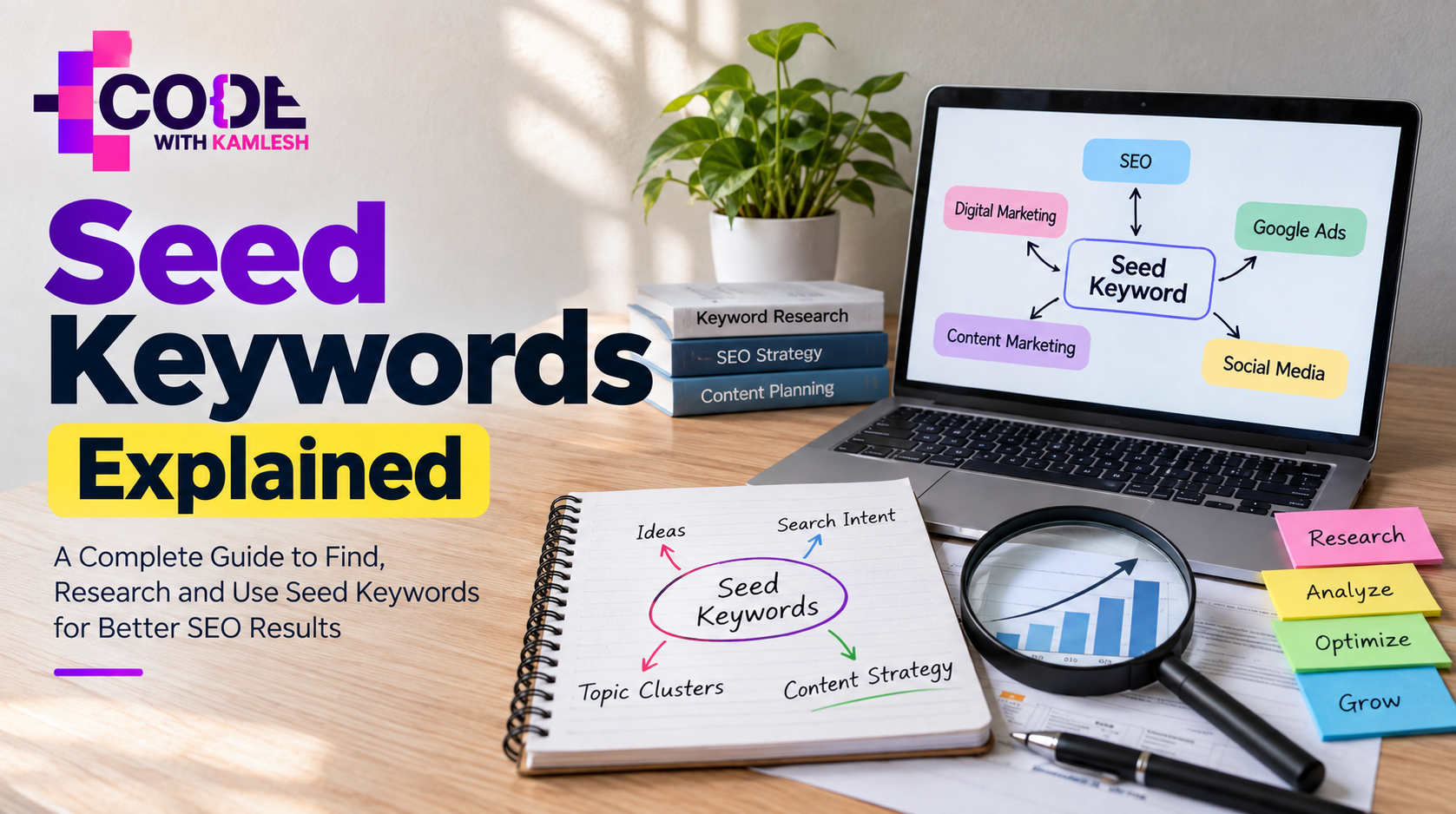
Imagine launching a website that sells running shoes. You might immediately think of broad terms such as “running shoes,” “sports footwear,” or “training shoes.” These phrases provide a starting point, but they do not reveal everything potential customers want to know.
Some visitors may want affordable shoes for beginners. Others may be comparing brands, looking for products suitable for particular activities, or searching for a store nearby.
Each of these needs represents a different keyword opportunity.
By researching relevant starting terms, you can discover these opportunities, understand search intent, organize related topics, and develop content that attracts the right audience.
In this guide, we will explain what seed keywords are, why they matter in SEO, how to find them, and how to turn a simple list into a practical keyword research strategy.
What Are Seed Keywords in SEO?
Seed keywords are broad words or phrases used as the starting point for keyword research. They represent the main products, services, topics, or problems associated with a website.
They are also sometimes called foundational keywords or head terms.
For example, a business providing digital marketing services might begin its research with:
- SEO
- Digital marketing
- Google Ads
- Content marketing
- Social media marketing
These expressions represent different areas of the business. However, they do not necessarily identify the exact searches that will generate valuable website traffic.
The purpose of a seed keyword is to help discover more specific search queries.
Consider the term “SEO.”
Using a keyword research tool, you could explore related searches such as “SEO services for small businesses,” “technical SEO checklist,” or “how to improve local SEO.”
Those variations reveal much more about what individual searchers want.
The important distinction is that seed keywords begin the research process. They are not automatically the best keywords to target on individual pages.
A useful seed list connects your business expertise with the language your potential customers use.
Why Are Seed Keywords Important for SEO?
Starting keyword research without identifying your main topics can lead to an unorganized content strategy.
You may discover hundreds of interesting phrases, but many could have little connection to your products, services, or business objectives.
A structured starting list helps avoid this problem.
1. Establish a Clear Research Direction
Every business operates within a particular market.
A website offering accounting software should research topics related to invoicing, bookkeeping, taxes, and financial management rather than pursuing every popular business-related search.
Seed keywords establish these boundaries and keep research relevant.
2. Discover More Specific Search Opportunities
Broad search terms often have multiple interpretations.
Someone searching for “website design” might want inspiration, tutorials, software recommendations, or professional services.
Expanding that term helps uncover more precise queries.
Specific searches can be especially useful because they provide better clues about the information or solution a visitor expects.
3. Support Better Website Organization
A clear collection of related topics makes it easier to structure website navigation and content categories.
For example, an education website might organize resources around competitive exams, study materials, online classes, and mock tests.
Each major subject can develop into a separate content category containing closely related articles.
4. Improve Content Planning
Instead of choosing random blog titles every week, you can develop an editorial calendar around meaningful subjects.
This creates a more consistent experience for readers and helps prevent unnecessary overlap between articles.
5. Connect Content With Business Goals
Organic traffic is valuable when it reaches people interested in what your business offers.
A relevant starting list helps you find topics that support awareness, consideration, and purchasing decisions.
Seed Keywords vs Short-Tail Keywords vs Long-Tail Keywords
These terms are closely related, but they describe different concepts.
A seed keyword refers to the role a term plays in research.
Short-tail and long-tail keywords describe broader and more specific search patterns, although the distinction is not determined by word count alone.
Keyword TypeExampleMain Purpose
Seed keyword
Digital marketing
Starting point for research
Short-tail keyword
SEO services
Broad search topic
Long-tail keyword
Affordable SEO services for small businesses
More specific search need
Primary keyword
Local SEO services in Indore
Main target for a relevant page
Secondary keyword
Local SEO agency in Indore
Supporting relevant variation
One expression can belong to multiple categories.
For instance, “SEO services” could be a seed keyword when researching a new service category and a primary keyword when optimizing a suitable landing page.
Similarly, not every long-tail keyword is necessarily easy to rank for. Competition depends on the specific search results, websites competing for visibility, and the relevance of their content.
Understanding these differences helps marketers make better decisions when planning SEO campaigns.
Seed Keyword Examples for Different Industries
The easiest way to understand foundational search terms is to examine how they work across different businesses.
IndustrySeed Keyword ExamplesPotential Keyword Opportunities
Digital marketing
SEO, Google Ads
SEO audit services, Google Ads management
Real estate
Apartments, property
2 BHK apartments in Indore
Education
Online courses, GATE coaching
GATE preparation courses for beginners
Healthcare
Dental care, physiotherapy
Physiotherapy clinic near me
Ecommerce
Running shoes, handbags
Lightweight running shoes for daily use
Hospitality
Hotels, resorts
Family-friendly resorts near Jaipur
Web development
WordPress, Shopify
Shopify development services
Interior design
Home interiors, office design
Modern office interior designer
These are illustrative examples rather than verified keyword-volume recommendations.
An effective research process would investigate the demand, competition, relevance, and search intent associated with each phrase before selecting content targets.
How to Find Seed Keywords: A Step-by-Step Guide
There is no single method that discovers every useful starting term.
Combining business knowledge, customer feedback, competitor research, and search data usually produces a more comprehensive list.
Step 1: Understand Your Business and Audience
Begin with a simple question:
What products, services, or information does your website provide?
Write down your main business categories without worrying about monthly search volume.
For a digital marketing agency, the initial categories might include search engine optimization, website development, paid advertising, and social media management.
Next, identify who needs these services.
A small business owner may use different language from an experienced marketing manager.
For example, one person might search for “how to get more customers from Google,” while another searches for “local SEO strategy.”
Both expressions can reveal valuable areas for research.
The goal is to identify business-related subjects from the customer's perspective.
Step 2: Examine Your Website Structure
Your existing website can provide useful starting terms.
Review your homepage, navigation menu, service pages, product categories, and frequently asked questions.
Look for recurring subjects that clearly describe what the business offers.
An ecommerce store might already have categories such as wireless headphones, gaming accessories, smartwatches, and laptop bags.
These are natural research starting points.
However, website navigation does not always reflect customer vocabulary.
Businesses sometimes use internal terminology that their audience rarely searches for.
Compare category labels with real searches before finalizing your list.
Step 3: Analyze Competitor Websites
Competitor research helps identify subjects your business may have overlooked.
Start by selecting websites that serve similar audiences.
Review their service categories, educational resources, page titles, product collections, and frequently discussed subjects.
Suppose you operate a web development agency.
A competitor may have separate service pages covering ecommerce migration, website maintenance, conversion optimization, and performance improvements.
Those categories could reveal additional research opportunities.
SEO tools can also help identify search queries associated with competitor pages.
However, avoid assuming that every keyword a competitor targets is relevant to your business.
Evaluate whether the topic matches your expertise and audience before including it.
Step 4: Explore Google Search Suggestions
Google Search can reveal how people phrase questions about a subject.
Start typing a relevant term and observe the autocomplete suggestions.
Then examine the search results for related searches and People Also Ask questions, where those features are available.
For example, searching for “WordPress website” may reveal interest in website speed, security, development costs, plugins, and maintenance.
Some suggestions may be suitable as specific article targets. Others can reveal broader themes worth investigating.
Search suggestions vary by location, language, and changing demand, so treat them as research clues rather than permanent or complete keyword datasets.
Step 5: Review Customer Questions and Feedback
Customers often describe their problems more naturally than marketers describe their services.
Sales conversations, support tickets, contact forms, customer reviews, and frequently asked questions can reveal useful terminology.
Consider a business offering professional website development.
Potential customers may frequently ask:
“How much does a business website cost?”
“Can my existing website be redesigned?”
“Why is my website loading slowly?”
These questions suggest broader research topics such as website pricing, redesign services, and website performance.
Use this information responsibly, without exposing private customer details.
First-hand customer language is particularly helpful for discovering needs that generic keyword tools might overlook.
Step 6: Use Google Search Console
If your website already receives organic search impressions, Google Search Console can reveal the queries associated with that visibility.
Open the Performance report for Google Search results and review the Queries tab.
Look for recurring topics, relevant variations, and unexpected subjects that already generate impressions.
A website primarily focused on digital marketing might discover growing visibility for website audits, content optimization, or local SEO services.
These patterns can help uncover additional starting terms.
The official Google Search Console Performance report guide explains how to interpret search queries, clicks, impressions, and related metrics.
Remember that Search Console reports queries connected with your existing Google Search presence. It is not a complete database of everything people search for.
Step 7: Research Industry Communities
Online communities often reveal the everyday language people use when discussing a topic.
Relevant forums, professional groups, public discussions, and question-and-answer platforms can help you understand recurring problems.
Instead of collecting individual questions immediately, look for patterns.
If business owners repeatedly discuss slow websites, poor conversion rates, and declining search traffic, those conversations may suggest broader research themes.
Community research is useful for identifying audience concerns, but popularity within a discussion does not necessarily indicate substantial Google search demand.
Validate promising subjects using additional research.
Step 8: Identify Synonyms and Related Concepts
One of the most common research limitations is relying on a single description of a product or service.
Different audiences may use alternative expressions.
For example, a business offering interactive classroom displays might encounter terms such as interactive flat panels, smart boards, digital teaching displays, and classroom technology.
Although these expressions overlap, they are not always interchangeable.
Some describe particular products, while others represent broader categories.
Create separate starting terms when a variation reflects a meaningful product distinction or a different customer need.
This can help uncover opportunities that would otherwise remain hidden.
Best Tools for Seed Keyword Research
Choosing a research tool depends on your budget, website size, experience, and objectives.
Google Keyword Planner
Google Keyword Planner is primarily designed for advertising research, but it can also support SEO discovery.
Enter a broad subject using the Discover New Keywords feature to explore related expressions and estimated search demand.
You can also research relevant topics using website information.
Google explains the available research features in its official Keyword Planner documentation.
Keep in mind that advertising competition and organic SEO difficulty are different measurements.
Ahrefs
Ahrefs provides keyword discovery and competitive analysis features.
Its keyword research reports can help expand initial phrases, investigate related queries, and assess potential topics.
Competitor analysis features are useful when you need to discover subjects that other websites already cover.
Semrush
Semrush offers tools for keyword discovery, competitive research, and organizing related topics.
Its keyword research features can help marketers compare opportunities and develop more structured content plans.
SE Ranking
SE Ranking combines keyword research with competitor analysis and search performance tools.
It can be useful for exploring related phrases and examining opportunities across a particular market.
Other Useful Resources
Google Trends can help compare relative interest in topics across regions and time periods.
Autocomplete suggestions, customer feedback, website search data, and existing analytics can also contribute valuable information.
A paid platform is not mandatory for beginning keyword research. A thoughtful initial list combined with accessible research resources can provide a practical foundation.
How to Turn Seed Keywords Into a Complete Keyword List
Collecting starting terms is only the beginning.
The next stage is to transform broad topics into specific opportunities that can guide website optimization.
Start With a Relevant Topic
Suppose you operate a company providing digital marketing services.
One of your initial subjects is “local SEO.”
This subject is relevant to your business, but the phrase alone does not reveal exactly what someone wants.
Expand the Topic
Research related searches covering local SEO pricing, business profile optimization, local rankings, local SEO audits, and location-specific services.
At this stage, focus on discovering relevant variations rather than immediately selecting target pages.
Identify Search Intent
Search intent describes what a person hopes to accomplish.
Someone searching “what is local SEO” probably wants an explanation.
A person searching “local SEO services in Indore” may be evaluating professional assistance.
Meanwhile, “local SEO checklist” suggests a preference for actionable instructions.
Different intentions frequently require different content formats.
Evaluate Keyword Metrics
Once you have a collection of potential terms, examine relevant data.
Search volume indicates estimated demand.
Keyword difficulty provides a tool-specific estimate of ranking competition.
Cost-per-click may offer additional commercial context, although it does not directly measure organic ranking difficulty.
Also review current search results to understand what kinds of pages perform well.
Metrics should support your judgment rather than replace it.
Select Appropriate Content Targets
Choose the most suitable page type for each search opportunity.
An educational query may deserve a detailed guide.
A service-related query may require a dedicated commercial landing page.
A comparison query may be better served by a balanced article examining available options.
For a broader introduction to this process, explore our keyword research for SEO guide.
How to Choose the Right Seed Keywords
Not every relevant topic deserves the same level of investment.
A practical selection process considers several factors.
Business relevance: Does the topic connect with something you offer or understand well?
Audience demand: Are people actively interested in the subject?
Search intent: Does the resulting research reveal needs your website can satisfy?
Content potential: Can the topic support useful articles, service pages, or educational resources?
Competitive environment: Are there realistic opportunities to develop content that offers meaningful value?
Consider an agency providing SEO and website development.
The broad term “technology” might produce an enormous range of keyword suggestions, but most would be unrelated to the agency's services.
“Technical SEO” would likely offer a more relevant direction.
A smaller collection of focused topics is often more manageable than an enormous list of unrelated possibilities.
The strongest choices are those that connect customer needs with genuine business expertise.
How Many Seed Keywords Should You Start With?
There is no universally correct number.
A small local business may need only a handful of categories, while a large ecommerce website could require many separate topic groups.
For an initial research project, starting with approximately five to ten clearly relevant subjects can be manageable.
This is a practical workflow suggestion, not an SEO ranking requirement.
You can expand the list after reviewing your website, competitors, and customer conversations.
The important factor is coverage.
If your business offers five substantially different services, researching only one category may cause you to overlook useful opportunities.
Conversely, collecting dozens of nearly identical phrases may create unnecessary work.
Focus on meaningful distinctions rather than the total number of entries.
How Seed Keywords Help Build Topic Clusters
Topic clustering is a content planning approach that groups related resources around a central subject.
A broad topic provides the organizing theme, while supporting pages address more specific questions.
For example, suppose your central subject is technical SEO.
A related content collection might cover website crawling, XML sitemaps, canonical tags, website architecture, page speed, and indexing problems.
A comprehensive technical SEO guide could serve as the central resource.
Supporting articles could examine individual issues in greater detail.
Relevant internal links would help visitors move between the resources and understand how the subjects connect.
This structure can also make a website easier for search engines to discover and interpret.
However, creating multiple articles around similar keywords does not automatically improve rankings.
Each page should have a distinct purpose and provide useful information.
If several search queries represent essentially the same intent, one comprehensive resource may be more appropriate than separate pages.
Practical Example: Building a Seed Keyword Strategy for a Digital Marketing Agency
Consider a hypothetical digital marketing agency serving small and medium-sized businesses in Indore.
The agency offers SEO, website development, Google Ads management, and content marketing.
Its objective is to attract business owners searching for digital growth solutions.
Phase 1: Identify Core Topics
The research begins with four categories: SEO, website development, Google Ads, and content marketing.
These topics reflect the agency's actual services.
Phase 2: Expand Relevant Searches
For the SEO category, the agency investigates queries related to website audits, local optimization, technical SEO, organic traffic, and professional SEO services.
For website development, it explores WordPress websites, ecommerce development, website redesign, and maintenance.
Each category produces a collection of potential searches.
Phase 3: Segment the Audience
The agency identifies three important groups.
Business owners who are unfamiliar with digital marketing need introductory guidance.
Marketing managers may want practical comparisons and implementation advice.
Business owners actively seeking an agency may want service information, relevant examples, and consultation options.
Understanding these differences prevents the agency from creating identical content for every search.
Phase 4: Plan the Website Content
The agency develops educational resources for informational searches and focused service pages for commercial searches.
A blog article might explain the benefits of technical SEO, while a dedicated service page communicates the scope of professional optimization work.
The content strategy connects both types of resources where appropriate.
Phase 5: Measure Relevant Outcomes
After publishing, the agency reviews which pages gain visibility and whether relevant visitors take meaningful actions.
It tracks qualified inquiries alongside organic traffic.
This hypothetical example illustrates why a well-organized keyword process is more valuable than simply collecting popular phrases.
Common Seed Keyword Research Mistakes
Even experienced marketers can make errors when identifying starting topics.
Choosing Topics That Are Too Broad
A term such as “business” might generate many unrelated ideas.
A more focused expression, such as “business accounting,” provides greater direction for a company offering accounting services.
Ignoring Customer Language
Businesses sometimes use technical terminology that their customers do not recognize.
Research should reflect how people describe their needs, not just the terminology used internally.
Prioritizing Search Volume Alone
A popular search phrase is not automatically a valuable business opportunity.
A lower-volume query with a clear and relevant purpose may provide better results for a particular website.
Treating Every Keyword as a Separate Page
Creating multiple pages for nearly identical searches can cause content overlap and make website navigation confusing.
Group related queries according to meaning and intent before deciding which pages to publish.
Copying Competitor Strategies
Competitor websites provide research inspiration, but their content priorities may differ from yours.
Select topics based on your own audience and capabilities.
Forgetting to Update Research
Customer needs, products, terminology, and search behavior change.
Review your foundational topics periodically to identify new opportunities and remove outdated assumptions.
Advanced Tips for Better Seed Keyword Research
Once your basic process is established, you can improve it by incorporating additional research techniques.
Explore Problem-Based Topics
Customers do not always search directly for products.
They may describe symptoms of a business problem instead.
For example, a company offering website optimization could investigate subjects such as slow website performance, low website conversions, and poor mobile usability.
These problems can reveal relevant educational content opportunities.
Consider Regional Language Differences
Different locations may use different terminology for the same service.
Research phrases in the language and region of your intended audience.
Avoid assuming that a keyword popular in one country has identical demand elsewhere.
Combine Qualitative and Quantitative Research
Keyword tools provide estimates, while customer conversations reveal context.
Using both approaches creates a more informed understanding of audience needs.
Avoid Unnecessary Topic Expansion
Not every related subject deserves coverage.
A business should prioritize areas where it can provide accurate information, credible expertise, and genuine value.
For additional guidance on producing relevant articles, read our SEO content writing guide.
How to Measure the Success of Your Seed Keyword Strategy
Seed keywords themselves are research inputs, so their success should be evaluated through the content and business opportunities they help uncover.
Start by monitoring organic search impressions for relevant pages.
An increase in impressions can indicate that pages are appearing for more queries, although visibility does not guarantee traffic.
Next, review organic clicks and click-through rates.
These metrics help reveal which resources are attracting searchers.
Evaluate engagement using appropriate website analytics, while recognizing that engagement metrics do not directly establish search ranking performance.
For business-focused websites, track meaningful outcomes such as qualified inquiries, consultation requests, purchases, or registrations.
Finally, review the search queries associated with successful pages.
You may discover additional subjects that deserve dedicated research.
SEO measurement should inform ongoing improvements rather than become a one-time reporting exercise.
Frequently Asked Questions About Seed Keywords
1. What is a seed keyword in simple words?
A seed keyword is a broad word or phrase used to begin keyword research. It describes a central subject related to a website, business, product, or audience interest.
For example, “digital marketing” can be a starting term for discovering searches about SEO, advertising, content creation, and related services.
2. Are seed keywords important for SEO?
Yes. They help organize keyword discovery, identify important topics, and guide content planning.
However, selecting relevant starting terms does not guarantee higher search rankings. Successful SEO also depends on content quality, technical accessibility, search intent, competition, and other factors.
3. What is the difference between a seed keyword and a primary keyword?
A seed keyword is used to discover potential search opportunities.
A primary keyword represents the main search query a particular page is intended to satisfy.
Sometimes the same phrase can serve both purposes, depending on the research context and page objective.
4. Can seed keywords contain more than two words?
Yes. Although they are commonly short, a seed keyword can contain several words.
The defining characteristic is its function as a research starting point rather than an exact word-count limit.
For instance, “commercial interior design” could be a useful starting subject for an architecture business.
5. How do beginners find seed keywords?
Beginners can start by listing their website's products, services, and important topics.
They can then review competitor websites, Google search suggestions, customer questions, and existing website content.
Keyword research tools can help expand and evaluate the resulting terms.
6. Are seed keywords and long-tail keywords the same?
No.
Seed keywords describe the starting point of research, while long-tail keywords are more specific search queries, often associated with particular needs.
For example, “running shoes” might be a seed keyword, while “comfortable running shoes for beginners” represents a more specific query.
7. Can I use seed keywords directly in website content?
Yes, when they fit naturally and support the page's purpose.
A broad subject can be appropriate for a category page or comprehensive guide.
However, you should not force the same phrase into every heading or paragraph.
Content should prioritize clear explanations and user needs rather than keyword repetition.
8. Do I need paid tools to research seed keywords?
No. You can begin with business knowledge, competitor websites, Google search suggestions, customer feedback, and available performance data.
Paid tools can provide additional discovery features and SEO metrics, but they are not essential for generating an initial list.
Final Thoughts
Seed keywords are the starting point of a structured keyword research process.
They help businesses identify important subjects, discover more specific searches, understand audience needs, and organize relevant content.
However, their real value appears when research moves beyond a list of broad phrases.
A useful SEO strategy examines search intent, evaluates opportunities, plans appropriate pages, and measures meaningful results.
Instead of chasing every popular term, focus on the subjects that connect your expertise with your audience's actual needs.
Effective keyword research begins with the right questions, not the largest keyword list.
For businesses looking to build a more organized SEO strategy, Code With Kamlesh provides professional digital marketing guidance, keyword research support, and search optimization services.
Copyright © 2026 Code With Kamlesh. All Rights Reserved.
Kamlesh Singad
Founder, Code With Kamlesh. Helped 200+ businesses scale through SEO, Google Ads & Social Media. 8+ years of digital marketing experience.
Comments (0)
No comments yet. Be the first to comment!