Types of SEO: On-Page, Off-Page, Technical & Local SEO Explained
Code With Kamlesh is an educational and digital marketing platform providing practical tutorials, web development guides, and actionable SEO strategies to help developers, marketers, and business owners build, optimize, and scale high-performing websites.
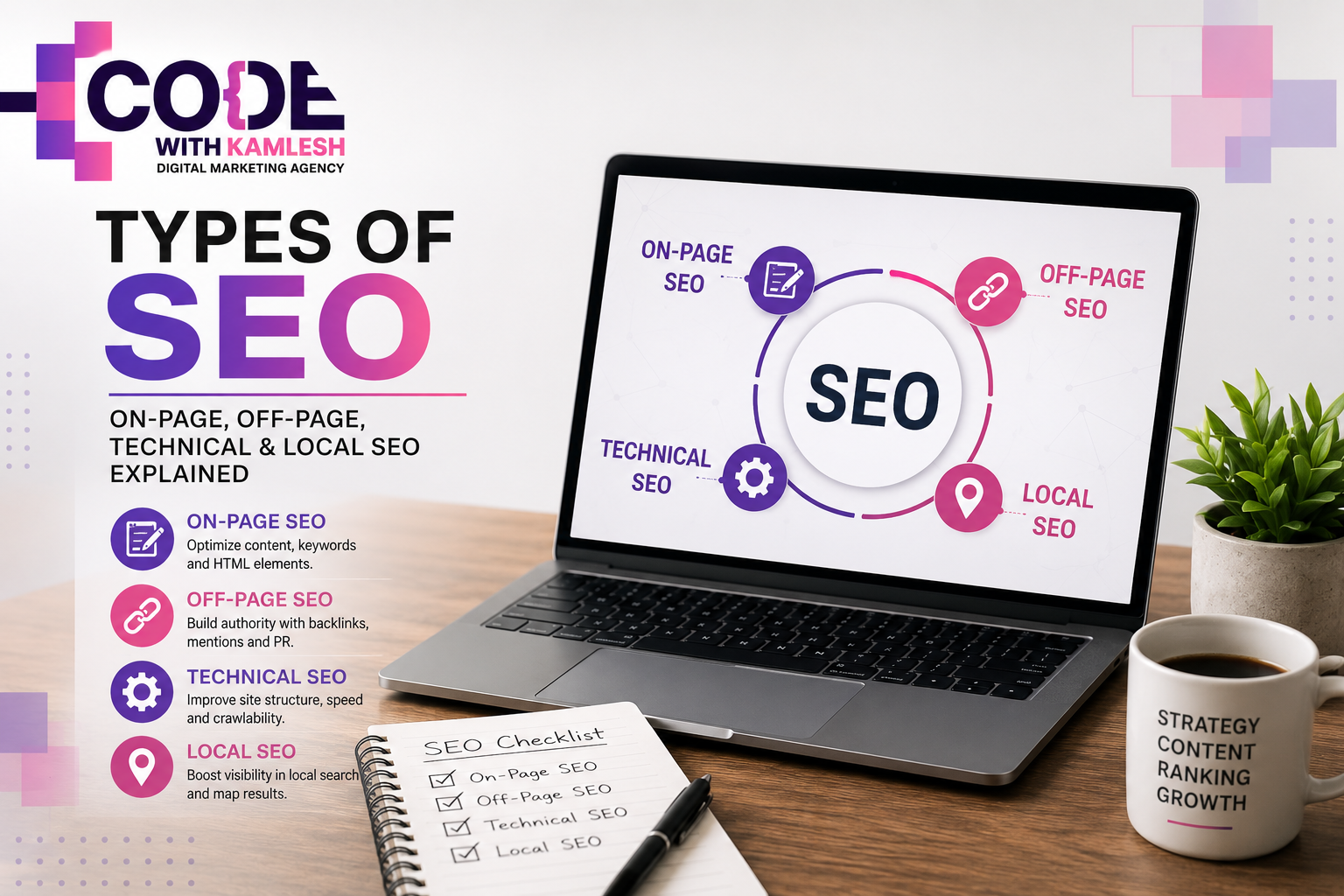
Types of SEO: On-Page, Off-Page, Technical & Local SEO Explained
When a website fails to generate organic traffic, the knee-jerk reaction is usually to write more blog posts or buy a batch of links. Yet, after weeks of effort, rankings often refuse to budge. The underlying issue is simple: search engine optimization is rarely a one-dimensional task. Ranking on modern search engines requires a balanced combination of site architecture, high-value content, external credibility, and geographic targeting.
SEO is divided into specific disciplines, each addressing a distinct aspect of how search engines evaluate websites. The four main types of SEO are:
- On-Page SEO: Optimizing the content, keywords, and HTML elements on your pages.
- Off-Page SEO: Building authority, digital PR, and backlinks from third-party websites.
- Technical SEO: Ensuring search engines can crawl, render, index, and load your pages efficiently.
- Local SEO: Maximizing visibility for location-specific queries and map searches.
Understanding how these disciplines function individually—and how they reinforce one another—is essential for building a sustainable search marketing strategy that drives qualified traffic and tangible business revenue.
What Is SEO?
Search Engine Optimization (SEO) is the practice of enhancing a website to increase its visibility in organic (non-paid) search engine results. When people search for products, services, or information, search engines evaluate billions of web pages to deliver the most relevant, reliable, and accessible answers.
Crawling (Bot Discovery) → Indexing (Storage & Parsing) → Ranking (Relevance & Authority) → Organic Traffic
The journey from an unranked page to organic visibility follows four stages:
- Crawling: Search engine bots (such as Googlebot) follow links across the web to discover new and updated pages.
- Indexing: The search engine analyzes the content, media, and code of the page, storing it in a massive database (the index).
- Ranking: When a user enters a query, algorithms score indexed pages based on relevance, quality, usability, and authority to determine the search results order.
- Organic Traffic: Users click on the displayed results, driving targeted visitors to the website without direct ad spend.
Businesses invest in search engine optimization because organic search reaches users at the exact moment of intent. Unlike interruption marketing, organic visibility
captures users actively looking for solutions, building long-term brand equity, qualified leads, and measurable growth.
What Are the Main Types of SEO?
While SEO encompasses dozens of daily tasks, professional practitioners organize these activities into four distinct categories.
SEO Type
Main Focus
Common Activities
Primary Goal
On-Page SEO
Content relevance & page structure
Keyword mapping, headings, copywriting, internal links
Match user search intent
Off-Page SEO
External reputation & authority
Backlink acquisition, digital PR, brand mentions
Build domain trust & authority
Technical SEO
Website architecture & performance
Page speed, crawlability, mobile design, structured data
Ensure accessibility & efficient indexing
Local SEO
Geographic & map visibility
Google Business Profile, local citations, reviews
Capture nearby customers
These categories are not competing strategies; they represent different layers of a single website ecosystem. A technically flawless website will not rank without relevant content, and great content will struggle without baseline authority and clean site architecture.
On-Page SEO
On-Page SEO involves optimizing the visible content and underlying HTML source code of individual web pages. Its primary goal is to help search engines understand the topic of your page while providing users with an informative, straightforward reading experience.
Important Elements of On-Page SEO
Keyword Research & Placement
Keyword research identifies the actual phrases people type into search engines. A mature keyword strategy uses three distinct tiers:
- Primary Keywords: The main high-volume topic of the page (e.g., types of SEO).
- Secondary Keywords: Supporting terms that provide contextual depth (e.g., on-page vs off-page SEO, technical website optimization).
- Long-Tail Keywords: Highly specific, lower-volume queries with clear intent (e.g., how to optimize technical SEO for ecommerce).
Rather than repeating keywords unnaturally—a outdated practice known as keyword stuffing—modern optimization focuses on semantic search. Search engines evaluate topic clusters and related terms to gauge topical depth.
Search Intent Optimization
Search intent represents the underlying goal behind a user's query. Google categorizes search intent into four primary buckets:
- Informational: The user wants to learn something (e.g., "what is technical SEO").
- Navigational: The user wants to find a specific website or brand (e.g., "Google Search Console login").
- Commercial Investigation: The user is comparing options before buying (e.g., "best SEO audit tools").
- Transactional: The user is ready to purchase or take action (e.g., "hire SEO consultant").
Aligning your content format with user intent is a critical ranking factor. If a search query produces step-by-step guides, publishing a product landing page for that keyword will rarely succeed.
SEO-Friendly Title Tags & Meta Descriptions
The title tag (<title>) is one of the strongest on-page relevance signals. It appears as the clickable headline in search engine result pages (SERPs).
- Place the primary keyword near the beginning.
- Keep the length between 50 and 60 characters to prevent truncation.
- Write unique titles for every page that accurately describe the content without using deceptive clickbait.
Meta descriptions do not directly influence rankings, but they serve as ad copy for your organic listing. A clear, compelling description of 140–160 characters improves click-through rates (CTR) by setting clear expectations for the searcher.
Heading Hierarchy (H1, H2, H3)
Proper heading structure creates a logical outline for both readers and web crawlers:
- H1: Reserved for the main page title. Every page must have exactly one H1 containing the primary topic.
- H2: Designates major subtopics across the page.
- H3–H4: Breaks down complex ideas within an H2 section.
Structured headings improve content readability, help users scan long articles, and assist search algorithms in understanding content hierarchy.
H1: Complete Guide to Web Analytics
  ├── H2: Setting Up Your Tracking Code
  │     ├── H3: Google Tag Manager Installation
  │     └── H3: Direct Code Implementation
  └── H2: Core Metrics to Monitor
        ├── H3: User Engagement Rate
        └── H3: Conversion Tracking
URL Structure
URLs should be clean, short, and descriptive. A human reader should be able to guess the page topic simply by looking at the address bar.
- Good URL: [https://example.com/services/technical-seo/](https://example.com/services/technical-seo/)
- Bad URL: [https://example.com/index.php?id_prod=8812&cat=99a](https://example.com/index.php?id_prod=8812&cat=99a)
Content Quality and Depth
Search engines reward original, accurate, and deeply helpful content. Under the framework of Google's search quality guidelines, content should demonstrate first-hand experience, subject-matter expertise, and authoritative sourcing. Thin, scraped, or AI-generated content that offers no unique insight struggles to sustain organic visibility over time.
Internal Linking
Internal links connect one page of your website to another. They serve three major functions:
- They establish site architecture and topical clusters.
- They distribute internal page authority (PageRank) throughout the domain.
- They keep users engaged by pointing them to relevant supporting guides.
For a deeper dive into website setup and optimization fundamentals, read our guide on what is SEO to understand how web properties build baseline search visibility.
Image Optimization
Images enhance user engagement but can harm performance if left unoptimized.
- File Format: Use modern web formats like WebP rather than heavy PNGs or uncompressed JPEGs.
- Image Compression: Reduce file sizes below 150 KB where practical.
- Alt Text: Write descriptive alternative text for screen readers and search bots (e.g., alt="Comparison chart of four types of SEO").
- Explicit Dimensions: Include width and height attributes in HTML to prevent layout shifts.
Featured Snippet Optimization
Featured snippets appear at the top of search results to provide quick answers. To optimize for snippets:
- Structure answers to definitional questions in 40–55 words directly below an H2 or H3 heading.
- Use clean bulleted lists for step-by-step processes.
- Use HTML tables for structured data comparisons.
On-Page SEO Example
Consider a digital agency optimizing a service page targeting the keyword "SEO Services in Indore":
- Page URL: [example.com/seo-services-indore/](https://example.com/seo-services-indore/)
- Title Tag: Professional SEO Services in Indore | Organic Growth Agency
- H1 Tag: Result-Driven SEO Services in Indore
- H2 Subheadings: Why Local Businesses in Indore Need SEO, Our Search Optimization Process, Client Case Studies & Results, Frequently Asked Questions.
- Content: 1,800 words detailing local market dynamics, case studies of regional businesses, transparent deliverable lists, and schema-supported customer reviews.
- Internal Links: Links pointing out to related sub-services (e.g., Technical Audits, Ecommerce SEO) and relevant case studies.
On-Page SEO Checklist
Primary keyword placed in the Title Tag, H1, first 100 words, and URL slug.
Unique, compelling Meta Description written within 150–160 characters.
Heading hierarchy cleanly structured with one H1 and sequential H2s/H3s.
Content thoroughly matches the primary search intent.
- Descriptive, contextual internal links pointing to and from relevant pages.
- All images compressed, formatted as WebP, and populated with descriptive alt text.
- No keyword stuffing; synonyms and semantic variations used naturally.
Off-Page SEO
Off-Page SEO encompasses all actions taken outside of your own website to influence your search engine rankings. While On-Page SEO tells search engines what your site is about, Off-Page SEO demonstrates how the rest of the web perceives your authority, reliability, and popularity.
Important Off-Page SEO Activities
Link Building
Backlinks remain one of the most influential ranking signals. A backlink is a vote of confidence from one website to another. However, modern algorithms evaluate links based on quality rather than sheer volume:
- Relevance: A backlink from an industry-specific publication carries significantly more value than a link from an unrelated food blog.
- Domain Authority: Links from established, trusted publications pass stronger authority.
- Editorial Placement: Links embedded naturally within body copy pass more value than footer, sidebar, or author-profile links.
- Anchor Text: Natural, varied anchor text protects your profile from algorithmic penalties.
A single link from an authoritative, relevant publication like a major trade journal can deliver more value than hundreds of automated directory listings.
Digital PR
Digital PR involves creating original research, proprietary data studies, interactive tools, or expert commentary that journalists, editors, and industry bloggers actively want to reference. When a publication cites your research, you earn high-tier, natural backlinks and strong brand visibility.
Brand Mentions & Online Reputation
Unlinked brand mentions—instances where your company is discussed on reputable platforms without an active hyperlink—help search engines build a contextual map of your brand's prominence and industry standing.
Strategic Guest Posting
Writing high-quality articles for established publications in your niche exposes your brand to an existing, relevant audience. Guest blogging should focus on sharing expertise and driving qualified referral traffic, rather than acquiring low-value links at scale.
Content Promotion & Distribution
High-value content rarely gains traction in isolation. Systematic promotion via newsletter distribution, industry community sharing, and targeted outreach ensures your content reaches the content creators and decision-makers most likely to link back to it.
Social Signals
Social media shares, likes, and comments are not direct search ranking factors. However, social distribution amplifies content reach, increases brand searches, and drives referral traffic, indirectly expanding the pool of people who may discover and link to your work.
White Hat vs. Spammy Link Building
Search engines penalize manipulative link acquisition tactics. The difference between sustainable authority building and risky manipulation is significant:
Strategy Aspect
White Hat Link Building (Sustainable)
Black Hat / Spam Links (High Risk)
Methodology
Creating link-worthy assets, digital PR, outreach
Buying links, Private Blog Networks (PBNs)
Link Sources
Industry publications, real editorial sites
Spam directories, hacked sites, forum spam
Anchor Text
Natural, descriptive, branded
Exact-match, keyword-stuffed
Sustainability
Compounds over time; safe from penalties
Temporary gains followed by algorithmic devaluation
User Value
Drives qualified referral traffic
Zero user value; strictly intended to trick algorithms
Off-Page SEO Example
A business-to-business (B2B) cloud software provider wants to build authority for its analytics platform. Instead of buying directory submissions, the company surveys 500 IT directors and publishes an annual report titled: The State of Enterprise Data Security.
- The company publishes the findings along with downloadable charts and data summaries.
- An outreach campaign pitches key data findings to technology journalists and industry blogs.
- Over three months, 35 tech publications cite the report, earning natural, high-authority backlinks.
- The software company’s domain authority increases, lifting organic rankings across all of its commercial product pages.
Technical SEO
Technical SEO focuses on optimizing the underlying website and server infrastructure to help search engine spiders crawl, interpret, render, and index your content without friction, while providing users with a fast, secure browsing experience.
Even the most comprehensive content will fail to rank if technical issues prevent search engines from discovering or rendering the page correctly. Technical foundations must be verified directly via Google Search Central documentation to ensure ongoing alignment with platform standards.
Site Architecture → Server Configuration → Bot Crawling → Rendering & Parsing → Indexing Status
Important Technical SEO Elements
Website Crawling & Indexing
Search engines discover web pages by crawling links. If your architecture traps spiders or wastes crawl budget on infinite redirect loops, critical content remains undiscovered.
Crawling means discovering the code and assets; indexing means evaluating, parsing, and storing that page in the search engine's database. A page must be indexed before it can rank for any search query.
XML Sitemaps
An XML sitemap acts as a roadmap of your website, listing all canonical URLs that search engines should index.
- Include only indexable 200 OK status URLs.
- Exclude redirects (301), broken pages (404), and blocked pages (noindex).
- Keep the sitemap updated automatically via your CMS and submit its location to search consoles.
Robots.txt
The robots.txt file instructs search engine crawlers which parts of your server they should or should not access. A single misplaced line of code (such as Disallow: /) can accidentally block entire sections of a website from search engine crawlers.
Plaintext
# Example of a clean robots.txt configuration
User-agent: *
Disallow: /wp-admin/
Disallow: /checkout/
Disallow: /cart/

Sitemap: https://example.com/sitemap_index.xml
Canonical Tags (rel="canonical")
E-commerce sites and dynamic blogs often generate multiple URLs featuring identical or near-identical content (e.g., filtered product pages, sorting parameters, tracking URLs). A canonical tag explicitly tells search engines which URL represents the master copy.
HTML
<link rel="canonical" href="https://example.com/types-of-seo/" />
Website Architecture & URL Hierarchy
A logical website structure helps users navigate intuitive pathways and allows link equity to flow down from the homepage to deep subpages.
Homepage (Tier 1)
  └── Category Page (Tier 2)
        └── Subcategory / Topic Hub (Tier 3)
              └── Individual Article or Product (Tier 4)
Keeping important pages within three clicks of the homepage ensures efficient crawl paths and intuitive navigation.
HTTPS & Security
Secure Sockets Layer (SSL/HTTPS) encrypts communication between the user's browser and the hosting server. Search engines treat HTTPS as a standard baseline security signal; non-secure sites display warnings that damage user trust and conversion rates.
Mobile-Friendly Responsive Design
Google indexes content primarily using a smartphone agent (mobile-first indexing). Your desktop and mobile versions must deliver identical content, structured data, and navigation. A responsive design that adapts smoothly across screen sizes is mandatory for modern search visibility.
Page Speed Optimization
Page speed directly influences user bounce rates and conversion efficiency. Key optimization steps include:
- Asset Minification: Removing white spaces and unused code from CSS and JavaScript files.
- Browser Caching: Setting caching headers so returning visitors load static assets locally.
- Content Delivery Networks (CDNs): Routing files through global edge servers to reduce latency.
- Server Response Time (TTFB): Using quality hosting environments to keep Time to First Byte under 200ms.
Core Web Vitals
Core Web Vitals are user-centric performance metrics evaluated by search engines:
- Largest Contentful Paint (LCP): Measures perceived loading speed. Marks the point when the main content block has loaded. Target: Under 2.5 seconds.
- Interaction to Next Paint (INP): Measures page responsiveness to user clicks and taps. Target: Under 200 milliseconds.
- Cumulative Layout Shift (CLS): Measures visual stability by tracking unexpected layout shifts during page load. Target: Score below 0.1.
Structured Data (Schema Markup)
Schema markup is standardized code (JSON-LD format) placed on pages to help search engines understand entities, relationships, and context. Common schemas include:
- Organization and LocalBusiness
- Article and BlogPosting
- Product and AggregateRating
- FAQPage and HowTo
- BreadcrumbList
JSON
{
  "@context": "https://schema.org",
  "@type": "Article",
  "headline": "Types of SEO: On-Page, Off-Page, Technical & Local SEO Explained",
  "author": {
    "@type": "Person",
    "name": "Kamlesh Singh"
  },
  "publisher": {
    "@type": "Organization",
    "name": "Code With Kamlesh"
  }
}
While schema markup does not guarantee rich results, it ensures search engines parse your content correctly.
Broken Links, Status Codes, and Redirects
- 301 Redirects: Permanent redirects that pass authority from an old URL to a new one.
- 404 Status: Not Found error indicating a missing page. These should be fixed if they have incoming backlinks.
- Redirect Chains: Multiple sequential redirects (e.g., A → B → C) that slow down page loads and waste crawl budget.
Regularly auditing your infrastructure with tools and reviewing performance via the official Google Search Console Help documentation will keep crawl errors to a minimum.
Technical SEO Example
An established retail website publishes high-value content, yet organic impressions continue to drop. A technical audit uncovers several structural problems:
- A development update left <meta name="robots" content="noindex"> tags on key subcategory pages.
- Product image sizes averaged 4 MB each, causing the Largest Contentful Paint (LCP) to spike to 6.2 seconds.
- Faceted product navigation generated 40,000 duplicate URL parameters without canonical tags, exhausting the site's crawl budget.
The Fix:
- The noindex tags were removed, restoring indexation.
- Images were converted to WebP format, reducing LCP to 1.8 seconds.
- Self-referencing canonical tags were implemented across dynamic sorting URLs.
Within eight weeks, the site’s indexed page count stabilized, and overall organic sessions increased by 42%.
Technical SEO Audit Checklist
- Domain enforces sitewide HTTPS without mixed-content warnings.
- Mobile-friendliness verified across various viewport sizes.
- XML sitemap contains only live, canonical 200 OK URLs and is submitted in Search Console.
- robots.txt allows indexing of all public, valuable assets and pages.
- Core Web Vitals meet recommended thresholds (LCP < 2.5s, INP < 200ms, CLS < 0.1).
- Valid JSON-LD Structured Data implemented and verified with rich result validators.
- Redirect chains eliminated and broken internal links (404s) corrected.
Local SEO
Local SEO is the practice of optimizing your online presence to attract business from location-specific searches. It is essential for brick-and-mortar storefronts, regional service providers, and multi-location franchises.
Queries like "emergency plumber near me", "accounting firm in Manchester", or "best pizza downtown" trigger local search features, notably the Google Map Pack.
Search Query ("plumber near me") → Local Search Engine Algorithm → Map Pack (Top 3 Local Profiles) + Localized Organic Results
Important Local SEO Factors
Google Business Profile (GBP) Optimization
Your Google Business Profile is the cornerstone of local visibility. A fully optimized profile should feature:
- Exact, legitimate business name (avoid keyword-stuffing penalties).
- Highly accurate primary and secondary business categories.
- A detailed description highlighting services and geographic coverage.
- Precise business address, verified pin marker, and local phone number.
- Updated operating hours, including special holiday hours.
- High-resolution interior, exterior, and team photos.
- Direct listings of products, services, and clear service areas.
NAP Consistency
NAP stands for Name, Address, and Phone Number. Search engines scan business directories, review sites, and social platforms to verify business details. If your business is listed with different addresses or phone formats across directories, algorithms struggle to trust your location data.
Local Keywords & Content
Local optimization requires targeting geo-modified keywords naturally across your website:
- [Service] + [City / Neighborhood] (e.g., HVAC repair in Austin)
- [Industry] near me
- Localized landing pages for distinct geographic territories
Avoid creating dozens of near-identical location pages with thin content. Every city page should highlight distinct projects, client testimonials, local staff, and physical service boundaries.
Reviews & Customer Feedback
Online customer reviews directly influence local pack rankings and consumer conversion:
- Quantity: Consistently generating new reviews over time.
- Sentiment: Maintaining a strong overall star rating (ideally 4.5+).
- Keywords: Natural mentions of services in customer review text.
- Owner Responses: Replying promptly and professionally to both positive and negative reviews.
Local Citations & Directories
Submitting your business details to respected regional and industry directories (such as Yelp, YellowPages, Better Business Bureau, and local Chambers of Commerce) confirms your physical location. Focus on high-authority directories rather than low-quality automated listing services.
Local Link Building
Local links validate your physical community involvement. Effective local link-building tactics include:
- Sponsoring local charity events, youth sports teams, or community initiatives.
- Joining regional trade associations and Chambers of Commerce.
- Partnering with complementary local non-competing businesses.
- Earning coverage in local news outlets for community projects.
LocalBusiness Schema
Add LocalBusiness structured data to your website to provide clear data points directly to search engines:
JSON
{
  "@context": "https://schema.org",
  "@type": "LocalBusiness",
  "name": "Apex Digital Marketing",
  "image": "https://example.com/logo.png",
  "telephone": "+1-555-019-2834",
  "address": {
    "@type": "PostalAddress",
    "streetAddress": "100 Main Street",
    "addressLocality": "Austin",
    "addressRegion": "TX",
    "postalCode": "78701",
    "addressCountry": "US"
  }
}
Local SEO Example
A local healthcare clinic in Birmingham targets the query "Pediatric Physiotherapist in Birmingham":
- Google Business Profile: Configured under the primary category Physiotherapist, with exact clinic hours, high-quality clinic photos, and a list of specific pediatric treatments.
- On-Site Optimization: The website includes a dedicated service page detailing pediatric treatments, insurance plans accepted, staff credentials, and embedded directions via Google Maps.
- Local Schema: MedicalBusiness structured data markup embedded on the contact page.
- Local Links & PR: Sponsoring a regional children’s athletic event earned a direct link from the event's official domain and a mention in the local newspaper.
- Review Strategy: Follow-up appointment emails invite parents to leave feedback, earning over 60 five-star reviews within four months.
This multi-pronged approach enables the clinic to secure a top-three placement in the local map pack and rank on the first page of organic results.
To see how specialized technical setups intersect with business optimization, explore our breakdown of technical SEO to refine your site architecture.
On-Page vs. Off-Page vs. Technical vs. Local SEO
SEO Type
Where Optimization Happens
Primary Objective
Common Activities
Best For
On-Page SEO
Directly on web page content and HTML source code
Align content relevance with specific user queries
Keyword research, copywriting, internal links, headings
All websites publishing content
Off-Page SEO
Third-party platforms and external websites
Build domain trust, authority, and industry reputation
Digital PR, backlink acquisition, guest articles
Competitive national & international niches
Technical SEO
Server, code architecture, and website performance
Facilitate crawling, indexing, and mobile usability
Core Web Vitals, XML sitemaps, canonical tags, schema
Every modern web property
Local SEO
Google Business Profile, directories, local pages
Capture high-intent geographic and nearby searches
GBP optimization, NAP consistency, local reviews
Storefronts & regional service businesses
How All Four Types of SEO Work Together
Search marketing functions best when these four disciplines operate as an integrated system.
       ┌────────────────────────┐
       │     Technical SEO      │ (Crawlable, fast foundation)
       └───────────┬────────────┘
                   ▼
       ┌────────────────────────┐
       │      On-Page SEO       │ (Relevant, high-value content)
       └───────────┬────────────┘
                   ▼
       ┌────────────────────────┐
       │      Off-Page SEO      │ (External authority & backlinks)
       └───────────┬────────────┘
                   ▼
       ┌────────────────────────┐
       │       Local SEO        │ (Geographic capture & map pack)
       └────────────────────────┘
Consider how a regional dental practice uses all four types of SEO in tandem:
- Technical SEO ensures the dental website loads in under two seconds, features an easy-to-use mobile booking form, and contains no broken URLs or redirect loops.
- On-Page SEO structures individual service pages (e.g., Teeth Whitening, Invisalign Treatments) with clear headings, optimized imagery, helpful FAQs, and internal links.
- Off-Page SEO builds domain authority as regional news outlets and dental associations link back to the practice’s guides and community programs.
- Local SEO maintains the practice's top-three ranking in Google Maps when nearby patients search for "dentist near me".
If any single component is neglected, overall growth slows. A fast, well-structured site with no content will not rank; an authoritative, content-rich site with critical crawl blocks will remain invisible.
Which Type of SEO Should You Focus on First?
Prioritizing your search strategy depends on your business model, current site health, and market competition.
New Website:
Technical SEO  ──►  On-Page SEO  ──►  Off-Page SEO

Local Business:
Local SEO (GBP) ──►  On-Page SEO  ──►  Local Citations & Reviews

Established Content Site:
Technical Audit ──►  Content Optimization  ──►  Digital PR & Authority
- For New Websites: Start with Technical SEO to verify your foundation, then build out core On-Page SEO content. Without indexed pages and keyword-targeted content, off-page outreach yields minimal return.
- For Local Service Businesses: Prioritize Local SEO (claim and complete your Google Business Profile, secure local reviews) along with fundamental local On-Page service pages.
- For Established Content Sites: Focus on On-Page SEO updates (refreshing decaying content and optimizing internal links) alongside Technical SEO audits to eliminate crawl bloat.
- For Competitive Industries: If your technical health and content quality match top competitors, prioritize Off-Page SEO and digital PR to build the authority required to win top rankings.
Common SEO Mistakes to Avoid
- Keyword Stuffing: Artificially forcing search queries into text harms readability and triggers search quality penalties.
- Publishing Thin Content: Re-packaging generic information without adding original data, practical insights, or real experience.
- Ignoring Search Intent: Creating commercial service pages for informational queries, or writing high-level blogs when users need actionable tools.
- Purchasing Low-Quality Links: Buying bulk link packages or relying on private link networks puts your domain at risk of algorithmic devaluation.
- Neglecting Mobile Usability: Evaluating page layouts solely on desktop monitors while ignoring mobile rendering and touch targets.
- Overlooking Core Web Vitals: Allowing uncompressed images and bloated JavaScript files to slow page speeds and frustrate visitors.
- Robots.txt Misconfigurations: Accidentally blocking CSS, JS files, or entire critical directories from search engine bots.
- Creating Thin Location Pages: Generating hundreds of boilerplate pages with only the city name swapped out.
- Focusing Solely on Rankings: Prioritizing vanity search rankings over organic conversions, leads, and actual revenue.
How to Build a Complete SEO Strategy
Step 1: Technical Audit ──► Step 2: Keyword Strategy ──► Step 3: On-Page Optimization
                                                                    │
Step 6: Measurement     ◄── Step 5: Authority Building ◄── Step 4: Content Hubs
Step 1: Conduct a Comprehensive Technical Audit
Identify and fix crawl errors, redirect chains, mobile usability issues, and slow Core Web Vitals scores before scaling content production.
Step 2: Perform Intent-Focused Keyword Research
Map primary, secondary, and long-tail keywords to every stage of your buyer's journey. Group related terms into structured topic hubs.
Step 3: Optimize On-Page Elements
Update page title tags, H1/H2 headings, image alt texts, meta descriptions, and internal linking structures to align directly with target search intent.
Step 4: Build Comprehensive Content Clusters
Write well-researched, deeply helpful content that answers user questions thoroughly. Use structured tables, clean lists, and direct answers to target rich snippets.
Step 5: Execute an Authority-Building Plan
Earn high-quality backlinks through digital PR, proprietary data surveys, expert roundtables, and helpful guest contributions on respected industry websites.
Step 6: Optimize Local Visibility (If Applicable)
Complete and verify your Google Business Profile, ensure sitewide NAP consistency, generate steady customer reviews, and build regional citations.
Step 7: Monitor Metrics and Refine
Track organic search visibility via real business metrics:
- Organic Impressions & Clicks: Monitor baseline search discovery in Google Search Console.
- Keyword Rankings: Track position velocity across primary search terms.
- Conversions and Assisted Conversions: Measure email signups, phone calls, form completions, and sales in Google Analytics.
- Technical Health Score: Regularly audit crawl errors, indexed URL counts, and core page loading speeds.
Recommended SEO Tools
- Google Search Console: Essential for tracking indexation status, submitting sitemaps, diagnosing technical crawl errors, and analyzing real search queries.
- Google Analytics (GA4): Tracks user behavior, traffic acquisition channels, engagement metrics, and organic conversion funnels.
- Google PageSpeed Insights: Analyzes real-user performance data and provides specific recommendations to improve Core Web Vitals.
- Google Keyword Planner: Free utility for identifying search volume, commercial intent, and keyword trends directly from Google Ads data.
- Screaming Frog SEO Spider: Desktop site crawler used to audit redirects, broken links, missing metadata, canonical tags, and internal link distribution.
- Ahrefs / Semrush: Comprehensive toolkits for backlink profile analysis, competitor research, keyword gap identification, and rank tracking.
Frequently Asked Questions
What are the main types of SEO?
The four main types are On-Page SEO (content and internal page elements), Off-Page SEO (external backlinks and authority), Technical SEO (infrastructure, indexing, and speed), and Local SEO (location targeting and map pack visibility).
What is the difference between On-Page and Off-Page SEO?
On-Page SEO involves optimizing elements within your direct control on your own website, such as copywriting, HTML headings, and images. Off-Page SEO focuses on external authority signals, including backlinks, brand mentions, and third-party reviews.
Is Technical SEO difficult for non-developers?
Basic technical optimization—such as creating sitemaps, checking robots.txt files, compressing images, and auditing broken links—can be managed using modern CMS plugins. Complex issues like server latency, JavaScript rendering, and advanced schema integration may require developer assistance.
How long does SEO take to produce measurable results?
Most websites see measurable improvements within three to six months of consistent optimization. Competitive industries with high-authority competitors often require nine to twelve months of sustained technical, content, and link-building efforts.
Can a website rank without building backlinks?
A website can rank for low-competition, long-tail search queries with strong On-Page and Technical SEO alone. However, competitive and commercial queries almost always require high-quality backlinks to establish search authority.
What is NAP consistency in Local SEO?
NAP stands for Name, Address, and Phone Number. Ensuring your NAP details are identical across your website, Google Business Profile, social pages, and directory listings helps search algorithms verify your physical location.
Does social media activity directly improve organic search rankings?
No. Social media metrics (such as likes, followers, and retweets) are not direct ranking signals. However, social distribution amplifies your content reach, increasing brand visibility and the likelihood of earning editorial backlinks.
What is the fastest way to improve Core Web Vitals?
The most effective speed optimizations include converting images to WebP format, serving static assets through a Content Delivery Network (CDN), implementing browser caching, and deferring non-critical JavaScript.
How often should a website undergo an SEO audit?
Perform a comprehensive technical and content audit every six months. In addition, run mini-audits after major website redesigns, CMS updates, or noticeable drops in organic search traffic.
Should a new website focus on content creation or link building first?
A new website should prioritize Technical SEO and On-Page content creation. Earning backlinks is significantly easier and more effective when your domain already features comprehensive, high-value resources worth referencing.
Summary of Modern Search Optimization
Search engine optimization is not an assortment of disconnected tricks; it is a holistic strategy. Earning consistent, long-term organic traffic requires:
- A Technical Foundation: Ensuring your website is fast, secure, mobile-friendly, and accessible to search engine crawlers.
- On-Page Precision: Publishing high-value, intent-driven content optimized with clear headings, structured data, and internal links.
- Off-Page Authority: Earning genuine editorial links, industry citations, and brand recognition through digital PR and original research.
- Local Prominence: Managing your geographic footprint, local listings, and customer feedback to win nearby searches.
When these four pillars work in harmony, your website will build durable search visibility that delivers qualified traffic, customer trust, and sustainable business revenue.
© 2026 Code With Kamlesh. All rights reserved.
Kamlesh Singad
Founder, Code With Kamlesh. Helped 200+ businesses scale through SEO, Google Ads & Social Media. 8+ years of digital marketing experience.
Comments (0)
No comments yet. Be the first to comment!