What Is Organic Search & How Does Organic Traffic Work?
Organic search is the foundation of long-term, high-intent website growth. This comprehensive guide breaks down how search engines discover, crawl, and rank pages, how users navigate the organic search funnel, and practical SEO strategies to turn unpaid search impressions into qualified business leads.
Picture a homeowner waking up on a cold November morning to find their basement floor covered in three inches of standing water. They pull out their phone, open a browser, and type "emergency basement drain repair near me" into Google.
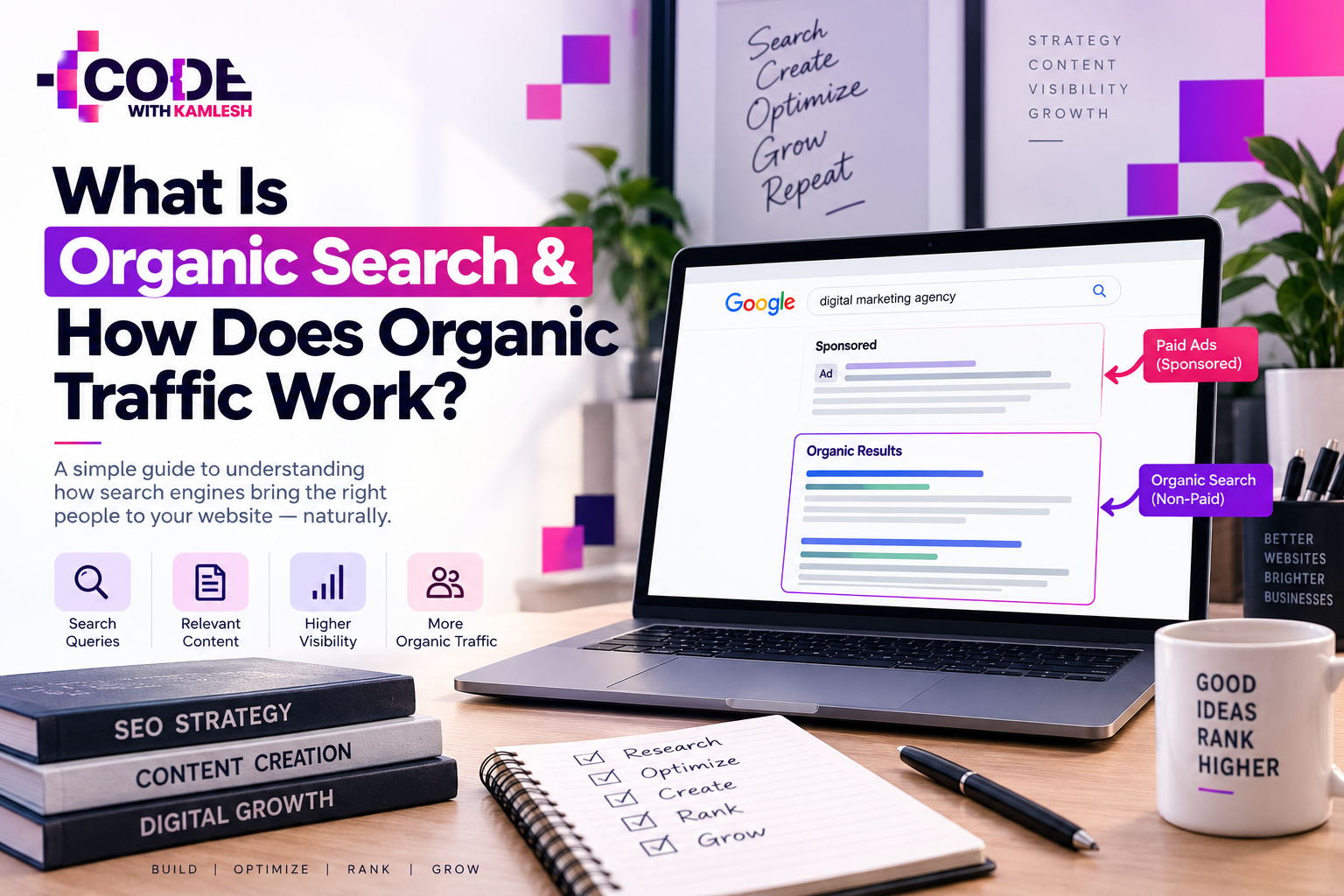
Within seconds, the search engine serves up a page filled with options. At the very top, a couple of listings carry a small, bolded tag indicating they are sponsored ads. Right beneath them, however, sits an interactive local map pack followed by standard website listings: established local plumbing companies, guides on how to shut off a main water valve, and detailed service pages.
The homeowner ignores the sponsored links, clicks on the first standard listing—a local company with an informative page on emergency water extraction—and calls the phone number displayed on their screen. That plumbing company did not pay Google a single penny for that specific click. They earned it because the search engine decided their page was the most relevant, reliable solution to the user's urgent problem.
That single interaction represents organic search in action, and the resulting visit is organic traffic. It is the backbone of how people navigate the modern web, find answers, evaluate products, and choose service providers.
What Is Organic Search?
Organic search refers to the non-paid listings that appear on a search engine results page (SERP) after a user enters a query. These results are evaluated, ranked, and displayed by mathematical algorithms based on relevance to the user's intent, content quality, technical accessibility, and website authority, rather than paid placement.
When you look at search engine results pages, the links fall into two broad buckets: paid advertisements and organic listings. Paid search operates on an auction model where businesses bid to show their ads when specific words are queried. The moment an advertiser exhausts their budget or turns off their campaign, their presence on that page vanishes entirely.
Organic search listings work on an earned model. A search engine scans billions of public web pages, attempts to understand what each page is about, evaluates how thoroughly and reliably it answers questions, and organizes those pages into an index. When someone conducts a search, the engine selects the best pages from that index and ranks them in order of usefulness.
This is why these listings are called "organic." They grow naturally out of the search engine's assessment of content merit and alignment with user needs. To appear prominently within organic search results, website owners practice search engine optimization (SEO). Through deliberate technical adjustments, content creation, and authority-building efforts, site owners align their pages with what search engines look for when deciding which resources deserve top billing.
What Is Organic Traffic?
Organic traffic represents the visitors who land on your website by clicking an unpaid link found within search engine results. When an individual turns to Google, Bing, DuckDuckGo, or Yahoo, types a phrase into the search box, and selects your web page from the standard search listings, an analytics platform records that visit as an organic session.
To truly understand organic traffic, it helps to distinguish it from the other channels an analytics tool tracks:
- Organic Traffic: A user searches for a term on a search engine, sees your page among the free results, and clicks through to your domain.
- Direct Traffic: A user types your exact website address directly into their browser's address bar, uses a saved bookmark, or clicks an untracked link in an offline document or messaging app.
- Referral Traffic: A user clicks a hyperlink leading to your site from another website, such as an editorial mention on a news outlet or a recommendation in a third-party blog post.
- Social Traffic: A visitor arrives at your website by clicking a link shared on a social networking platform such as LinkedIn, Reddit, or X.
- Paid Search Traffic: A user clicks a search result that was explicitly paid for by an advertiser through platforms like Google Ads, typically marked with an "Ad" or "Sponsored" label.
A healthy web property generally maintains a diversified mix of these sources. However, organic search traffic remains uniquely valuable because it captures people at the exact moment they are seeking an answer, researching an issue, or looking to purchase a solution.
Organic Search vs Organic Traffic
While marketers frequently use "organic search" and "organic traffic" interchangeably in casual conversation, they describe two distinct sides of the same coin.
Organic search is the ecosystem, the medium, and the process. It encompasses the search engine software, the algorithms calculating page relevance, the search queries typed by human beings, and the presentation of unpaid links on the results page.
Organic traffic, on the other hand, is the physical metric generated by that ecosystem. It is the countable volume of human beings, sessions, pageviews, and clicks that travel from those search listings directly onto your server. Without organic search mechanics, organic traffic cannot exist; without users clicking through to websites, organic search would simply be a static directory.
Aspect
Organic Search
Organic Traffic
Core Definition
The unpaid system and search engine listings displayed on a SERP.
The visitors who arrive at a website via those unpaid listings.
Location
Takes place on the search engine platform (e.g., Google or Bing).
Takes place on the destination website.
Primary Metric
Impressions, SERP positions, click-through rates (CTR).
Sessions, unique users, pageviews, bounce rate, conversions.
Management Focus
Keyword research, technical SEO, content optimization, backlinks.
User experience, conversion rate optimization, content engagement.
How Does Organic Search Work?
To understand how organic search functions, you have to peel back the layers of technology that search engines use to organize the internet. Google does not search the live web in real time when you hit enter. Instead, it searches its own meticulously maintained index of the web. This process involves a sequential series of steps.
For an overarching look at how search engines categorize their crawl and ranking operations, you can read Google's official guide on how search works.
[ Crawling ] ──> [ Indexing ] ──> [ Query Processing ] ──> [ Algorithm Evaluation ] ──> [ SERP Display ] ──> [ Organic Click ]
Step 1 – Search Engines Discover and Crawl Pages
Before a search engine can rank a page, it must discover that the page exists. Search engines employ automated programs—commonly called spiders, web crawlers, or bots (such as Googlebot)—to navigate the public internet around the clock.
Crawlers begin with a vast list of known web addresses derived from previous crawls and sitemaps provided by website owners. As a crawler inspects a page, it renders the HTML, CSS, and underlying code, reading the text and identifying hyperlinks pointing to other pages across the web. Following these links is the primary mechanism search engines use to discover newly created content.
To ensure your pages are discovered, you must maintain clean crawlability. A well-organized XML sitemap submitted to search engines gives bots a direct roadmap of your critical pages. Similarly, an unrestrictive robots.txt file ensures you do not inadvertently block web crawlers from reading your most valuable digital assets.
Step 2 – Search Engines Index Content
Crawling is simply the act of visiting a URL; indexing is the act of understanding, cataloging, and storing that page in a massive distributed database known as the search index.
During indexing, the search engine parses the textual content, analyzes media elements, inspects page structure, and attempts to determine what the page is actually about. It stores words, images, and contextual elements so they can be retrieved in milliseconds when a relevant search query is executed.
Just because a page has been published does not guarantee it will be indexed. If a search engine encounters duplicate content, low-value information, technical rendering errors, or directives such as a noindex tag, it may deliberately choose to exclude that page from its index. If a page is not indexed, it cannot appear in organic search results.
Step 3 – A User Enters a Search Query
The organic search sequence springs to life on the user's end the moment they type or speak a query into a search engine. This query might be a brief phrase ("best running shoes"), a question ("how to change a flat tire"), or a highly specific commercial inquiry ("enterprise customer support software with SOC2 compliance").
Modern search engines do not just look for literal keyword matches. Through natural language processing algorithms, they deconstruct the phrase to identify the underlying search intent. They evaluate what the user actually wants to accomplish: Are they seeking information? Trying to locate a specific website? Looking to buy something immediately?
Step 4 – Search Engines Evaluate Relevant Pages
Once the engine interprets the query's intent, it searches its index for matching pages. Because thousands—or even millions—of indexed pages might contain the answer, algorithms evaluate an extensive array of quality and relevance signals to determine the final presentation order.
These algorithms weigh hundreds of factors simultaneously:
- Content Relevance: Does the page comprehensively answer the specific query?
- Topical Authority: Does the website have an established history of publishing credible, accurate content within this broader topic area?
- Backlinks: Have other respected, authoritative websites linked back to this page as a trustworthy source?
- Page Experience: Does the site load quickly, render cleanly on mobile devices, and avoid intrusive popups that disrupt reading?
No single factor dictates success. Search algorithms adjust weighting based on the context of the query. For example, a query regarding breaking news prioritizes fresh publication dates, while a query about medical treatment options prioritizes deep, authoritative expertise.
Step 5 – Search Results Are Displayed
The calculated listings are assembled and presented to the user on the SERP. Modern organic search results rarely consist of a simple, uniform list of ten plain blue links.
Today, organic listings share screen space with diverse search features:
- Featured Snippets: Direct answers pulled from a top-ranking page placed in a dedicated box at the absolute top of the page.
- Local Map Packs: A map displaying three local business profiles relevant to queries with local intent.
- People Also Ask (PAA) Boxes: Expandable accordions highlighting related questions and short snippet answers.
- Video and Image Carousels: Visual search assets pulled from indexed pages and platforms.
- Standard Web Results: Traditional organic listings containing a title tag, a URL path, and a short descriptive snippet.
Step 6 – The User Clicks an Organic Result
The process concludes when the user reads through the titles, descriptions, and features displayed on the SERP, decides which listing best meets their criteria, and clicks the hyperlink.
That decisive action bridges the gap between the search engine's platform and the publisher's property, officially registering a single event of organic search traffic.
How Does Organic Traffic Work?
From a visitor's perspective, navigating via organic search feels virtually seamless. From a website owner's perspective, however, organic traffic represents a multi-stage funnel where every individual phase must function properly to generate meaningful results.
Search Query ──> SERP Impression ──> Organic Listing Click ──> Landing Page Load ──> Session Engagement ──> Business Conversion
- The Search Query: A user experiences an information gap, problem, or desire. They open their browser and submit a targeted query to a search engine.
- The Impression: The search engine processes the request, locates your indexed page, and renders your listing on the SERP. The moment your link appears on a screen viewed by the user, your site logs a search impression.
- The Organic Click: Your title tag and meta description present a compelling, highly relevant summary of what the user is looking for. The user chooses your link over competitor options, ads, and alternative search features, clicking through to your site.
- The Landing Page Experience: The user’s browser requests your webpage. Your web hosting server responds, scripts run, stylesheets apply, and the content renders. If this step takes too long or displays broken layouts, the user may hit the "back" button before the visit even registers properly in your analytics.
- The Website Session: Once the page loads, the user begins their session. They scroll, read, click to secondary pages, watch embedded videos, or review your product specifications. Your web analytics platform tracks these behavioral interactions as engaged organic sessions.
- The Conversion: If the content answers their initial question and offers a clear next step, the visitor takes action: subscribing to an email newsletter, booking a software demo, filling out a contact form, or making a direct e-commerce purchase.
A Real-World Example of Organic Search Traffic
To see how these concepts function in practice, consider a realistic business example.
Imagine a mid-sized accounting firm in Austin, Texas, that specializes in helping growing software startups navigate early-stage tax liabilities and research and development (R&D) tax credits.
Rather than relying solely on paid advertisements, the firm develops an exhaustive, practical guide titled: "How Early-Stage SaaS Companies Can Claim R&D Tax Credits."
Here is how organic search traffic unfolds for that firm:
- The Query: The founder of a recently funded software startup searches: "qualifying for software R&D tax credit guidelines."
- The Engine's Evaluation: Google processes the query, identifying strong commercial investigation intent. The search engine scans its index, bypassing basic glossaries, and identifies the Austin firm's guide. The algorithm notices that the article thoroughly explains software developer wage tracking, cites official tax statutes, features structured headings, and is hosted on a domain with several editorial links from respected financial blogs.
- The Organic Click: The searcher reviews the SERP. They bypass an advertisement at the top because it looks like a generic tax preparation service. They see the Austin firm's listing in the second organic position. The title tag is clear, and the snippet directly mentions software developer qualification rules. The founder clicks the link.
- The Experience: The founder spends four minutes reading the guide. The page contains a clear qualification flow-chart and breaks down complex legal concepts into clear operational steps.
- The Business Outcome: At the bottom of the article, a callout offers a free 20-minute assessment to review eligibility. The founder clicks the link, picks a time on the calendar, and submits their company information.
That interaction did not cost the accounting firm a per-click fee, yet it produced a high-value, pre-qualified business lead purely through organic search performance.
Organic Search vs Paid Search
Organizations seeking visibility on search engines almost universally weigh organic search against paid search (often referred to as Pay-Per-Click or PPC). While both strategies target users via the same interface, their operational dynamics, economics, and long-term implications are fundamentally different.
Organic Search: Upfront Investment ──> Compounding Long-Term Traffic (No Cost Per Click)
Paid Search:    Ongoing Spend      ──> Immediate Direct Traffic (Stops When Spend Ceases)
Factor
Organic Search (SEO)
Paid Search (PPC / Google Ads)
Cost Model
No cost per click. Requires investment in content, site architecture, and technical maintenance.
Direct cost per click (CPC). You pay a fee every time a user clicks your advertisement.
Placement on SERP
Displayed in standard web results, local map packs, and featured snippets.
Displayed at the very top or bottom of the SERP, labeled as "Sponsored" or "Ad."
Speed to Results
Requires patience. Often takes months of deliberate optimization to build authority and gain traction.
Immediate. Ads can appear on the first page of search results within minutes of campaign launch.
Long-Term Sustainability
High compounding value. High-ranking pages can continue generating traffic long after publication.
Temporary. Traffic stops entirely the moment the advertising budget is depleted or paused.
User Trust & Perception
Often perceived as more credible and objective by users who deliberately skip ads.
Highly visible, but some users avoid sponsored links due to perceived commercial bias.
Scalability
Scaled by publishing comprehensive content, improving authority, and earning links over time.
Scaled by increasing ad spend, bidding on more keywords, or targeting broader regions.
Message Control
Search engines can rewrite title tags, modify snippets, or choose alternative landing pages.
Total control over ad copy, headlines, extensions, and precise destination URLs.
It is a common misconception that organic traffic is completely "free." While you do not pay a direct fee to search engines when someone clicks an organic link, earning that spot requires real capital.
Organizations invest heavily in expert writers, technical web developers, SEO tools, analytics platforms, and digital public relations campaigns. The critical economic difference is that organic investments create durable assets that compound over time, whereas paid search functions like a utility: turn off the power, and the lights go out immediately.
Why Is Organic Search Important for Businesses?
A predictable, diversified marketing mix is critical to business survival. For most digital properties, organic search serves as the most dependable, scalable engine for customer acquisition.
               [ Consistent Inbound Visibility ]
                              │
               [ Captures Active Search Intent ]
                              │
[ Long-Term Value ] ──> Organic Search <── [ Higher Brand Credibility ]
                              │
               [ Lower Long-Term Blended CAC ]
Consistent Website Visibility
Paid campaigns operate under rigid daily budget limits. Once a budget cap is hit for the day, those ads disappear until the next billing cycle. High-ranking organic assets remain visible 24 hours a day, seven days a week, continuously capturing search demand regardless of internal budget fluctuations.
Captures Active Search Intent
Most digital marketing interruptions—such as display banner ads or social media promotions—reach users while they are doing something else: reading a news story, catching up with friends, or watching videos.
Organic search captures users in an active state of inquiry. They have identified an issue and are actively hunting for an answer. Visitors arriving via search intent are typically far more receptive to educational content and commercial offers.
Stronger Brand Discovery and Credibility
A significant segment of internet users instinctively distrust advertisements, actively filtering them out using mental ad-blindness or browser ad-blocking extensions. When a website consistently appears in the top organic positions for dozens of industry-related searches, users begin to view that business as an established authority in its field.
Compounding Value Over Time
When you launch a paid marketing campaign, your cost-per-acquisition remains relatively static or rises as ad platforms become more competitive. With organic search, the work you put into a comprehensive piece of content today can attract hundreds of visitors a month from now, thousands of visitors next year, and continue driving qualified leads three years into the future with only minor updates. This compounding return significantly lowers a company's blended customer acquisition costs.
What Determines Organic Search Rankings?
Search engines rely on intricate, continuously tuned systems to rank indexed pages. Rather than a rigid checklist of hidden formulas, modern rankings are governed by broad categories of quality, accessibility, and relevance.
Search Intent and Relevance
Relevance is the primary criteria for any ranking system. The search engine asks: Does this page satisfy the user's intent?
If someone searches for a broad definition, serving them an e-commerce checkout page creates a poor experience. Conversely, if a user searches for an immediate product purchase, an exhaustive 4,000-word historical essay is equally unhelpful. High-ranking pages match both the topical subject matter and the format of information the user needs.
Helpful and Original Content
Search engines prioritize pages that demonstrate clear first-hand experience, depth, and original insight. Content that merely summarizes what ten other websites have already said without adding new analysis, examples, original data, or unique perspectives rarely holds top rankings over the long term. Pages need to demonstrate clear utility and answer subsequent questions before the user has to leave to find them elsewhere.
On-Page SEO
On-page optimization helps search engines parse the structure and context of your content. This involves:
- Crafting descriptive, accurate title tags that contain primary keywords.
- Writing succinct meta descriptions that encourage searchers to click.
- Structuring content with logical heading tags (H1, H2, H3) to establish clear information hierarchy.
- Applying descriptive image alt text to improve accessibility and image indexation.
Technical SEO
A website must be mechanically sound for search engine bots to crawl and render it efficiently. Technical search engine optimization ensures:
- Search engines can parse code without getting stuck in infinite redirect loops.
- The site uses secure protocols (HTTPS).
- Canonical tags are implemented correctly to eliminate duplicate content issues.
- A clean XML sitemap is accessible to search spiders.
If your technical infrastructure prevents crawlers from reading your content, your on-page copy will not rank, regardless of its quality. To explore how technical architecture integrates with your overall digital marketing initiatives, read our breakdown of the different [Types of SEO]([INSERT INTERNAL URL – TYPES OF SEO]).
Website Architecture and Internal Linking
Websites are not just collections of disconnected pages; they are structured networks. A logical architecture groups related topics together cleanly.
Strategic internal linking—placing contextual text links from one page on your site to another related page—helps search crawlers discover new pages and distributes authority across your domain. It also signals to search engines which pages on your site serve as the primary pillar resources for specific topics.
Backlinks and Website Authority
Search engines treat links from independent third-party websites as digital votes of confidence. When reputable, topically relevant websites link to your content, they signal to search algorithms that your material is reliable and worth referencing.
Earning authoritative backlinks remains one of the strongest organic search visibility signals. However, link quality and relevance far outweigh raw quantity. A single editorial link from an established industry publication carries far more weight than hundreds of links generated on automated, low-quality web directories.
User Experience and Mobile Usability
The majority of global search queries happen on smartphones and mobile devices. Consequently, search engines use mobile-first indexing, meaning they evaluate the mobile version of your page's content, layout, and performance to determine rankings.
Pages that feature text that is too small to read, contain unclickable overlapping buttons, or shift visually while loading deliver a frustrating experience and struggle to retain top rankings.
Page Performance
Page speed is a validated ranking factor. Users expect web pages to load instantly. Search engines recognize that slow, bloated websites lead to higher bounce rates and unhappy users.
Optimizing images, streamlining CSS, minimizing third-party tracking scripts, and using fast hosting infrastructure all contribute directly to better page performance.
Content Freshness Where Relevant
For queries where information changes rapidly—such as technological developments, tax laws, breaking news, or annual software reviews—search algorithms look for freshness signals.
Regularly updating older content with updated facts, current statistics, and modern examples keeps that content relevant in search rankings.
What Are the Main Types of Organic Search Keywords?
Keywords are the bridge connecting what real people search for to the content you create. Understanding the intent behind these terms helps you craft pages that directly address user needs. To master finding and selecting these terms for your editorial calendar, review our guide on [Keyword Research for SEO]([INSERT INTERNAL URL – KEYWORD RESEARCH]).
Search queries are generally divided into several primary categories:
[ Informational ] ──> "how to set up email forwarding"
[ Commercial ]    ──> "best crm software for real estate"
[ Transactional ] ──> "buy standing desk converter online"
[ Navigational ]  ──> "slack login"
Informational Keywords
The user is looking to learn something, solve a problem, or find an answer.
- Examples: "how to fix a leaky faucet," "what is cloud computing," "keto diet guidelines."
- Best Content Format: Detailed guides, blog posts, comprehensive tutorials, glossaries, and how-to videos.
Navigational Keywords
The user already knows which brand, company, or web page they want to access and is using the search engine as an address bar.
- Examples: "Gmail login," "Asana project boards," "Bank of America customer service."
- Best Content Format: Dedicated brand pages, clean site structures, and transparent homepages.
Commercial Investigation Keywords
The user knows they want a product or service, but they are evaluating options, comparing features, reading reviews, and checking pricing.
- Examples: "Shopify vs WooCommerce," "best lightweight hiking boots," "top enterprise accounting tools."
- Best Content Format: Comparison tables, buyer's guides, unbiased review roundups, and detailed product breakdown pages.
Transactional Keywords
The user has reached the end of their buying journey and is ready to make a purchase, download software, or hire a provider.
- Examples: "hire licensed electrician Denver," "buy mechanical keyboard online," "discount project management software subscription."
- Best Content Format: High-converting product pages, clear e-commerce landing pages, transparent service quote forms.
Branded vs. Non-Branded Keywords
- Branded Keywords: Searches that explicitly contain your business or product name (e.g., "HubSpot pricing"). These users already possess brand awareness.
- Non-Branded Keywords: Searches for industry products, concepts, or services without mentioning any specific company (e.g., "inbound marketing automation tool"). Capturing non-branded search traffic is the foundation of expanding your audience via organic search.
Long-Tail Keywords
Long-tail keywords are longer, more specific search phrases that generally carry lower individual search volumes but exhibit significantly higher search intent and conversion rates.
- Short-Tail: "Coffee maker" (High volume, vague intent, fierce competition).
- Long-Tail: "Best programmable drip coffee maker under 100 dollars with thermal carafe" (Low volume, precise intent, straightforward path to ranking and conversion).
How to Increase Organic Traffic
Improving your organic traffic is an ongoing process that blends research, content development, technical refinement, and strategic promotion.
1. Research & Analysis  ──> Audience Insights, Keyword Research, Search Intent
2. Infrastructure      ──> Logical Site Architecture, Technical Health, Page Speed
3. Content Execution   ──> High-Quality Creation, Metadata, Semantic Richness
4. Distribution & Care ──> Authority Link Building, Topic Clusters, Content Updates
1. Understand Your Target Audience
Never produce content solely for search engines. Start by uncovering the actual questions, pain points, and challenges your ideal customers discuss daily. Review support tickets, interview sales representatives, and browse industry forums to see how real people phrase their problems.
2. Perform Thorough Keyword Research
Uncover the search terms people use to find answers in your niche. Use specialized tools to analyze monthly search volume, keyword difficulty, and related queries. Balance your efforts between competitive, high-volume terms and reachable, long-tail phrases that can produce immediate visits.
3. Analyze Search Intent
Before writing a single sentence, manually run your target keyword through Google. Examine the top five organic listings:
- Are they how-to tutorials?
- Are they short product pages?
- Are they directory-style lists?
- Your page must deliver the format and depth the search engine is already rewarding for that specific query.
4. Build a Logical Website Structure
Organize your website into clear, themed categories. Keep your URL structure short and descriptive (e.g., [example.com/services/plumbing-repair/](https://example.com/services/plumbing-repair/)). A clean hierarchy makes it easy for visitors to navigate and helps search engine crawlers understand the contextual relationship between your pages.
5. Create High-Quality, In-Depth Content
Write content that addresses the user's primary question and anticipates their logical follow-up questions. Use straightforward language, break up text with descriptive subheadings, incorporate practical examples, and share real-world insights that cannot be found on every other ranking page.
6. Optimize Titles and Meta Descriptions
Your title tag is one of the strongest on-page ranking signals and acts as the headline on the SERP. Place your primary target keyword naturally near the front of the title, and keep the total length under 60 characters to prevent truncation. Craft an engaging meta description that clearly outlines the value of the page and encourages searchers to click.
7. Improve On-Page SEO
Organize your content body using a single H1 tag for the page title, followed by H2 and H3 tags for subtopics. Use descriptive file names and alt attributes for all images. Naturally weave primary and secondary keywords into your body copy, introductions, and section conclusions without forcing them into sentences awkwardly.
8. Strengthen Internal Linking
Every time you publish a new piece of content, identify two to four existing, related pages on your website and add contextual internal links pointing toward your new page. Use descriptive, natural anchor text rather than generic phrasing like "click here" or "learn more."
9. Fix Technical SEO Problems
Regularly audit your website for technical errors. Fix broken 404 links, correct faulty redirect chains, verify that your robots.txt file is not inadvertently blocking important resources, and ensure your canonical tags point to preferred page URLs.
10. Improve Website Speed and Mobile Usability
Compress heavy image files using modern formats like WebP. Enable browser caching, minimize unnecessary JavaScript execution, and select a dependable web hosting provider. Test your pages regularly to verify they render fast and cleanly on mobile screens.
11. Earn Relevant Backlinks
Build relationships with other publishers, editors, and industry professionals. Produce original research, publish comprehensive data studies, offer expert commentary for journalism platforms, or engage in digital public relations. A few links earned from credible, topically relevant sites provide substantial authority.
12. Build Topic Clusters
Instead of writing isolated articles, organize your content into topic clusters. Create a central, comprehensive "pillar page" that provides a broad overview of a major topic. Then, build several satellite articles covering specific subtopics in detail, linking each satellite post back to the main pillar page and vice versa.
13. Update Existing Content Regularly
Information decays over time. Set a calendar schedule to revisit your high-value pages every 6 to 12 months. Refresh outdated statistics, fix broken links, expand thin sections, and update references to maintain your search rankings.
How Long Does Organic SEO Take to Generate Traffic?
One of the most frequent questions business owners ask is: "When will we see organic traffic results?"
The realistic answer is: it typically takes anywhere from three to nine months to begin seeing meaningful organic search traction, and often a year or more to achieve substantial, compounding scale.
There is no universal timeline because search engines evaluate every website within its specific competitive context. Several variables dictate how quickly your efforts will bear fruit:
- Website Age and History: A brand-new domain with zero established trust operates in a sandbox phase where search engines crawl slowly and cautiously. An established website with years of clean history and existing authority will rank new content far more rapidly.
- Competitive Landscape: If you are trying to rank for queries dominated by well-funded, legacy media publications, securing a top position takes significantly longer than competing for localized, low-competition, long-tail phrases.
- Resource Investment: A business that produces one mediocre blog post per month will take considerably longer to see meaningful movement than a company methodically launching two well-researched, technically optimized, well-linked resources per week.
- Technical Health: A domain burdened with severe crawl errors, index bloat, or slow loading times will experience stalled growth until those structural bottlenecks are resolved.
SEO is a long-term capital investment. Paid ads resemble renting an apartment—you get immediate shelter, but you build no equity. SEO resembles purchasing and renovating a home—it demands upfront work, patience, and capital, but it leaves you holding an asset that delivers lasting value.
How to Measure Organic Search Traffic
You cannot manage what you do not measure. Evaluating your organic search performance requires monitoring the right metrics through the right platforms.
       [ Measurement Tools ]
      ┌──────────┴──────────┐
      ▼                     ▼
Google Search Console  Google Analytics
(Pre-Click Metrics)    (Post-Click Metrics)
 • Impressions          • Organic Sessions
 • Organic Clicks       • Engaged Sessions
 • Average CTR          • Conversion Rate
 • Average Position     • Revenue / Leads
Essential Tools
- Google Search Console: The single most important primary tool for measuring pre-click organic search performance. It reveals precisely which queries are displaying your pages, your average ranking positions, impressions, and technical indexation issues. For a direct look at how to interpret this data, reference the Google Search Console guide on performance reporting.
- Web Analytics Platforms (e.g., Google Analytics 4): Measures what happens after a visitor clicks your organic link and lands on your site.
Key Metrics to Track
- Organic Impressions: The number of times a user saw a link to your site on an organic search results page.
- Organic Clicks: The raw count of times users selected your organic listing from a search results page.
- Organic Click-Through Rate (CTR): The percentage of impressions that resulted in an organic click (Clicks ÷ Impressions = CTR). A low CTR on a page ranking in the top three positions indicates your title tag or meta description needs optimization.
- Average Position: The mathematical mean ranking position of your pages across all the search queries for which you appeared.
- Organic Sessions: The number of browsing visits initiated by visitors coming from organic search.
- Engaged Sessions: Visits where a user spent more than 10 seconds on your site, viewed two or more pages, or completed a conversion event.
- Branded vs. Non-Branded Organic Traffic: Tracking these separately is essential. An increase in branded traffic often reflects general brand awareness efforts (such as podcasts, billboards, or PR), whereas growth in non-branded traffic proves that your organic search strategy is bringing in new prospects.
Traffic alone is a vanity metric. If a website drives 50,000 monthly visits to an article about "office humor ideas," but the company sells specialized industrial manufacturing hardware, that organic traffic contributes little to business health. Track business outcomes alongside raw visitor numbers.
Organic Traffic vs Organic Conversions
The primary objective of generating organic traffic is rarely traffic itself; it is business growth. A common trap for digital marketers is celebrating massive organic traffic spikes that yield zero qualified leads, phone calls, or sales.
[ High-Volume, Misaligned Query ] ──> 10,000 Clicks ──> High Bounce Rate ──> 0 Conversions
[ Focused, Intent-Matched Query ] ──>    500 Clicks ──> Deep Engagement  ──> 25 Conversions
Consider two different pieces of content on an enterprise payroll software site:
- Page A: "50 Funny Work Memes for Friday." It ranks in position 1 and receives 20,000 organic visits a month. The visitors are students, employees killing time, and casual browsers. They look at the memes, chuckle, and close the tab. The conversion rate is 0.01%.
- Page B: "Multi-State Payroll Compliance Checklist for Remote Teams." It ranks in position 3 and receives only 400 visits a month. The visitors are human resource directors, chief financial officers, and operations executives dealing with remote worker tax filing. The conversion rate is 6.5%.
Page B generates vastly superior financial returns despite attracting only a fraction of the raw traffic. When planning and tracking an SEO strategy, always prioritize search intent alignment over sheer search volume.
Common Organic Search Mistakes
Many organizations spend months struggling with stagnant search visibility because of avoidable strategic and technical missteps:
- Keyword Stuffing: Forcing the same target keyword into every headline, paragraph, and image alt tag makes content unreadable and signals manipulative practices to modern search algorithms. Write naturally for human beings first.
- Publishing Thin Content: Releasing 300-word articles that merely restate superficial definitions without providing practical answers, context, or examples. Search engines consistently pass over pages that offer little substantive value.
- Targeting Keywords Without Understanding Intent: Attempting to rank an e-commerce catalog page for an informational search query, or publishing an academic essay for a transactional phrase. When the page does not match user intent, visitors leave immediately.
- Ignoring Technical SEO Foundations: Producing valuable content while your website remains plagued by slow load times, broken links, non-functional mobile displays, or accidental noindex directives.
- Poor Internal Linking: Leaving valuable articles as isolated digital islands with no internal links passing authority to or from the rest of your domain.
- Relying on Low-Quality Link Schemes: Purchasing automated, low-grade links from private blog networks (PBNs) or spammy web directories. Search algorithms easily detect unnatural link schemes, which can lead to algorithmic devaluation or manual penalties.
- Ignoring the Mobile Experience: Designing exclusively on a desktop monitor and failing to verify that buttons, text formatting, images, and menus function cleanly for mobile users.
- Keyword Cannibalization: Creating multiple separate pages targeting the exact same keyword and intent. Rather than dominating the search page, your own URLs end up competing against one another, diluting authority and confusing search engines.
- Expecting Immediate Results: Abandoning an SEO campaign after two months because traffic has not grown exponentially. Search marketing requires sustained execution, patience, and realistic expectations.
Can Organic Search Traffic Disappear?
Yes. Unlike owned media assets such as an internal email list, your visibility on organic search results pages is hosted on rented land. Search engines frequently adjust their algorithms, competitors publish new content, and technical systems can break.
Common reasons organic search traffic declines include:
- Algorithm Adjustments: Search engines regularly roll out core updates designed to improve result quality. These changes recalibrate how systems assess authority, intent, and relevance across entire industries.
- Competitor Actions: Competitors do not sit idle. If an industry competitor updates an existing guide, earns high-tier press mentions, and improves their page speed, they can legitimately outrank your older content.
- Technical Issues and Site Migrations: Redesigning a site, modifying URL permalink structures without implementing proper 301 redirects, or misconfiguring robots.txt directives can cause organic traffic to drop overnight.
- SERP Layout Shifts: Google may introduce a new search feature—such as an expanded AI Overview, a local pack, or additional paid ad units—above your organic ranking. Even if your organic position remains unchanged at rank 2, your page gets pushed down the screen, which lowers your click-through rate.
- Natural Changes in Search Demand: Some drops have nothing to do with technical health or quality. Searches for "outdoor patio dining ideas" naturally fall during cold winter months, just as interest in tax filing guides drops substantially once the annual deadline passes.
                  [ Organic Traffic Drops ]
                              │
       ┌──────────────────────┼──────────────────────┐
       ▼                      ▼                      ▼
[ Technical Issue? ]   [ SERP Layout Shift? ]   [ Algorithmic Update? ]
 • Check robots.txt     • New ad blocks?         • Broad core change?
 • Check noindex tags   • New map packs?         • Competitor improvements?
 • Verify 301 redirects • Lower CTR on rank 1?   • Search intent shift?
When diagnosing a traffic drop, keep a clear head. Check Google Search Console first. Determine whether the decline is happening across your entire site or isolated to a handful of pages.
Verify that your critical pages are still indexed, confirm your server is operating smoothly, and evaluate whether user search demand has simply experienced seasonal variation.
The Role of Organic Search in a Complete Digital Marketing Strategy
Organic search is most effective when integrated into a unified, cross-channel digital marketing strategy rather than operating as an isolated tactic.
- Organic Search and Paid Ads (PPC): Organic and paid search complement each other effectively. PPC delivers immediate keyword testing data and instant SERP visibility, while organic efforts build long-term, low-cost customer acquisition over time. When your brand occupies both the paid ad spot and the top organic spot for a query, you claim significant SERP real estate.
- Organic Search and Content Marketing: Content marketing generates the educational assets, guides, and research that fuel your organic reach. Without thoughtful content creation, you have nothing for search engines to index; without SEO, your content will struggle to find an audience.
- Organic Search and Social Media: While social media signals do not directly influence search rankings, social platforms amplify content reach. When people discover and share your work on social channels, it increases brand awareness, leading to more branded searches and organic backlinks from journalists, podcasters, and industry bloggers.
- Organic Search and Email Marketing: Organic search serves as a top-of-funnel acquisition channel that attracts new visitors to your digital footprint. High-value lead magnets convert those searchers into email newsletter subscribers, enabling you to build direct, owned communication channels that do not rely on search engine algorithms.
Future of Organic Search
Organic search continues to evolve. What began as a static directory of matching keywords has transformed into a sophisticated semantic system capable of parsing voice, images, natural language, and user behavior.
Search engines are increasingly shifting toward generative, interactive experiences. Search result pages now feature synthesized overviews, conversational interfaces, and interactive modules designed to answer simpler queries directly on the SERP.
This shift means zero-click searches will remain common for brief, purely factual inquiries (such as "what time is it in Tokyo" or "how many ounces in a pound").
To thrive as search interfaces change, businesses and content creators must shift their focus away from short, generic definitions and toward content that requires real-world experience:
- Providing distinct, first-hand perspectives and proprietary data that machines cannot synthesize.
- Building recognizable brand authority so users intentionally seek out your point of view.
- Structuring content with clean markup and semantic data so search engines can easily parse your information.
- Developing deep topical clusters that address complex customer journeys rather than targeting individual keywords in isolation.
The medium and the visual interface of the results page will continue to evolve, but the core mechanics of organic search remain constant: human beings will always have questions, and search engines will always need to direct them toward trustworthy, well-structured answers.
Frequently Asked Questions About Organic Search
What is organic search in simple terms?
Organic search refers to the natural, unpaid listings that appear on a search engine results page after a user enters a query. Websites earn these placements through relevance and authority rather than paying for direct ad placement.
What is an example of organic traffic?
An example of organic traffic is when an individual types "how to winterize a lawn" into Google, sees a blog post from a local gardening center on the search results page, clicks that link, and browses the article on the garden center’s website.
Is organic traffic free?
Organic traffic is free of direct click fees—you do not pay the search engine when someone clicks your organic link. However, earning that traffic requires investments of time, labor, and capital to manage content development, technical optimization, and digital marketing.
What is the difference between SEO and organic search?
Organic search is the medium and the ecosystem—the search engine, the unpaid listings, and the user queries. Search engine optimization (SEO) is the practical work of optimizing a website to help it rank higher within those organic search listings.
How does Google determine organic search results?
Google uses automated algorithms to crawl billions of pages, index them, and evaluate them based on intent match, content depth, technical usability, site architecture, and website authority earned through backlinks.
How can I increase organic traffic to my website?
To grow organic traffic, publish well-researched content that answers specific user searches, resolve technical site performance issues, build logical internal links, optimize your title tags, and earn natural backlinks from reputable sites in your industry.
How long does SEO take to increase organic traffic?
Most websites begin to see the initial impact of deliberate SEO efforts within three to six months. Meaningful, compounding growth typically takes between six and twelve months, depending on site age, competition, and publishing consistency.
Is organic traffic better than paid traffic?
Neither channel is inherently superior; they serve different purposes. Paid traffic delivers immediate results, scalable visibility, and total control over messaging. Organic traffic takes longer to establish, but it generates compounding, cost-effective returns that persist over time.
How do I check organic traffic?
You can track organic traffic by setting up web analytics tools like Google Analytics, which tracks organic sessions and conversions, and Google Search Console, which monitors impressions, organic clicks, and ranking positions directly from Google.
Why did my organic traffic suddenly drop?
Sudden organic traffic declines are usually caused by technical errors (such as broken redirects or accidental noindex tags), major search engine algorithm updates, competitors releasing improved content, SERP layout changes, or seasonal shifts in consumer search interest.
Final Thoughts
Organic search is the underlying infrastructure that connects human intent with digital information. It powers how billions of people find solutions, evaluate products, and discover new businesses every day.
Organic traffic cannot be bought on demand, manipulated with superficial tricks, or built overnight. It must be earned. The websites that consistently succeed in organic search operate with a simple, disciplined mindset: they align their technical architecture with search engine standards, and they build their content to serve the real-world needs of their audience.
By focusing on genuine search intent, creating original and informative content, maintaining a fast and technically sound website, and earning authority within your industry, you build an inbound marketing channel that will drive qualified, engaged visitors to your business for years to come.
© 2026 Code With Kamlesh. All Rights Reserved.
Kamlesh Singad
Founder, Code With Kamlesh. Helped 200+ businesses scale through SEO, Google Ads & Social Media. 8+ years of digital marketing experience.
Comments (0)
No comments yet. Be the first to comment!