AI Tools for Digital Marketing: Everything You Need to Know in 2026
Discover how AI tools are transforming digital marketing in 2026. This guide covers AI-powered content creation, SEO, social media, paid ads, email marketing, automation, lead management, analytics, and practical strategies to grow your business efficiently.
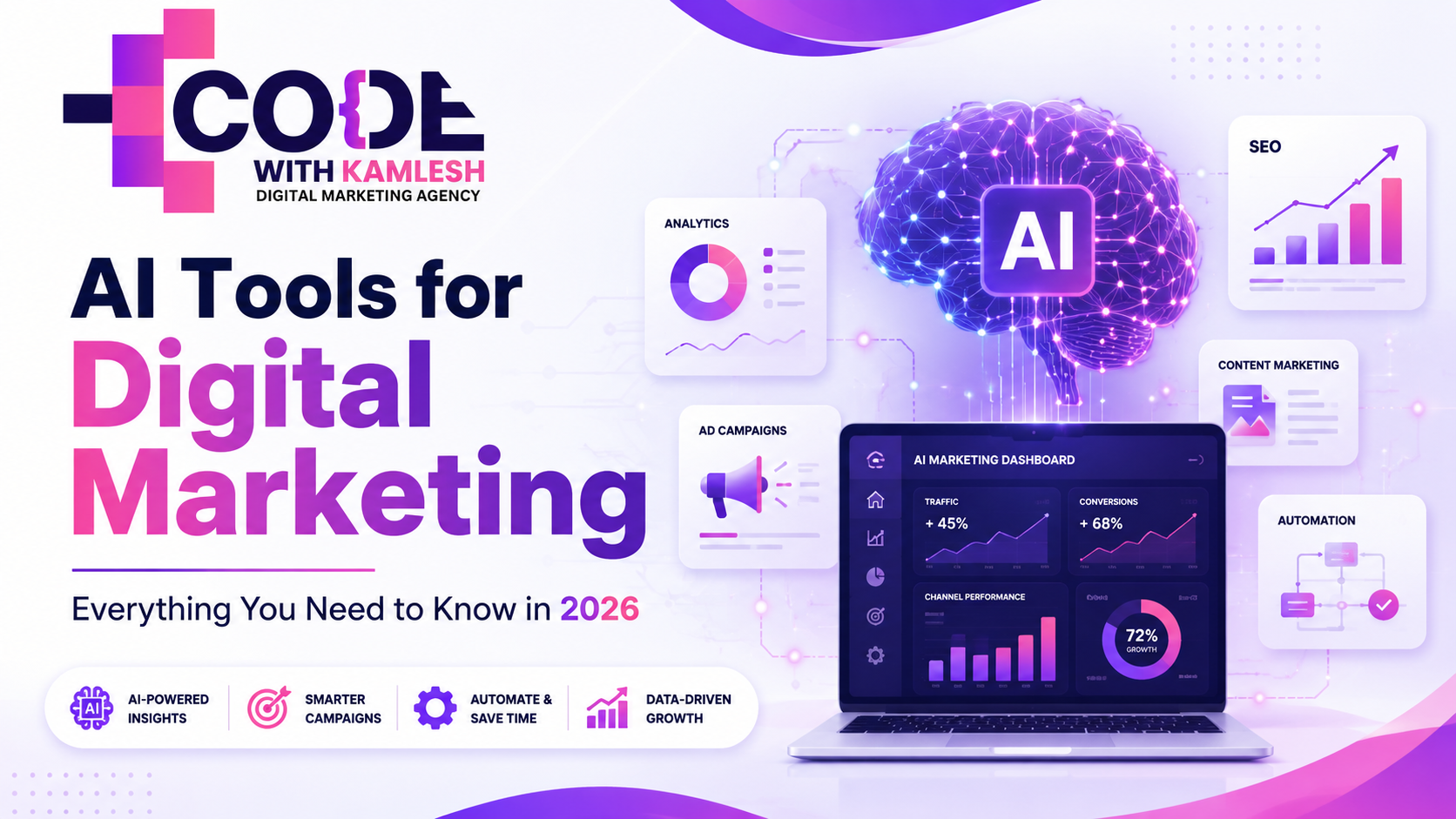
Digital marketing has always evolved quickly, but the changes happening in 2026 feel different. Artificial intelligence is no longer an optional productivity tool used only for writing captions or generating blog ideas. It has become an important part of campaign planning, content production, paid advertising, SEO, customer relationship management, email marketing, analytics, and marketing automation.
A few years ago, marketers were asking, “Should we use AI?”
Today, the more relevant question is, “Where should we use AI, and where should human judgment remain in control?”
That distinction matters. Businesses that use AI only to produce more content will eventually create more noise. Businesses that use AI to understand customers, improve decisions, test ideas, personalize communication, and remove repetitive work can build a genuine competitive advantage.
AI tools can now help a marketing team move from research to execution significantly faster. They can analyse customer information, identify patterns, develop campaign ideas, generate creative variations, assist with audience targeting, repurpose content, optimize advertisements, qualify leads, and support customers.
However, AI is not a replacement for marketing fundamentals. It cannot fix a weak offer, unclear positioning, poor customer service, or a product that people do not want. It can accelerate a strong strategy, but it can also accelerate a bad one.
This guide explains what AI tools for digital marketing are, how they are being used in 2026, which categories matter most, how to create an effective AI marketing workflow, and what mistakes businesses should avoid.
What Are AI Tools for Digital Marketing?
AI tools for digital marketing are software platforms that use technologies such as machine learning, natural language processing, predictive analytics, generative AI, computer vision, and automation to support marketing activities.
In simple terms, these tools can process large amounts of information, recognize patterns, generate content, recommend actions, and sometimes complete multi-step tasks with limited manual involvement.
For example, an AI marketing tool may help you:
- Research a target audience.
- Create a customer persona.
- Generate a campaign concept.
- Write ad copy.
- Design social media creatives.
- Analyse keyword opportunities.
- Personalize an email campaign.
- Optimize advertising bids.
- Qualify website leads.
- Summarize campaign performance.
- Convert a long video into multiple social posts.
The most important development in 2026 is that AI is moving beyond isolated content generation. Modern systems are increasingly connected with CRM platforms, advertising accounts, analytics dashboards, documents, customer conversations, and internal business data.
OpenAI describes current marketing use cases for ChatGPT as campaign planning, content creation, research, media generation, and performance analysis. Its workplace research also indicates that writing, research, and media generation are among the most common tasks performed by go-to-market teams.
Why AI Marketing Is Different in 2026
The first generation of generative AI tools mostly responded to prompts. A marketer entered an instruction, received an output, edited it, and copied it into another platform.
The 2026 AI marketing environment is becoming more integrated and agentic.
An AI assistant may now be able to examine CRM data, identify a customer segment, develop messaging, create campaign assets, recommend a distribution plan, and analyse the resulting performance. Some systems can complete parts of this workflow automatically, while others prepare the work for human review.
This shift is important because the biggest challenge in marketing is rarely a lack of ideas. The real challenge is connecting research, strategy, creative production, distribution, measurement, and follow-up.
Platforms such as HubSpot are positioning AI agents as specialized digital teammates for prospecting, customer support, data research, content production, and other repetitive workflows. Mailchimp also describes AI agents as tools that can support personalization, productivity, and smarter campaign execution.
The goal is not to remove marketers from the process. The goal is to reduce the time marketers spend moving information between tools and completing predictable tasks.
Major Benefits of AI Tools in Digital Marketing
Faster Research and Planning
Good marketing begins with understanding the market. AI can help marketers summarize customer reviews, examine competitor messaging, categorize common objections, identify recurring questions, and turn scattered information into useful insights.
Instead of manually reading hundreds of comments, support tickets, sales notes, and survey responses, a marketer can use AI to organize that information into themes.
This does not mean the AI’s conclusions should be accepted without verification. It means the first stage of analysis can be completed more efficiently, giving the marketer more time to interpret the findings.
Scalable Content Production
AI can generate drafts for blogs, landing pages, social media posts, advertisements, email campaigns, scripts, product descriptions, and sales material.
The real advantage is not simply producing more words. It is creating multiple variations for different audiences, platforms, funnel stages, locations, and campaign objectives.
A single webinar, for example, can be transformed into:
- A detailed blog article.
- A YouTube description.
- Multiple short-video scripts.
- An email newsletter.
- LinkedIn posts.
- Frequently asked questions.
- Sales enablement material.
- Website content.
- Remarketing advertisements.
HubSpot’s Breeze platform is designed to help marketers transform one piece of content into formats such as emails, social posts, and blogs while using CRM information and brand context.
Better Personalization
Traditional personalization often involved adding a customer’s first name to an email. AI-driven personalization can go much further.
Marketing systems can use behavioural data, customer history, purchase patterns, engagement signals, and CRM information to recommend content or offers that are more relevant to individual audience segments.
Mailchimp’s AI features, for example, include content assistance, predictive attributes, segmentation support, marketing flows, and send-time recommendations based on engagement patterns.
Effective personalization should make communication more useful, not intrusive. Businesses must still be transparent about data collection and avoid using sensitive information irresponsibly.
Faster Experimentation
Marketing performance improves through testing. AI allows businesses to create more meaningful variations without requiring the creative team to start every asset from zero.
A marketer can test:
- Different headlines.
- Different value propositions.
- Different calls to action.
- Different visual formats.
- Short-form versus long-form copy.
- Product-led versus problem-led messaging.
- Emotional versus logical positioning.
- Audience-specific landing page content.
The marketer must still define the hypothesis and interpret the result. AI simply reduces the production cost of each experiment.
Improved Operational Efficiency
Many marketing departments lose time on administrative activities such as formatting reports, cleaning CRM records, preparing campaign summaries, resizing designs, categorizing leads, and updating content calendars.
AI can automate or accelerate these activities, allowing team members to focus on positioning, creative direction, customer experience, partnerships, and business strategy.
Best Categories of AI Tools for Digital Marketing in 2026
There is no single “best AI marketing tool” for every business. The right choice depends on your team, business model, customer journey, existing technology, and marketing objectives.
The following categories are the most useful areas to evaluate.
1. AI Tools for Marketing Strategy and Research
Research tools help marketers understand audiences, markets, competitors, customer needs, and campaign opportunities.
General-purpose AI assistants such as ChatGPT can be used to analyse documents, organize research, refine communication, develop campaign structures, compare positioning options, and generate customer interview questions. OpenAI’s content creation guidance also highlights document analysis, tone refinement, structured writing, and visual concept development as relevant business applications.
The quality of the result depends heavily on the information provided. Asking an AI tool to “create a marketing strategy” without supplying customer data, business goals, previous results, constraints, and competitive context will usually produce generic advice.
A stronger research prompt would include:
- The product or service.
- Target customer.
- Geographic market.
- Pricing.
- Main competitors.
- Customer objections.
- Existing marketing channels.
- Previous campaign results.
- Available budget.
- Desired outcome.
AI should support strategic thinking, not replace direct customer research. Interviews, sales conversations, analytics data, reviews, and real campaign performance remain more valuable than assumptions generated by a model.
2. AI Tools for Content Writing
AI writing tools are widely used for blogs, emails, advertisements, video scripts, landing pages, social content, and website copy.
They are particularly useful for:
- Creating an initial outline.
- Organizing complex information.
- Producing headline variations.
- Adapting content for another platform.
- Simplifying technical language.
- Improving grammar and readability.
- Converting notes into a structured draft.
- Generating alternative calls to action.
- Matching a defined brand voice.
The common mistake is publishing the first AI-generated draft without adding real expertise.
Unedited AI content often sounds polished but empty. It may repeat familiar points, use predictable phrases, make unsupported claims, or explain a topic without offering original experience.
Google’s guidance states that generative AI can be useful for research and structuring original content. However, generating large numbers of pages without providing meaningful value may violate its scaled-content abuse policies. Google continues to prioritize helpful, reliable, people-first content.
A strong AI-assisted article should include:
- First-hand experience.
- Real examples.
- Original opinions.
- Specific processes.
- Accurate data.
- Expert interpretation.
- Screenshots or demonstrations.
- Relevant case studies.
- Clear editorial review.
Use AI to accelerate writing, not to remove expertise from the article.
3. AI Tools for SEO and AI Search Visibility
SEO in 2026 includes both traditional search visibility and visibility within AI-driven discovery experiences.
People are increasingly finding information through AI Overviews, AI Mode, conversational assistants, and other answer-based interfaces. This has led to growing interest in terms such as Answer Engine Optimization, or AEO, and Generative Engine Optimization, or GEO.
However, marketers should avoid treating AI search as an entirely separate discipline built around tricks.
Google’s official guidance says that established SEO best practices remain relevant because its generative search experiences use core ranking and quality systems.
Google recommends technically accessible websites, unique and useful content, relevant images and videos, and people-first information. It also says that businesses do not need special AI markup, forced content “chunking,” or an llms.txt file to appear in Google’s generative search experiences.
AI SEO tools can help with:
- Keyword clustering.
- Search-intent classification.
- Content-gap analysis.
- Competitor research.
- Internal linking recommendations.
- Content briefs.
- Title and meta-description variations.
- Technical issue prioritization.
- Content refresh planning.
- Brand visibility monitoring in AI-generated answers.
Semrush’s AI Visibility Toolkit is designed to show how brands and competitors appear within AI-generated responses. Its Content Toolkit combines search data and AI-supported workflows to help marketers create and repurpose content for search, social platforms, and AI discovery systems.
AI can identify opportunities, but marketers should validate every recommendation. A keyword with high search volume may not be commercially relevant. A competitor’s ranking page may receive traffic without generating qualified leads. Strategy requires understanding the business outcome behind the metric.
4. AI Tools for Graphic Design and Creative Production
AI design tools allow marketers to generate concepts, remove backgrounds, resize assets, create visual variations, translate designs, and adapt campaigns for different platforms.
Canva’s Magic Studio combines multiple AI-assisted design capabilities within its platform. Canva has also introduced features for applying tools such as Magic Write, translation, background removal, and resizing across larger batches of campaign assets.
Adobe Firefly is integrated with Adobe’s broader creative ecosystem and is intended to support content generation and production workflows. Adobe has also introduced an AI assistant designed to coordinate multi-step creative work across tools such as Firefly, Photoshop, Premiere, Express, Lightroom, and Illustrator.
AI design tools are useful for:
- Campaign mood boards.
- Thumbnail concepts.
- Social media graphics.
- Product backgrounds.
- Ad variations.
- Presentation visuals.
- Storyboard development.
- Image resizing.
- Localized creative.
- Early-stage brand concepts.
AI-generated designs still need creative direction. A technically attractive image may not match the brand, communicate the offer, or attract the right customer.
Marketers should define visual guidelines covering typography, composition, image style, colour usage, logo placement, product accuracy, and acceptable AI-generated elements.
5. AI Tools for Video Marketing
Video production traditionally requires scripting, recording, editing, captioning, resizing, and repurposing. AI can assist at almost every stage.
Marketers can use AI to:
- Generate video concepts.
- Create script drafts.
- Produce storyboards.
- Remove filler words.
- Generate subtitles.
- Translate voice and captions.
- Identify highlight clips.
- Turn long videos into short clips.
- Create supporting visuals.
- Produce simple animated explainers.
- Resize footage for different platforms.
Canva, for example, has integrated text-based video generation capabilities using Google’s Veo technology, including the ability to create short video clips with synchronized audio.
The most effective video content still depends on a strong hook, clear storytelling, audience understanding, and believable presentation. AI can improve production speed, but it cannot automatically make a boring idea interesting.
For educational and founder-led brands, authentic videos often outperform overly polished AI-generated content because viewers want experience, personality, and trust.
6. AI Tools for Paid Advertising
Advertising platforms have used machine learning for bidding and delivery for years. In 2026, AI is becoming even more influential in targeting, campaign setup, creative selection, and performance optimization.
Google Performance Max provides access to multiple Google advertising channels—including Search, YouTube, Display, Discover, Gmail, and Maps—through a goal-based campaign format. Google’s AI Max for Search can use real-time signals to help refine targeting and creative delivery with less manual work.
Meta Advantage+ uses AI and automation to optimize advertising campaigns across Facebook and Instagram. Advantage+ Creative can generate or enhance different image, video, and carousel variations and personalize delivery according to what individual users may respond to.
AI advertising tools can assist with:
- Audience expansion.
- Bid optimization.
- Budget allocation.
- Placement selection.
- Creative combinations.
- Copy variations.
- Product recommendations.
- Conversion prediction.
- Campaign diagnostics.
- Performance summaries.
However, advertisers should not confuse automation with guaranteed profitability.
The platform can optimize toward the conversion data it receives. If tracking is inaccurate, lead quality is poor, or the campaign is optimizing toward the wrong event, AI may efficiently generate the wrong outcome.
A successful AI-supported advertising campaign still requires:
- Accurate conversion tracking.
- A competitive offer.
- Strong landing pages.
- Reliable first-party data.
- Meaningful creative variety.
- Clear profitability targets.
- Lead-quality feedback.
- Regular human analysis.
Do not judge a campaign only by click-through rate or cost per lead. A low-cost lead that never becomes a customer is not an efficient result.
7. AI Tools for Email Marketing
Email marketing benefits from AI because it generates a large amount of behavioural data. Marketers can analyse opens, clicks, purchases, website activity, customer segments, and campaign history.
AI email tools can support:
- Subject-line generation.
- Email copywriting.
- Audience segmentation.
- Send-time optimization.
- Product recommendations.
- Customer journey creation.
- Re-engagement campaigns.
- Lead nurturing.
- Predictive attributes.
- Campaign performance analysis.
Mailchimp combines AI-supported writing, segmentation, predictive functionality, send-time recommendations, and automated marketing flows. Its send-time features use historical engagement patterns to recommend when subscribers may be more likely to engage.
The objective should not be to send more emails. It should be to send more relevant emails.
AI cannot compensate for a poor email list, misleading subject lines, weak offers, or excessive frequency. Businesses should monitor unsubscribe rates, spam complaints, conversion quality, and long-term subscriber engagement.
8. AI Tools for CRM and Lead Management
CRM platforms contain valuable information about customers, sales activity, deal stages, communication history, and revenue.
When AI is connected with CRM data, it can help businesses:
- Fill missing customer information.
- Prioritize leads.
- Identify buying signals.
- Summarize conversations.
- Recommend follow-up actions.
- Generate personalized outreach.
- Detect stalled opportunities.
- Qualify website visitors.
- Route leads to the appropriate team member.
- Prepare reports.
HubSpot’s Breeze tools can use CRM context to support audience planning, campaign development, data enrichment, buyer-intent identification, lead qualification, and customer handoffs.
AI lead scoring should not operate in isolation. Sales teams need to tell marketing which leads became qualified opportunities and which leads were irrelevant. This feedback improves the data used for future decisions.
9. AI Tools for Marketing Automation and Agents
Traditional automation follows predefined rules:
“When a person submits this form, send this email.”
AI-supported automation can be more adaptive:
“Analyse the lead’s company, behaviour, questions, and likely intent, then prepare the most appropriate follow-up for review.”
AI agents are emerging as systems that can complete multi-step tasks using connected data and tools. Depending on the platform and permissions, an agent may research prospects, generate content, update records, analyse conversations, or support customers.
This creates enormous opportunities, but businesses should introduce agentic automation carefully.
Start with low-risk workflows such as:
- Summarizing reports.
- Categorizing customer feedback.
- Creating draft responses.
- Updating internal documentation.
- Producing content variations.
- Identifying incomplete CRM records.
- Preparing meeting briefs.
Only after the system proves reliable should it receive permission to complete higher-impact actions.
How to Choose the Right AI Marketing Tools
The most expensive AI platform is not automatically the most useful. In many cases, businesses subscribe to too many tools that perform similar functions.
Before purchasing a tool, ask five questions.
What Specific Problem Will It Solve?
Avoid buying software because it is described as “AI-powered.”
Define the exact problem:
- Content production is too slow.
- Lead follow-up is inconsistent.
- Reporting requires too much manual work.
- Creative testing is limited.
- Customer data is incomplete.
- The SEO team cannot monitor AI visibility.
- Emails are not personalized.
- The marketing team lacks research capacity.
A clear problem makes it easier to measure value.
Does It Integrate With Your Existing Workflow?
A powerful tool that creates another isolated dashboard may increase complexity rather than reduce it.
Check whether it connects with your CRM, analytics platform, website, advertising accounts, email system, cloud storage, project-management platform, and existing content workflow.
Can You Control the Output?
Your team should be able to review, edit, approve, reject, and understand AI-supported work.
Avoid complete dependence on a system whose decisions cannot be audited or corrected.
Is Customer Data Protected?
Before uploading customer lists, sales records, internal documents, financial information, or confidential strategy, review the platform’s privacy, security, retention, and data-usage policies.
NIST’s AI Risk Management Framework recommends treating AI risk as part of broader organizational risk management, including privacy, cybersecurity, transparency, and accountability considerations.
Can You Measure Its Business Impact?
Measure the tool against outcomes such as:
- Hours saved.
- Faster campaign launches.
- Better conversion rates.
- Higher qualified-lead volume.
- Reduced cost per acquisition.
- Improved customer response time.
- Increased content output without reducing quality.
- Better lead-to-sale conversion.
- Reduced reporting workload.
Do not measure success only by the amount of content generated.
A Practical AI Marketing Workflow for 2026
A reliable AI workflow should keep humans responsible for strategy and quality.
Step 1: Collect Real Business Information
Gather customer reviews, sales notes, analytics reports, support questions, competitor examples, brand guidelines, product details, and campaign history.
AI becomes more valuable when it works with relevant context.
Step 2: Identify the Marketing Objective
Choose one clear objective, such as increasing qualified leads, improving repeat purchases, generating local visibility, reducing acquisition costs, or increasing demo bookings.
Step 3: Use AI for Research
Ask the system to identify customer problems, objections, purchase triggers, content gaps, messaging opportunities, and competitor patterns.
Treat the output as a research assistant’s draft, not a final conclusion.
Step 4: Develop the Strategy Manually
Decide the audience, positioning, offer, channel, message, budget, conversion path, and success metric.
AI may recommend options, but a responsible person should make the final decision.
Step 5: Generate Campaign Assets
Create copy, scripts, visuals, emails, landing-page sections, and advertisement variations.
Provide brand examples and clear constraints to reduce generic output.
Step 6: Review for Quality and Accuracy
Check every important claim, price, product feature, statistic, customer promise, legal statement, and brand reference.
Remove unnecessary repetition and predictable AI language.
Step 7: Launch a Controlled Test
Begin with a defined audience and budget. Compare AI-assisted creative against existing human-created material instead of assuming the new version is better.
Step 8: Analyse Business Results
Examine lead quality, conversion rate, revenue, retention, and customer feedback—not only surface-level engagement.
Step 9: Feed the Learning Back Into the System
Update prompts, audience information, content guidelines, negative examples, and campaign rules using real performance data.
This creates a continuous improvement cycle.
How to Write Better Prompts for Marketing
A useful marketing prompt should include context, objective, audience, format, constraints, evidence, and evaluation criteria.
Instead of writing:
“Create a Facebook ad for my digital marketing company.”
Write:
“Create three Facebook lead-generation ad variations for a digital marketing agency serving small business owners in Indore.
The primary service is local SEO and Google Ads management. The audience has tried freelancers before but is concerned about poor reporting and low-quality leads. Focus on transparent reporting, qualified enquiries, and practical strategy. Avoid exaggerated guarantees. Each version should include a headline, primary text, description, and clear call to action.”
The second prompt is better because the AI understands the customer, objection, service, location, objective, and limitations.
Save your strongest prompts as reusable templates, but continue updating them as the business evolves.
Common Mistakes to Avoid
Publishing Generic AI Content
Content that repeats information already available on hundreds of websites will not build authority. Add experience, proof, examples, and a distinct point of view.
Automating Before Fixing the Process
Do not automate a broken lead-generation or customer-follow-up system. First define the correct process, then automate suitable parts.
Trusting Every AI Output
AI can produce inaccurate information confidently. Important outputs require verification.
Ignoring Brand Voice
Without clear examples and guidelines, AI may produce content that sounds similar to every competitor.
Focusing Only on Productivity
Saving time is useful, but marketing should also improve customer understanding, communication quality, and revenue.
Giving AI Excessive Access
Start with limited permissions. Review performance before allowing a system to publish content, contact customers, change budgets, or modify important records.
Replacing Original Expertise
AI-generated summaries cannot replace real experience. Experts should add analysis that a general model cannot produce from common online information.
Will AI Replace Digital Marketers?
AI will replace certain repetitive marketing tasks, but it is unlikely to replace strong marketers.
The role of the marketer is changing from manually producing every asset to directing systems, interpreting information, developing strategy, maintaining quality, and making business decisions.
Skills that are becoming more valuable include:
- Customer research.
- Positioning.
- Offer development.
- Creative direction.
- Data interpretation.
- Prompt design.
- Automation planning.
- Conversion optimization.
- Brand building.
- Ethical decision-making.
- Cross-channel strategy.
A marketer who only produces basic captions may face increasing competition from automation. A marketer who understands the customer, connects marketing with revenue, and uses AI responsibly will become more valuable.
The Future of AI in Digital Marketing
The next stage of AI marketing will be defined by connected systems rather than isolated generators.
Businesses will increasingly use AI to connect customer data, content, advertisements, sales activity, and support interactions. Marketing systems will create more personalized journeys and provide recommendations based on real-time behaviour.
At the same time, audiences will become more sensitive to generic AI-generated content. Trust, authenticity, recognizable expertise, and original perspectives will become stronger competitive advantages.
Search visibility will also continue to evolve. Marketers will need to create content that serves people while remaining technically accessible to search engines and AI-powered discovery platforms. Google’s current guidance continues to emphasize foundational SEO, valuable non-commodity content, crawlability, and genuine usefulness rather than special “AI ranking” tricks.
The winning approach will not be “AI versus humans.”
It will be skilled humans using AI to research faster, create better, test more intelligently, and serve customers more effectively.
Frequently Asked Questions
What is the best AI tool for digital marketing in 2026?
There is no universal best tool. ChatGPT can support research, planning, writing, and analysis. Canva and Adobe Firefly are useful for creative production. Semrush supports SEO and AI visibility research. HubSpot Breeze connects AI with CRM and customer-facing workflows. Mailchimp provides AI-supported email marketing and automation. The right choice depends on the business objective.
Can AI tools create complete marketing campaigns?
AI can assist with research, messaging, copy, designs, audience ideas, email sequences, and reporting. A human should still approve the strategy, offer, budget, brand communication, targeting, and final assets.
Are AI-generated blogs good for SEO?
They can perform well when they are accurate, original, helpful, properly edited, and enhanced with genuine expertise. Publishing large amounts of generic AI-generated material without adding value may create quality and spam-policy concerns.
Is SEO still important after AI Overviews and AI search?
Yes. Google states that its generative search features rely on core Search ranking and quality systems, making foundational SEO practices relevant to both conventional and AI-powered search experiences.
Can AI manage Google Ads automatically?
Google Ads uses AI for bidding, targeting, creative delivery, and cross-channel optimization through products such as Performance Max and AI Max. Advertisers must still provide accurate conversion tracking, suitable assets, business goals, and performance oversight.
Can AI improve Facebook and Instagram ads?
Meta Advantage+ can automate or optimize elements such as audience discovery, campaign delivery, and creative variations. Results still depend on the offer, tracking, creative quality, customer data, and sales process.
Is AI marketing suitable for small businesses?
Yes. Small businesses can use AI to accelerate content creation, customer communication, email campaigns, reporting, research, and basic design. They should begin with one clear use case rather than purchasing several overlapping tools.
How much should a business spend on AI marketing tools?
The budget should be based on expected value. Calculate the time saved, additional revenue potential, improved campaign performance, and cost of implementation. Start with a small number of tools and expand only when the business case is clear.
What information should not be uploaded to an AI tool?
Avoid uploading confidential customer information, passwords, payment details, private contracts, sensitive employee records, proprietary business data, or other protected information unless the platform has been formally approved for that purpose.
Does a business need an AI marketing expert?
Small teams may begin independently with controlled use cases. Larger businesses or companies handling sensitive data may benefit from a specialist who understands marketing operations, integrations, data governance, automation, and quality control.
Conclusion
AI tools have changed digital marketing, but they have not changed the basic reason marketing exists: understanding people and helping them choose a useful solution.
In 2026, AI can support nearly every stage of the marketing process. It can organize research, generate content, create visuals, optimize advertisements, personalize emails, analyse CRM information, qualify leads, and automate repetitive work.
But access to AI does not automatically create better marketing.
The strongest results come from combining technology with customer insight, strategic thinking, creative judgment, accurate measurement, and responsible oversight.
Start with a clear business problem. Select a tool that fits the existing workflow. Give it reliable information. Keep humans responsible for important decisions. Test the output against real performance. Improve the process using actual customer and campaign data.
Businesses that follow this approach will not simply produce more marketing content. They will build faster, smarter, and more customer-focused marketing systems.
That is the real value of AI tools for digital marketing in 2026.
© 2026 Code With Kamlesh. All Rights Reserved.
Kamlesh Singad
Founder, Code With Kamlesh. Helped 200+ businesses scale through SEO, Google Ads & Social Media. 8+ years of digital marketing experience.
Comments (0)
No comments yet. Be the first to comment!