Keyword Difficulty Explained: What It Is and How to Check It for SEO
Keyword Difficulty is an important SEO metric that helps you understand how competitive a keyword is in organic search. Learn what keyword difficulty means, how to check KD scores using Ahrefs, Semrush, and Moz, and how to find low-competition keywords to improve your SEO strategy and organic search visibility.
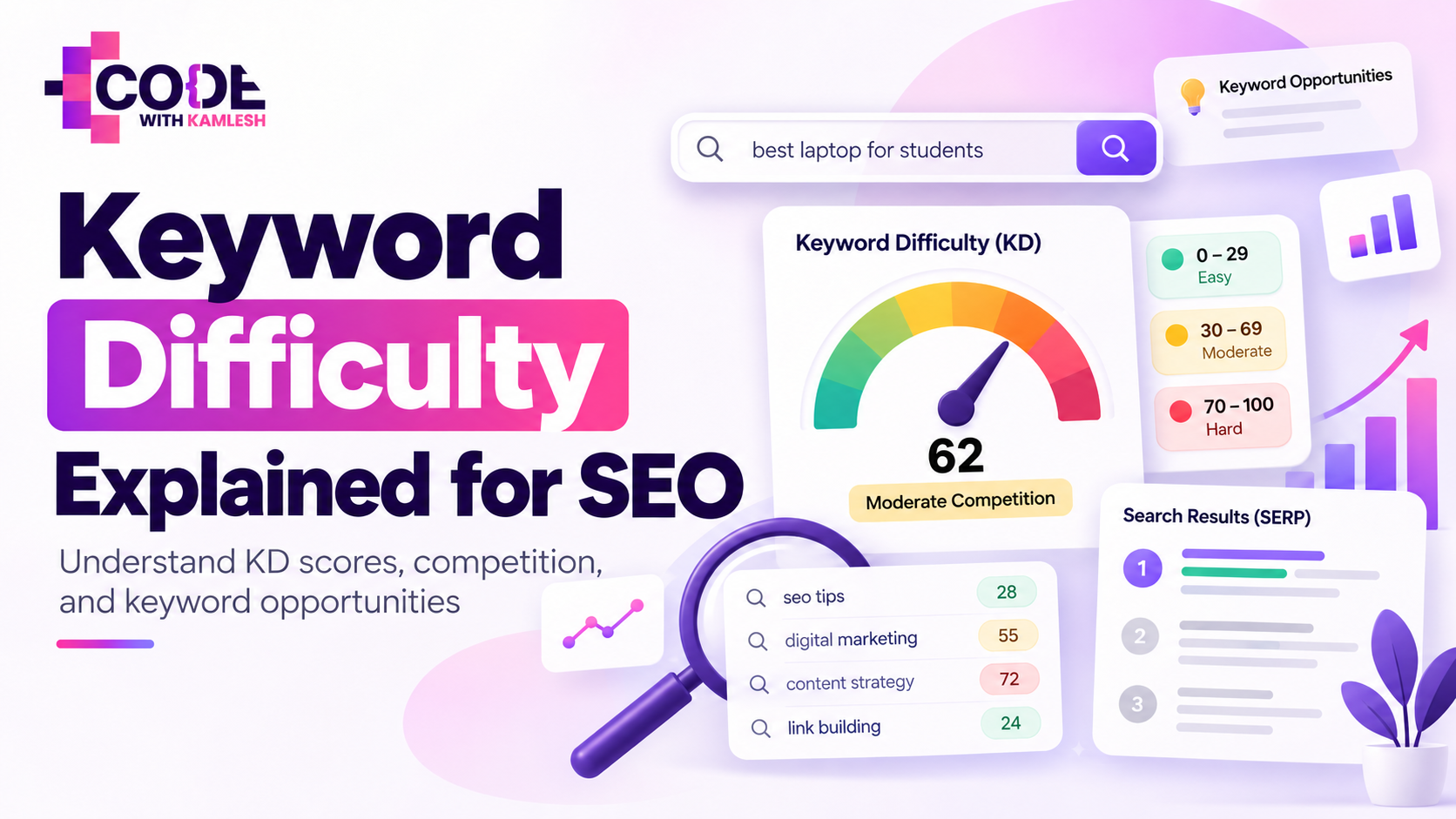
A keyword with 20,000 monthly searches can look like an obvious content opportunity. You publish a detailed article, improve its title, and wait for organic traffic. Yet the page barely attracts visitors, while a narrower article gains traction. Why? Often, the difference is not writing quality alone. It is the level and type of competition already present in the search results.
Keyword difficulty helps you investigate that competition before investing in a page. Most SEO platforms express it as a numerical estimate, but the number is only a starting point. It cannot fully account for your website, the searcher's expectations, or the quality of what you plan to publish.
This guide explains what keyword difficulty means, how popular tools calculate it, how to assess a results page yourself, and how to choose worthwhile keywords without mistaking a metric for a ranking guarantee.
What Is Keyword Difficulty in SEO?
Keyword difficulty (KD) is an SEO metric that estimates how challenging it may be to rank organically for a particular search query. Most tools use a scale from 0 to 100, where higher numbers indicate stronger competition. The usual reference point is earning a position among Google's top ten organic results, although each provider defines and calculates its score differently.
Suppose a new accounting blog is considering two topics: “accounting software” and “how to reconcile invoices for a small bakery.” The first may compete with established software brands and comparison publishers. The second has a narrower audience and more specific expectations. It might offer a better entry point, provided the existing results are not already excellent.
A score describes the competitive landscape through selected signals. Your actual opportunity also depends on whether your page fits the query, whether your site covers the subject credibly, and whether searchers can find a better answer elsewhere.
Google does not publish an official keyword difficulty score. KD values belong to third-party research products, not Google's ranking system.
Why Is Keyword Difficulty Important for SEO?
Without a competition check, keyword planning easily becomes a list sorted by search volume. That approach can commit a small website to topics where existing results have years of accumulated links, recognizable brands, and extensive topical coverage.
Difficulty estimates make a large research spreadsheet manageable. They help you separate near-term publishing opportunities from strategic topics that may require sustained investment. They also encourage more realistic conversations about the time, specialist input, original evidence, and promotion needed for a piece of content.
A specific question from potential customers may be worth answering before pursuing a national, high-volume phrase. For an established publisher, a difficult topic may still justify investment because it supports an important service or product category.
The broader process starts with identifying relevant queries, something explained in our guide to keyword research. Difficulty becomes valuable only after those queries have a clear audience and purpose.
How Is Keyword Difficulty Calculated?
There is no universal KD formula. SEO platforms study the pages currently ranking and convert selected competitive signals into a proprietary score. The exact weighting varies, and providers may update their models.
Backlinks and referring domains
A backlink points from another website to a page. A referring domain is a unique website that provides one or more of those links. Many keyword tools evaluate referring domains because they offer a measurable view of the link strength of leading results.
Ahrefs bases its KD metric on referring domains pointing to the top ten ranking pages. Its published explanation makes clear that the metric does not include on-page content quality. You can review its explanation of keyword difficulty for the methodology and limitations.
Authority and search-result characteristics
Other platforms use broader combinations. Semrush incorporates link-related signals, authority measures and characteristics of the search results. Moz considers the authority of ranking pages and domains, with weighting that reflects result visibility. Authority Score, Domain Authority and Domain Rating are vendor metrics; they are not interchangeable measures issued by Google.
Even a visible organic ranking may generate fewer visits than its reported search volume suggests.
A precise-looking score should therefore be interpreted as an approximation. It cannot measure whether you have unique evidence, the right page format, or an exceptionally relevant answer.
Understanding Keyword Difficulty Scores
The following ranges are illustrative planning bands, not official Google thresholds or a replacement for the labels used by your chosen tool.
Illustrative KD rangeGeneral interpretationRecommended response
0–20
Lower measured competition
Verify intent and look for suitable early opportunities.
21–40
Moderate competition
Compare ranking pages, links and content gaps carefully.
41–60
Strong competition
Plan a differentiated page and supporting content.
61–80
High competition
Consider a longer-term investment and promotion.
81–100
Very high competition
Target selectively when strategic value justifies the effort.
A KD of 30 is not universally “easy.” On one platform, it may represent different underlying evidence than a 30 on another. Use bands to triage topics, not to predict how many weeks a page will take to rank.
How to Check Keyword Difficulty Using SEO Tools
Search results for the same phrase can differ substantially by market, so location-specific data matters.
Ahrefs Keywords Explorer
Enter a seed phrase in Keywords Explorer, choose the target location, and inspect the KD score alongside search volume and the SERP overview. Review how many referring domains point to the leading pages, rather than stopping at the colored difficulty label. You can then expand into related queries and filter the list by difficulty.
Semrush Keyword Overview and Keyword Magic Tool
Search for the term in Keyword Overview to examine KD%, intent, estimated volume, and the leading results. Keyword Magic Tool helps generate variations and apply filters to a larger list.
Where available, compare the standard KD estimate with Personal Keyword Difficulty, which evaluates competitiveness in the context of a specified domain.
Moz Keyword Explorer
Use Keyword Explorer to inspect Difficulty together with estimated search demand and other opportunity indicators. Moz's score emphasizes the competitive strength of ranking pages, using its own authority metrics. The result should inform a review of the actual SERP, not replace it.
Other useful options
SE Ranking, Mangools KWFinder and Ubersuggest also offer difficulty metrics and keyword suggestions. If you compare providers, retain each score under its own tool name rather than averaging them together.
Record the keyword, location, date, metric source, search volume, intent and decision in one sheet. This turns an isolated lookup into a repeatable process.
How to Check Keyword Difficulty Manually
A manual search-result review is where a generic competition score becomes a website-specific decision. Use the following workflow after creating a shortlist in your keyword research tool.
Step 1: Inspect the actual search results
Search the phrase using the target location and device context where possible. Separate ads, map results, shopping elements, AI-generated summaries and organic listings. Note whether the page is dominated by major brands, niche specialists, community discussions or local businesses. A results page full of service listings usually requires a different approach from one filled with tutorials.
Step 2: Confirm the dominant search intent
Ask what users want to accomplish: learn, compare, purchase, visit or navigate to a known brand. Then inspect the format of the top results. If the query returns calculators and product category pages, publishing a broad opinion article is unlikely to match expectations. Our search intent guide explains how to interpret these patterns before assigning a keyword to a page.
Step 3: Compare page-level link strength
Inspect referring domains pointing to the ranking URLs, not only the strength of their homepages. Do not assume every weak-looking page is vulnerable; brand demand, freshness and other signals may also affect its position.
Step 4: Read the leading pages closely
Evaluate whether they answer the question promptly, explain important terms, use credible sources, and provide genuinely practical examples. Check whether data and screenshots remain current. A long article is not automatically better than a short one. The useful question is what an informed reader still cannot do after reading the existing results.
Step 5: Assess your own starting position
Compare your site's related content, current rankings, internal linking, technical accessibility and ability to provide trustworthy information. Check whether you already have a suitable page that should be improved instead of creating another URL. A focused site may compete effectively on a specialized query even without matching every competitor's domain-wide metrics.
Finally, write down the missing piece you can supply: a local comparison, a clearer procedure, a template, an original demonstration or a specific professional perspective. Without that difference, a lower KD score alone is not a compelling publishing plan.
Keyword Difficulty vs Search Volume
Keyword difficulty describes estimated competitive pressure. Search volume describes estimated search demand during a period, commonly reported as an average number of monthly searches. Neither metric directly tells you how many visits your page will receive.
MetricQuestion it answersWhat it cannot answer
Keyword difficulty
How competitive are the current organic results?
Will this particular website rank?
Search volume
How often is the query estimated to be searched?
How many searchers will click your page?
Search intent
What outcome does the searcher appear to want?
Whether your page can outperform competitors.
Business relevance
Does the visitor's need match your offering?
How difficult the rankings will be.
Consider a hypothetical agency choosing between “marketing” at high volume and “technical SEO audit for Shopify stores” at much lower volume. The second query may attract a smaller but more relevant audience. Its value depends on actual demand, ranking competition and what the agency can offer—not a rule that smaller keywords always convert better.
Keyword Difficulty vs Keyword Competition
These labels are often confused, particularly when switching between SEO software and Google Ads.
Organic keyword difficulty estimates competition for unpaid search rankings. Google Ads competition, as displayed in Keyword Planner, reflects how many advertisers compete for ad placements relative to the available opportunities. It is not a measure of the backlink strength of organic results.
A phrase may be attractive to advertisers but have limited high-quality organic explanations. Keep the two columns separate, and evaluate CPC or paid competition only when commercial demand and advertising strategy are relevant to your decision.
What Is a Good Keyword Difficulty Score?
A useful score is one that fits your website's current position and the importance of the topic. There is no universal cutoff that divides keywords into those you can and cannot rank for.
A new website with few relevant pages should often begin with specific problems it can answer convincingly. But it should not reject a strategically essential keyword simply because its KD is high. That term may deserve a foundational page, even if results take longer to develop.
Evaluate what your existing content already ranks for: those results offer a more meaningful benchmark than a generic score category.
Relevance comes before apparent ease.
How to Find Low-Difficulty Keywords
Start with your audience's questions rather than a list of broad industry terms. Customer emails, sales conversations, support requests and site-search queries can reveal precise problems that mainstream articles overlook.
An accounting firm might explore “how to prepare invoices for a freelance designer” instead of pursuing the much broader “accounting.” Specificity can help, but it is not proof of lower competition.
Use competitor keyword-gap reports to identify topics where relevant sites already earn visibility but yours does not. Cluster closely related queries by shared intent so that one strong page can answer them coherently; avoid producing separate thin posts for every wording variation.
Then inspect the SERP. Prioritize terms where the top results leave an identifiable gap and your website has a credible way to fill it. Low search volume should not automatically disqualify an important customer question, particularly when several related queries can be answered on the same page.
Common Keyword Difficulty Mistakes
Choosing the lowest score automatically. A weakly competitive term may have little demand or no connection to your audience. Low difficulty is an opportunity filter, not a business objective.
Ignoring intent. If searchers want product options, a definition article may fail regardless of its optimization. Match the task and content format before creating a brief.
Comparing scores across platforms directly. A 35 in Ahrefs and a 35 in Semrush do not necessarily represent equivalent conditions. Their formulas and databases differ.
Treating authority metrics as Google scores. Domain Authority, Domain Rating and similar values are proprietary approximations. Stronger sites often have advantages, but these numbers are not Google's published ranking thresholds.
Assuming long-tail always means easy. A specialized, purchase-ready query can be intensely competitive. Likewise, some short phrases have neglected results.
Ignoring changing search layouts. Answer boxes, video modules, maps and AI features can alter the clicks available to ordinary organic listings. High reported volume may not translate into equivalent website traffic.
Creating overlapping pages. Several posts serving the same intent can compete for attention and dilute your editorial resources. Decide which URL should own the topic before commissioning another article.
How to Use Keyword Difficulty in Your SEO Strategy
Turn research into a portfolio of quick opportunities, supporting content and longer-term priorities rather than selecting keywords solely by their KD values.
A practical keyword prioritization workflow
- Build a relevant topic list. Collect customer questions, existing Search Console queries, competitor topics and core service needs.
- Identify intent and page type. Label each topic informational, commercial, transactional or navigational, and map it to a suitable article or landing page.
- Add comparable metrics. Record search volume, difficulty, target market and the tool used. Avoid mixing data from different countries or treating cross-tool KD scores as equivalent.
- Manually review the SERP. Inspect competing page types, referring domains, content quality and features that occupy search-result space.
- Estimate business usefulness. Consider whether the query attracts likely customers, supports another important page or answers a recurring audience need.
- Choose a realistic action. Publish, improve an existing page, build supporting content, monitor the term or defer it until resources are available.
An illustrative prioritization example
Imagine a small agency offering SEO services to ecommerce brands. The numbers below are fictional examples for demonstrating a decision, not live keyword research or observed ranking data.
Potential topicHypothetical KDHypothetical monthly searchesStrategic assessment
SEO services
78
18,000
Important, but broad and resource-intensive.
Shopify SEO audit checklist
24
700
Relevant educational opportunity with practical format.
How to fix Shopify duplicate product URLs
18
250
Specific problem; strong potential for a useful tutorial.
Free social media wallpapers
7
3,500
Low competition, but poor fit for the agency.
The agency might publish the duplicate-URL tutorial first, develop the audit checklist next, and build a broader service page over time. The wallpaper term should be excluded despite its appealing numerical combination.
Review KD and volume alongside those judgments. A transparent editorial assessment is often more helpful than inventing a sophisticated formula with arbitrary weights.
Measure outcomes and revisit the decision
After publication, monitor indexing, query impressions, organic clicks, ranking trends and meaningful actions such as enquiries or sign-ups. If impressions rise but clicks remain limited, inspect the current result layout and snippet. If rankings stagnate, revisit intent, content usefulness, technical issues and the competitor set before assuming the problem is simply insufficient backlinks.
Difficulty can change as search results evolve. Review priority topics periodically instead of treating an old spreadsheet as permanent market intelligence.
Final Thoughts
Keyword difficulty is most useful as a screening tool, not a verdict. It helps reveal where competition may demand more resources, but it cannot replace reading the ranking pages or understanding what your own website can genuinely contribute.
Start with audience relevance, use one tool consistently, inspect the results manually, and publish something demonstrably useful. That approach creates a more defensible SEO strategy than chasing either the largest search volume or the smallest difficulty score.
As Google's guidance on people-first content emphasizes, a page should provide substantial value to readers rather than exist mainly to attract search traffic.
Frequently Asked Questions
1. What is keyword difficulty in SEO?
It is a third-party estimate of how challenging it may be to rank organically for a search phrase. The score generally reflects characteristics of pages currently appearing near the top of the results, rather than an official assessment from Google.
2. What is a good keyword difficulty score?
There is no universally good number. A moderate score for a highly relevant topic may be preferable to a low score for an irrelevant one.
3. Is a keyword difficulty score of 30 good?
Open the leading results, inspect page-level backlinks, and determine whether your proposed content can offer a clearer or more useful answer.
4. Can a new website rank for high-difficulty keywords?
Yes, but it may require exceptional topical relevance, useful original material, a strong site foundation and time. Building supporting content around less competitive questions can be a practical starting point while pursuing important longer-term topics.
5. How accurate are keyword difficulty tools?
They provide useful estimates based on measurable competitive signals. Accuracy varies because algorithms, datasets and update schedules differ, and no score captures every influence on a specific website's rankings.
6. Does Google provide a keyword difficulty score?
No. Scores labeled KD, SEO Difficulty or similar are produced by third-party platforms. Google Ads Keyword Planner provides advertiser competition data, which serves a different purpose.
7. What is the difference between keyword difficulty and search volume?
Difficulty describes estimated ranking competition. Volume describes estimated search frequency. Evaluate both alongside user intent, expected click opportunity and relevance to your business.
8. Can I check keyword difficulty for free?
Availability and usage limits change, so check each provider's current offer. You can also evaluate search results manually without relying on a paid score.
9. Why do Ahrefs and Semrush show different scores?
Ahrefs centers its KD calculation on referring domains to leading pages. Semrush uses a broader mix of backlink, authority and search-result signals. Different methodologies naturally produce different numbers for the same query.
10. Should I target only low-difficulty keywords?
No. Combine attainable topics with strategically important competitive terms. The right mix depends on audience needs, the site's current strengths, business priorities and available editorial resources.
Kamlesh Singad
Founder, Code With Kamlesh. Helped 200+ businesses scale through SEO, Google Ads & Social Media. 8+ years of digital marketing experience.
Comments (0)
No comments yet. Be the first to comment!