External Links and SEO: How Outbound Links Affect Search Rankings
Learn how external links affect SEO, content credibility, and user experience. This practical guide explains outbound links, anchor text, source selection, nofollow, sponsored and UGC attributes, external linking best practices, common mistakes, and how to build a reliable external linking strategy.
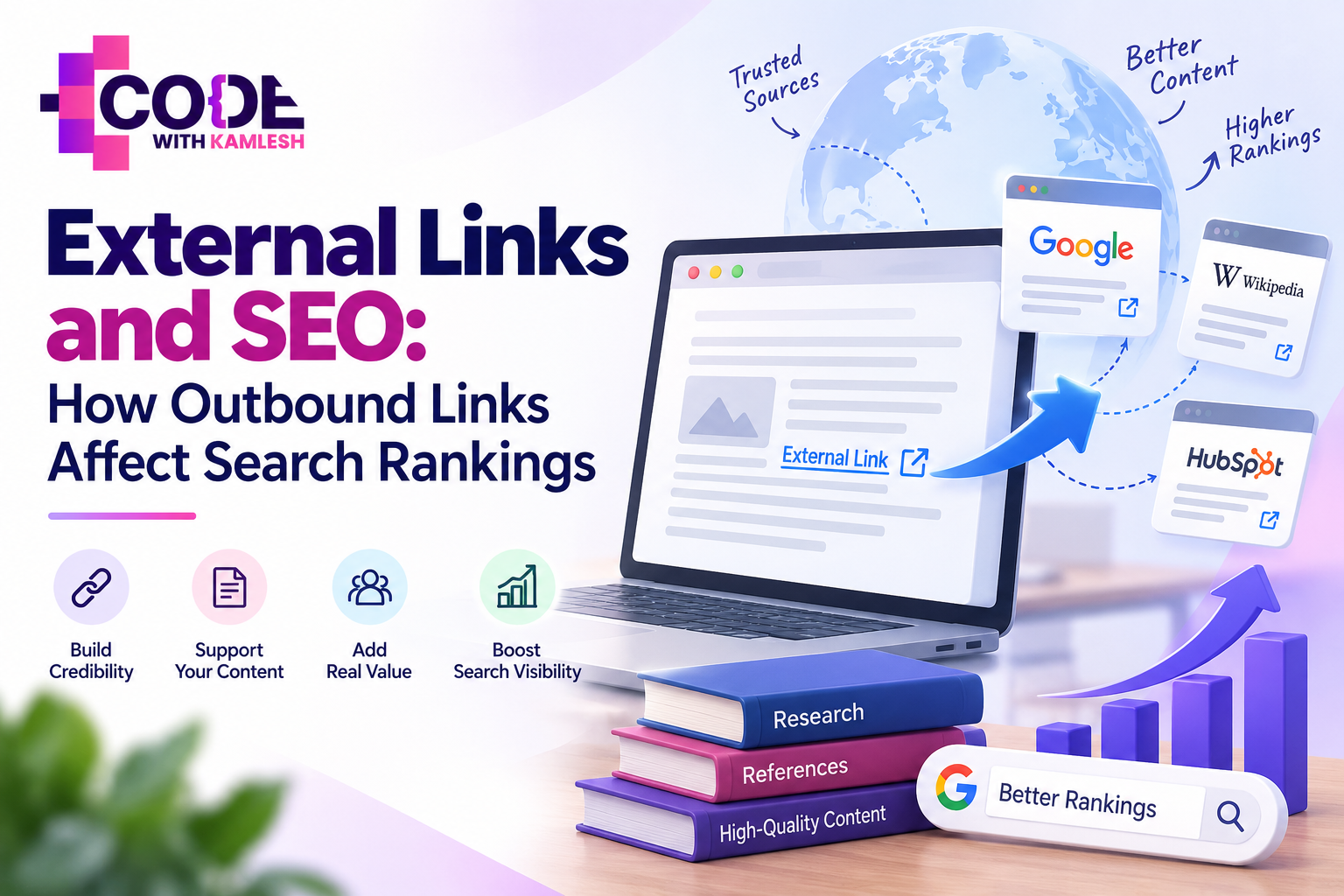
dding outbound links does not automatically improve Google rankings, but relevant and trustworthy links can strengthen content quality, credibility, transparency, and user experience.
The important part is not how many external links you add. What matters is whether each link has a genuine reason to exist.
A strong external linking strategy connects readers with useful sources without sending them away unnecessarily. It also makes research-heavy content easier to trust because important claims can be checked against original evidence.
What Are External Links in SEO?
An external link is a hyperlink from a page on one website to a page hosted on another website.
For example, imagine a digital marketing article discussing how Google handles outbound links. Linking from that article to official Google Search documentation would be an external link because the destination belongs to a different domain.
The website publishing the link is the linking or referring page. The website receiving the visitor is the destination website.
SEO professionals also commonly call these links outbound links when discussing links that leave a website. From the destination site's perspective, that same link may be considered a backlink.
External linking becomes valuable when the destination gives readers something useful that would be unnecessary or impractical to reproduce inside the original article.
Simple External Link Example
Suppose an article contains this sentence:
Google's documentation explains how publishers should qualify sponsored, UGC, and nofollow links.
Linking the descriptive phrase about Google's documentation directly to the relevant resource gives readers clear context before they click.
Compare that with:
Click here to learn more.
engines what the linked resource contains. The second provides almost no contextual information.
Good external link anchor text works like a small description of the destination.
Internal Links vs External Links vs Backlinks
Internal links, external links, and backlinks all involve hyperlinks, but they serve different purposes.
Link TypeWhere It PointsMain PurposeSEO RoleExample
Internal link
Another page on your own website
Connect related pages
Helps discovery, hierarchy, navigation, and contextual relationships
Blog → service page
External link
A page on another website
Reference or support outside information
Adds context, evidence, and useful resources
Blog → Google documentation
Backlink
Your website from another website
Refer visitors to your site
Can contribute to authority, discovery, and link signals
Industry publication → your guide
Internal links keep users moving through your own content ecosystem. A well-planned [Internal Linking for SEO]([INSERT INTERNAL URL]) strategy can help search engines discover important pages while showing how different topics on a website relate to one another.
External links work differently. Their primary purpose should usually be citation, verification, attribution, or additional reader value rather than trying to manufacture an SEO signal.
Backlinks are external links viewed from the receiving website's perspective.
Do External Links Help SEO?
Useful external links can support SEO, but adding outbound links is not a guaranteed ranking technique.
There is no credible rule saying that adding two, three, or five authority links will push a page higher in search results. Search performance depends on many factors, including relevance, content usefulness, website quality, technical accessibility, competition, links pointing to the page, and how well the page satisfies search intent.
External links are better understood as part of producing well-supported content.
Relevant outbound links can improve:
- Content credibility
- Supporting evidence
- Source transparency
- Topic depth
- Reader experience
- Factual verification
- Access to original research or documentation
Google's own guidance says linking to other websites can help establish trustworthiness when sources are cited appropriately, and it also states that there is no magical ideal number of links a page should contain.
That distinction matters.
A useful external link can make an article better. A better article may perform better in search. That does not mean the presence of the external link itself should be treated as a simple ranking switch.
External Links Are Not a Ranking Shortcut
A common SEO mistake is adding links to famous websites simply because those domains appear authoritative.
Consider an article about local SEO for restaurants. Randomly linking to Wikipedia, Forbes, Microsoft, or a major university does not make the article more trustworthy if those pages have little to do with the claim being discussed.
A smaller but highly specialized research organization may be a stronger source than a globally recognized website when its research directly supports the point being made.
The same principle applies when working on commercial pages. A company offering [SEO Services in Indore]([INSERT INTERNAL URL]) should not add unrelated outbound links just to make the page appear more authoritative. Links need a clear user or evidence-based purpose.
External linking works best when readers would genuinely lose something useful if the citation were removed.
Why External Links Matter for High-Quality Content
Well-researched content often depends on information that originated somewhere else.
Statistics come from studies. Technical rules come from documentation. Laws and regulations come from official bodies. Product specifications come from manufacturers. Scientific findings come from research institutions or journals.
Trying to present all of those claims without referencing their sources can weaken transparency.
External links are especially useful when you need to:
- Support statistics
- Cite original research
- Reference official documentation
- Explain technical standards
- Confirm factual claims
- Credit an original source
- Provide a deeper resource
- Help readers verify information
External linking should therefore start during research, not after an article has already been written.
When content teams add links as an afterthought, they often search for a convenient article supporting something they have already written. A better workflow identifies the original evidence while researching the topic and keeps that source attached to the claim it supports.
External Links Can Strengthen Content Credibility
Credibility is not created simply by attaching a hyperlink to a sentence.
The quality of the destination matters.
Suppose an SEO article discusses Google's treatment of rel="sponsored". Linking directly to Google documentation is more useful than referencing an anonymous blog that paraphrases the same documentation.
Readers can inspect the original guidance themselves. Writers also reduce the chance of repeating information that became distorted as it passed through several secondary articles.
Strong citations are particularly important for statistics, health information, legal information, financial claims, technical requirements, and rapidly changing industry topics.
SEO content may not need a citation after every sentence, but factual claims that depend on external evidence should have clear sourcing when verification would benefit the reader.
External Links Help Readers Verify Information
Readers increasingly want to know where a claim came from.
A sentence such as "research shows conversion rates increase significantly" is weak without identifying the research. Which study? Which audience? When was it conducted? What exactly improved?
Linking to the original study gives the statement context.
Source transparency also makes content easier for journalists, marketers, researchers, AI search systems, and other publishers to evaluate.
Good external linking does not interrupt the article. It quietly gives readers the ability to verify important information whenever they need to.
What Websites Should You Link To?
Choose external sources based on relevance, accuracy, originality, expertise, freshness, and reputation.
Domain popularity alone is not enough.
Before adding an outbound link, ask several practical questions:
- Does the source directly support the statement?
- Is this the original source of the information?
- Who published it?
- Does the publisher have subject expertise?
- Is the information still current?
- Is the page accessible and clearly written?
- Would I trust this source when making a real business decision?
- Is there a stronger primary source available?
Official documentation, government websites, universities, original studies, recognized research organizations, standards bodies, and trusted specialist publications are often useful starting points.
Context still matters. No category of website is automatically reliable for every topic.
Third-party SEO metrics such as Domain Authority, Domain Rating, Authority Score, or similar metrics can be useful for competitive analysis. They should not be treated as Google's own ranking metrics or used as the only reason to select a source.
Primary Sources vs Secondary Sources
Prefer primary sources when they provide the information you actually need.
A primary source is the original publisher of the information. Examples include Google's own documentation about Google Search, a company's official product specification, a government report, or the original researchers behind a study.
Secondary sources explain, interpret, summarize, or comment on primary information.
Both can be useful.
Secondary sources are valuable when expert interpretation makes complicated information easier to understand. For factual attribution, though, the original source is often stronger.
For example, when explaining Google's outbound-link attributes, reference Google's original guidance rather than another SEO blog summarizing it. Google's guidance on qualifying outbound links explains when sponsored, ugc, and nofollow are appropriate.
External Linking Best Practices for SEO
External linking works best when it follows editorial logic rather than a fixed SEO formula.
1. Link Only When the Destination Adds Value
Every external link creates a choice for the reader: continue reading your page or leave it.
That means the destination needs to justify the interruption.
Links are usually worthwhile when they provide evidence, original data, technical documentation, attribution, or a resource that would be inefficient to reproduce.
Removing an external link should make the article slightly less useful. When removing it changes nothing, the link may not have been necessary.
2. Prefer Relevant and Trustworthy Sources
Authority without relevance is not useful.
An authoritative medical website does not automatically become a suitable citation for a marketing claim. Match the source closely to the information being supported.
Subject expertise matters more than choosing the biggest domain available.
3. Use Descriptive Anchor Text
Anchor text should explain what readers will find after clicking.
Something like "Google's outbound link documentation" is clearer than "here."
Descriptive anchors improve usability because visitors can understand the destination without opening it first.
4. Avoid Generic Anchors
Repeated phrases such as "click here," "visit website," and "read more" provide little context.
Occasional generic anchors are not automatically harmful, but they usually waste an opportunity to make navigation clearer.
Write anchor text as part of the sentence instead of treating the link like a separate button.
5. Do Not Force Exact-Match Keywords
External anchor text should sound natural.
There is rarely a reason to stuff commercial phrases into citations. The goal is to describe the source accurately, not manipulate anchor-text signals.
Editorial links should read like editorial links.
6. Link Directly to the Relevant Page
Avoid sending readers to a homepage when a specific page contains the information being referenced.
For example, linking to the Google Search Central homepage while discussing sponsored links makes readers search again for the relevant documentation.
Deep-link directly to the useful resource whenever possible.
7. Check Whether External URLs Still Work
External pages change.
URLs redirect, resources move, studies disappear, and companies restructure websites. Content that was accurately sourced two years ago may now point to an error page or unrelated content.
Link checks should be part of routine content maintenance.
8. Avoid Excessive Outbound Links
There is no universal external-link limit.
Still, turning every second sentence into a hyperlink creates unnecessary distraction. Readers may struggle to identify which sources are actually important.
Prioritize evidence and usefulness rather than link volume.
9. Open External Links in a New Tab Only When Appropriate
Opening every external link in a new tab is not an SEO requirement.
Consider user experience instead.
For tools, references, dashboards, comparison resources, or documentation that users may consult while continuing to read your article, a new tab can be convenient. Forced new tabs can also frustrate users in some situations, particularly on mobile.
Make the decision based on usability.
10. Use Link Attributes Correctly
Do not add nofollow automatically to every external link.
Normal editorial links generally do not require a special rel value simply because they lead to another domain.
Sponsored relationships, user-generated content, or links you do not want to associate with require more careful handling.
11. Avoid Spammy Destinations
Never link to a questionable site simply because it ranks for the topic.
Check the destination before publishing.
Look at who created the content, whether aggressive advertising overwhelms the page, whether claims are supported, and whether the site appears trustworthy enough to recommend to your audience.
12. Audit Links During Content Updates
Content refreshes should include source refreshes.
When updating an article, inspect its external references alongside titles, keywords, statistics, screenshots, product information, and internal links.
A page containing current copy but outdated citations is only partially updated.
How to Write Good External Link Anchor Text
Poor anchor text:
- Click here
- Read more
- Website
Better anchor text:
- Google Search Central documentation on outbound links
- Original 2026 industry research
- Official HTML rel attribute reference
Good anchors are specific enough to set expectations without becoming awkwardly long.
Think about how the sentence would read without SEO in mind. Natural editorial wording is usually the best starting point.
Dofollow, Nofollow, Sponsored and UGC External Links
External link attributes describe the relationship between your page and the linked resource.
A normal editorial hyperlink does not need a rel="dofollow" attribute. "Dofollow" is commonly used SEO terminology for a standard crawlable link without a qualifying nofollow-style attribute; it is not a special link attribute you need to add.
Google supports specific values for situations where the relationship needs qualification.
AttributeWhen to Use ItTypical Example
Normal editorial link
Genuine citation or recommendation
Linking to official documentation
rel="nofollow"
When other values do not apply and you do not want Google to associate your site with the destination
Referencing a source you do not endorse
rel="sponsored"
Advertising, sponsorships, paid placements, or compensated links
Paid partner link
rel="ugc"
Links placed by users
Forum posts or blog comments
Paid links deserve particular attention. Google's spam policies state that paid or sponsored links should be properly qualified, with sponsored being the more specific attribute for advertising relationships.
UGC is designed for links added through user-generated content such as forums and comments.
nofollow remains useful where you do not want to associate your site with a destination and another relationship value is not more appropriate.
At the broader HTML level, the rel attribute describes the relationship between the current document and the linked resource. The MDN reference for the HTML rel attribute provides a technical overview of supported link relationships.
Do not use link attributes as decoration. Choose them according to the actual relationship behind the link.
How Many External Links Should a Blog Post Have?
There is no perfect number of external links for a blog post.
A 3,000-word article may need two external citations or twenty depending on what it covers. Research-heavy subjects naturally require more supporting sources than opinion pieces, tutorials based on original experience, or simple definitions.
The right number depends on:
- Article length
- Research requirements
- Number of factual claims
- Statistics included
- Subject complexity
- Availability of primary sources
- Reader usefulness
For a 3,000-word SEO guide, add links wherever an authoritative source genuinely strengthens a claim. Do not add five links because an SEO checklist told you five was ideal.
The opposite problem also exists.
Too many links can turn an article into a directory. Readers may leave before reaching your primary argument, and important references become harder to distinguish from unnecessary ones.
Editorial judgment should decide the number.
Common External Linking Mistakes
Poor external linking usually comes from chasing SEO signals instead of thinking about the reader.
Linking Only for SEO
Adding outbound links solely because someone said "Google likes authority links" creates unnatural citations.
Link because a source adds evidence, context, attribution, or further value.
Linking to Irrelevant High-Authority Websites
A high authority score does not make an unrelated page relevant.
Choose the best source for the specific claim rather than the domain with the highest third-party metric.
Linking to Competitors Without a Reason
Competitor links are not automatically bad.
Still, sending readers directly to a competing commercial page should have a clear editorial purpose. When a neutral primary source supports the same point better, use the primary source.
Adding Too Many Outbound Links
Excessive linking interrupts reading and can dilute the importance of meaningful citations.
Keep links purposeful.
Leaving Broken External Links
Broken references hurt usability and can make older content feel neglected.
Audit important evergreen content periodically and replace dead resources where suitable.
Using Poor Anchor Text
"Click here" gives readers no meaningful destination context.
Use concise descriptive wording instead.
Citing Outdated Sources
A source may still exist while its information has become obsolete.
Check publication dates, updated documentation, research methodology, and whether the organization has released a newer version.
Linking to Low-Quality Websites
Search visibility alone does not prove reliability.
Review the destination before treating it as a source.
Applying Nofollow Everywhere
Automatically adding nofollow to every external link misunderstands its purpose.
Editorial links to useful sources normally do not require nofollow simply because they leave your domain.
Hiding Sponsored Relationships
Paid placements should not be disguised as ordinary editorial recommendations.
Use the correct link qualification and follow applicable disclosure requirements.
Linking to the Homepage Instead of the Source
Make readers do as little searching as possible.
Reference the exact documentation, research page, dataset, report, or article that supports the statement.
Citing Summaries Instead of Original Evidence
Secondary articles sometimes simplify or misinterpret the source.
Whenever practical, trace statistics and factual claims back to their origin before publishing.
How We Approach External Links in an SEO Content Strategy
A practical external linking workflow starts during content research rather than during the final SEO checklist.
Step 1: Identify Claims That Require Evidence
Not every sentence needs a citation.
Definitions from common knowledge may not require one. Statistics, research findings, platform rules, technical requirements, and claims attributed to another organization usually deserve sourcing.
Mark those statements while drafting.
Step 2: Find the Original Source
Trace information back as far as reasonably possible.
When five blogs cite the same statistic, search for the study that produced it rather than simply linking to whichever article ranks first.
Step 3: Check Relevance and Freshness
Read the source rather than relying on its headline.
Confirm that the information actually supports your statement. Also check whether a newer study, policy, specification, or documentation page has replaced it.
Step 4: Choose Natural Anchor Text
Write the sentence first.
Then link the phrase that accurately describes the destination.
That approach usually produces cleaner anchors than deciding on a keyword before writing the sentence.
Step 5: Choose the Correct Link Attribute
Determine why the link exists.
Editorial citation? Usually a normal link.
Paid placement? Sponsored.
User-generated content? UGC may be appropriate.
A destination you do not want to associate your site with? Consider nofollow where relevant.
Step 6: Ask Whether the Link Improves the Page
Before publishing, remove the hyperlink mentally and reread the paragraph.
Does something useful disappear?
When the answer is yes, the link is probably justified. When nothing changes, reconsider whether it belongs there.
Step 7: Recheck Links During Updates
External linking is not a one-time task.
Whenever evergreen content receives an SEO refresh, review its sources too. Broken pages, outdated numbers, old documentation, redirected URLs, and changed source meaning can all weaken previously strong references.
That workflow keeps external links tied to editorial quality instead of arbitrary SEO quotas.
External Link Audit Checklist
Use this checklist when reviewing existing content:
- Check every external URL for a valid destination.
- Identify links producing errors.
- Review redirected URLs and update them to the final destination where appropriate.
- Remove irrelevant references.
- Replace outdated statistics with newer sources when available.
- Check whether anchor text still describes the destination accurately.
- Prefer secure HTTPS versions where appropriate and available.
- Review the reputation and reliability of linked sources.
- Check sponsored links for correct qualification.
- Review links added through user-generated content.
- Remove unnecessary nofollow usage.
- Replace references to pages that no longer exist.
- Confirm that cited pages still support the original statement.
- Check whether a stronger primary source has become available.
- Make sure external links still improve the reader's experience.
A link audit does not need to become a complicated project. For most websites, combining it with routine content refreshes is enough to catch the issues that matter.
Final Thoughts on External Links and SEO
External linking should be treated as part of good research and publishing, not as a ranking trick.
Strong SEO content needs to explain a topic clearly, answer the search intent, support important factual claims, and give readers enough confidence to trust what they are reading. Carefully chosen outbound links can contribute to each of those goals.
Relevance matters more than authority scores. Original sources are often more useful than third-party summaries. Descriptive anchor text is better than generic wording. Correct link attributes matter when commercial or user-generated relationships are involved.
Most importantly, every external link should earn its place.
When a reliable source helps readers verify a statement, understand a technical concept, examine original evidence, or continue their research, linking to it improves the content.
When a link exists only because someone believes outbound links are a ranking formula, it probably does not belong there.
Frequently Asked Questions
1. What is an external link in SEO?
An external link is a hyperlink that sends users from your website to a page on another domain. External links are commonly used for citations, supporting evidence, official documentation, original research, attribution, and additional resources.
2. Do external links improve SEO rankings?
External links do not guarantee higher rankings. Relevant links to trustworthy sources can improve credibility, evidence, transparency, and user experience, which contribute to better content quality. Adding authority links randomly should not be treated as a direct ranking tactic.
3. How many external links should I use in a blog?
There is no universal ideal number. Add external links when reliable outside sources genuinely support claims or improve the reader's understanding. A research-heavy article may naturally require more citations than a simple tutorial or experience-based article.
4. Should external links be nofollow?
No. Normal editorial external links generally do not need nofollow simply because they point to another website. Use appropriate relationship attributes when links are sponsored, user-generated, or when there is another specific reason to qualify the relationship.
5. Is linking to high-authority websites good for SEO?
It can be useful when the source is relevant and trustworthy, but authority alone is not enough. A highly relevant primary source is usually more useful than an unrelated website chosen simply because it has a strong third-party authority metric.
6. What is the difference between internal and external links?
Internal links connect pages within the same website, while external links lead to another domain. Internal links support site navigation and content relationships. External links commonly provide citations, evidence, references, or access to additional resources.
7. Can too many external links hurt SEO?
There is no fixed limit, but excessive unnecessary links can distract readers and weaken content flow. External links should support a purpose. Removing links that offer no evidence, context, attribution, or reader value usually produces cleaner content.
8. Should external links open in a new tab?
Not necessarily. Opening external links in a new tab is primarily a user-experience decision rather than an SEO requirement. Consider how readers interact with the resource and whether keeping the original article open makes their task easier.
9. What websites should I avoid linking to?
Avoid sources that are irrelevant, deceptive, outdated, unsafe, spam-heavy, factually unreliable, or unable to support the claim being cited. Review the actual destination page instead of judging source quality only by rankings or third-party SEO metrics.
© 2026 Code With Kamlesh. All Rights Reserved.
Kamlesh Singad
Founder, Code With Kamlesh. Helped 200+ businesses scale through SEO, Google Ads & Social Media. 8+ years of digital marketing experience.
Comments (0)
No comments yet. Be the first to comment!