Anchor Text Optimization: A Complete SEO Guide for Better Rankings
Master anchor text optimization with this complete SEO guide. Learn how to use exact-match, partial-match, branded, and contextual anchors naturally, improve internal linking, avoid over-optimization, and build a stronger SEO strategy.
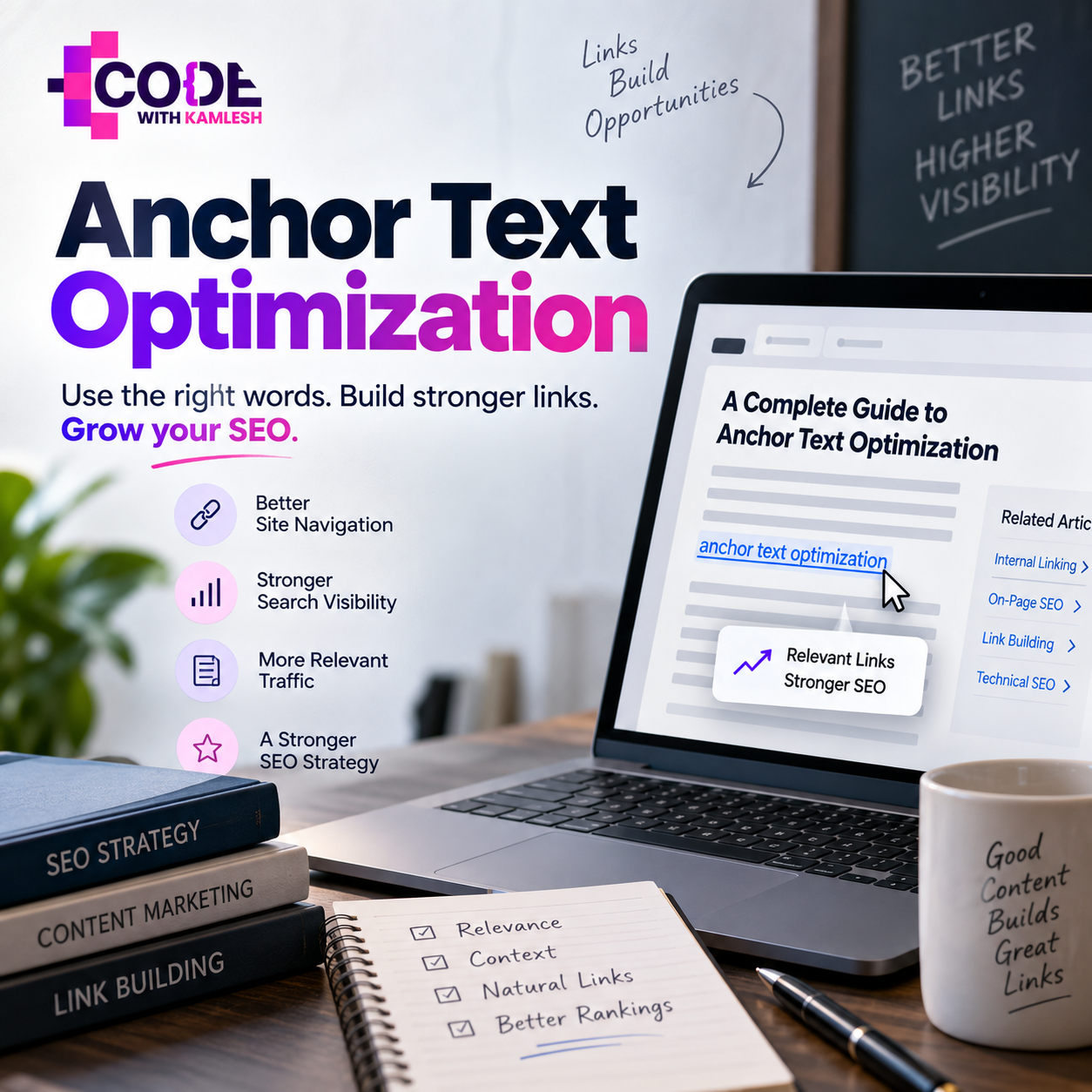
Anchor text may look like a small detail in SEO, but it plays an important role in how users and search engines understand links. Every time you add an internal link to another page on your website or earn a backlink from another domain, the clickable words associated with that link provide context about where the link leads.
When used properly, anchor text can improve website navigation, strengthen internal linking, provide contextual relevance, and help search engines understand relationships between pages. When handled poorly, however, it can make content look unnatural, create confusing navigation, and in aggressive cases contribute to an over-optimized link profile.
That is why modern anchor text optimization is not about placing the same target keyword in every link. It is about relevance, context, variety, and user experience.
Search engines have become much better at understanding language and the meaning surrounding a link. A natural phrase placed in a highly relevant paragraph can therefore be more useful than repeatedly forcing an exact keyword into every anchor.
In this guide, we will explore what anchor text is, how it works, the different types of anchor text, how to optimize internal and external links, common mistakes to avoid, and how to build a sustainable anchor text strategy.
What Is Anchor Text?
Anchor text is the visible and clickable text used in a hyperlink.
For example, imagine you are reading an article about improving the visibility of a website and encounter this sentence:
“Learn more about our SEO services for businesses.”
If the words “SEO services for businesses” are clickable and take you to an SEO service page, those words are the anchor text.
In HTML, a standard hyperlink may look like this:
<a href="https://example.com/seo-services">SEO services</a>
Here, “SEO services” is the anchor text.
Anchor text serves two audiences at the same time.
For users, it explains what they can expect after clicking the link.
For search engines, it provides additional context about the destination page and its relationship with the page containing the link.
This makes anchor text relevant to internal linking, backlink analysis, content optimization, website architecture, usability, and overall SEO strategy.
Google's own documentation explains that good anchor text should be descriptive, reasonably concise, and relevant to both the page containing the link and the destination page.
Why Is Anchor Text Important for SEO?
Links are one of the fundamental ways websites and pages are connected across the web. Search engines crawl links to discover pages and use numerous signals to understand what those pages contain.
Anchor text adds meaning to that relationship.
Suppose ten pages link to an article using phrases related to “technical SEO audit.” Those anchors can provide contextual information indicating that the destination is associated with technical SEO audits.
However, anchor text should never be considered in isolation. Search engines can evaluate the content surrounding a link, the relevance of the linking page, the authority and quality of the website, the destination page, and many other signals.
For website owners, anchor text optimization provides several practical benefits.
It can improve navigation by making links easier to understand.
It can strengthen contextual relationships between related pages.
It can make internal linking more useful.
It can help users discover additional information.
It can support a clearer website architecture.
Most importantly, effective anchor text serves the reader first. If users can understand where a link will take them before clicking it, the anchor is already performing one of its most important functions.
How Search Engines Understand Anchor Text
Search engines do not simply count keywords appearing inside links.
Modern search systems evaluate context.
Consider these two examples:
“Click here for more information.”
“Read our complete technical SEO audit guide.”
The second example provides considerably more context. Even without opening the destination page, a reader can understand what information is likely to be available after clicking.
Search engines can use similar contextual clues.
They may evaluate the words in the anchor, the sentence surrounding it, the topic of the source page, the content of the destination page, and the relationship between the two pages.
This is why anchor text optimization should be approached semantically rather than mechanically.
Instead of asking:
“How many exact-match anchors should I use?”
A better question is:
“What anchor text most accurately describes this destination within the current sentence?”
That change in mindset usually produces a much more natural internal linking structure.
Major Types of Anchor Text
Understanding different anchor types helps you analyze and diversify your linking strategy. There is no requirement that every website maintain a fixed percentage of each type. The classifications are primarily useful for understanding link patterns.
1. Exact-Match Anchor Text
Exact-match anchor text uses the exact target keyword associated with the destination page.
For example, if the destination page targets:
“on-page SEO”
The anchor could simply be:
“on-page SEO”
Exact-match anchors can be highly descriptive when used naturally.
The problem begins when the same keyword is deliberately repeated across a large number of links purely for ranking purposes.
A natural editorial link and a manufactured keyword pattern are very different things.
Use exact-match anchors where they genuinely fit the sentence, rather than trying to create them everywhere.
2. Partial-Match Anchor Text
Partial-match anchors contain the target keyword together with additional descriptive words.
Examples include:
“complete guide to on-page SEO”
“on-page SEO optimization techniques”
“learn more about on-page SEO”
These anchors often work naturally within content because writers have more flexibility to match the surrounding sentence.
For internal linking, partial-match anchors can be particularly useful because they provide context without requiring repetitive wording.
3. Branded Anchor Text
Branded anchor text uses the company, website, product, or organization name as the clickable text.
Examples include:
“Code With Kamlesh”
“Google”
“Ahrefs”
Brand anchors are especially common when websites naturally reference companies or sources.
For backlinks, branded anchors are also a normal part of an organically developed link profile because publishers often mention a company by name when linking to its website.
4. Naked URL Anchor Text
A naked URL occurs when the URL itself is displayed as the clickable link.
For example
Naked URLs are frequently found in citations, directories, resource pages, profiles, and references.
They are not always the best choice within editorial content because descriptive anchor text generally provides users with more information.
However, their presence is completely normal in many contexts.
5. Generic Anchor Text
Generic anchors use non-specific phrases such as:
“click here”
“learn more”
“read more”
“visit this page”
These phrases can sometimes make sense from a design or call-to-action perspective, but they provide little information when viewed independently.
Whenever possible, descriptive anchors are usually more useful.
Instead of:
“Click here to understand keyword research.”
You could write:
“Read our keyword research guide.”
The second version immediately communicates the destination.
6. Phrase-Match Anchor Text
Phrase-match anchors contain a target phrase within a broader sentence fragment.
For example, if the topic is “SEO strategy,” possible anchors could include:
“building an effective SEO strategy”
“SEO strategy for growing websites”
“improving your current SEO strategy”
This approach can make linking feel natural while still maintaining topical relevance.
7. Image Anchor Text
Images can also function as hyperlinks.
When an image is used as a link, its alternative text can provide information about the linked destination.
That is another reason descriptive image alt text matters.
Alt text should primarily describe the image appropriately and support accessibility rather than being treated as a place to stuff keywords.
Anchor Text Optimization for Internal Links
Internal links connect one page on your website to another page on the same domain.
They are completely under your control, which makes them one of the easiest areas of anchor text optimization to improve.
A well-planned internal linking strategy helps users discover related resources while creating logical connections between your pages.
For example, if you are writing about link optimization and want readers to understand broader page-level optimization, you can direct them to this complete guide to on-page SEO.
This internal link works because the anchor describes the destination and appears in a context where the additional information is useful.
Similarly, when discussing how keywords should be used naturally within page content and links, readers can explore this guide explaining what keywords are in SEO.
The objective is not simply to insert internal links. Every internal link should have a reason to exist.
Ask yourself:
Does this destination help the reader?
Is it contextually related?
Does the anchor accurately describe the destination?
Would I still add this link if search engines did not exist?
If the answer is yes, the link is probably useful.
Use Descriptive Anchor Text
One of the simplest improvements you can make is replacing vague anchors with descriptive ones.
Poor example:
“For additional SEO information, click here.”
Better example:
“Explore our technical SEO optimization guide.”
The better version tells the reader what the destination contains.
Descriptive does not mean unnecessarily long.
An anchor containing an entire paragraph creates a poor reading experience. In most cases, a concise phrase is sufficient.
The anchor should provide enough information to establish an expectation without disrupting the natural flow of the sentence.
Keep Anchor Text Relevant to the Destination Page
Relevance is fundamental.
If the anchor says “local SEO checklist,” users should not land on a generic social media marketing page.
A mismatch between anchor text and destination content creates a frustrating user experience and weakens contextual clarity.
Before adding a link, inspect the destination page.
Identify its primary topic.
Then choose an anchor that accurately represents that topic within the context of your current article.
For example, an article about keyword research could naturally link to a page about search intent using an anchor such as:
“understanding search intent”
There is no need to force a commercially valuable keyword if it does not fit the sentence.
Avoid Excessive Exact-Match Anchor Text
Exact-match anchor text is not inherently bad.
If a page is genuinely about “technical SEO,” using “technical SEO” as an internal anchor can be perfectly logical.
Problems occur when optimization becomes repetitive and artificial.
Imagine a website with hundreds of internal links pointing to the same service page, all using exactly:
“best SEO company in Indore”
Such a pattern can make content repetitive and reduce readability.
Natural language provides plenty of alternatives:
“SEO services in Indore”
“professional SEO support”
“SEO solutions for local businesses”
“our SEO services”
“search optimization services”
“SEO agency services”
The correct variation depends on the context.
Do not create variations merely to hit a percentage. Let the sentence and destination determine the anchor.
Anchor Text and Keyword Stuffing
One of the biggest misconceptions about anchor optimization is that adding more keywords automatically creates stronger SEO signals.
It does not.
Keyword stuffing makes content less natural and can reduce its quality.
For example:
“Our SEO agency provides SEO services. Learn about our SEO services from our SEO services page for professional SEO services.”
This provides little value to a reader.
A natural version could be:
“Businesses looking to improve organic visibility can explore our professional SEO services and optimization approach.”
The second version communicates the idea clearly without repeating a keyword unnaturally.
The same principle should apply across your entire website.
SEO copy should read like it was written for people, not like it was assembled to satisfy a keyword counter.
Surrounding Context Matters
Anchor optimization does not stop with the clickable words.
The surrounding sentence and paragraph help establish context.
Consider:
“Our technical SEO process includes crawl analysis, indexation checks, Core Web Vitals monitoring, structured data validation, and internal linking improvements.”
If “internal linking improvements” links to an internal linking guide, both the anchor and surrounding sentence reinforce the topic.
That creates a much clearer contextual relationship than placing an isolated link in an unrelated paragraph.
When adding internal links, therefore, evaluate the complete sentence rather than focusing only on the anchor.
Anchor Text for Backlinks
Backlinks are links from external websites pointing to your website.
Unlike internal links, you usually do not have complete control over how independent websites link to your content.
That is normal.
A healthy backlink profile can naturally contain branded anchors, URLs, article titles, descriptive phrases, keyword-related phrases, and other variations.
Trying to control every external anchor can make link building unnecessarily artificial.
The better approach is to earn links because your content, research, tools, services, data, or expertise deserve to be referenced.
Publishers should generally be free to choose wording that makes sense for their readers.
Anchor Text Diversity: What It Really Means
SEO discussions sometimes turn anchor diversity into a mathematical formula.
For example, you may encounter recommendations claiming that a website should use a particular percentage of branded anchors, exact-match anchors, URLs, and partial-match anchors.
There is no universal percentage that applies to every website.
Different industries naturally produce different link patterns.
A famous brand may receive a high proportion of branded links.
A research website may receive links using the titles of its studies.
A tool may receive anchors describing the function of the tool.
A local company may receive business-name and URL anchors from directories and citations.
Instead of trying to manufacture an arbitrary ratio, focus on whether your link profile makes sense for the website and how links were acquired.
Natural diversity is an outcome, not a percentage target.
Anchor Text and User Experience
SEO optimization should improve user experience rather than compete with it.
Good anchors allow readers to scan an article and understand where links lead.
This is particularly important in long-form content.
If every link says “click here,” users have to read the surrounding text carefully to determine the destination.
Descriptive anchors reduce that uncertainty.
They can also make content more accessible and improve navigation for people using assistive technologies.
This is one reason Google's guidance recommends meaningful anchor text. You can review Google's official SEO link best practices for additional guidance on crawlable links and descriptive link text.
The important takeaway is simple: write anchors for humans first.
Anchor Text and External Links
External links point from your website to another domain.
Anchor text principles remain largely the same.
The anchor should accurately explain the destination.
For example, when referencing independent SEO research, you could direct readers to the Ahrefs guide to anchor text.
The reader immediately knows both the source and the subject.
External links are particularly useful when citing research, official documentation, statistics, standards, original sources, or concepts that require further explanation.
Choose trustworthy sources and make sure the linked resource directly supports the surrounding statement.
Anchor Text Optimization for Topic Clusters
Anchor text becomes especially valuable when building topic clusters.
A topic cluster typically includes one broad pillar page supported by several more specific articles.
Suppose your pillar topic is:
“Search Engine Optimization”
Supporting articles might cover:
Keyword Research
On-Page SEO
Technical SEO
Internal Linking
Link Building
Anchor Text Optimization
Search Intent
Content Optimization
These pages should not exist as isolated pieces of content.
Relevant contextual links can connect them.
An anchor text article might link to internal linking, while an internal linking article might link to site architecture or on-page SEO.
This creates a logical content network.
The goal is not to link every page to every other page. Instead, connect pages where the relationship provides genuine value.
Avoid Linking the Same Anchor to Different Intentions
Consistency matters.
Suppose the anchor “SEO audit” links to a technical SEO audit service on one page but links to a beginner's SEO checklist elsewhere.
Users may receive inconsistent expectations.
This does not mean every occurrence of a phrase must always point to exactly the same URL. Context can legitimately change its meaning.
However, for strategically important topics, consistent internal linking can make your architecture easier to understand.
Map important pages to their primary themes and use contextually appropriate anchors when linking to them.
Avoid Overloading Content with Links
Adding dozens of contextual links does not automatically improve a page.
Too many links can distract readers and reduce the importance of genuinely useful references.
Imagine reading a paragraph where every second phrase is clickable.
Even if every destination is relevant, the reading experience becomes cluttered.
Internal linking should be selective.
Link when the destination expands on the current point, answers a likely follow-up question, supports a claim, or moves the visitor logically through your website.
Quality matters more than simply increasing the number of links.
Anchor Text for Commercial Pages
Commercial pages require particular care because marketers naturally want to use valuable keywords.
Suppose you have an SEO service page.
You might be tempted to link to it from every article using an exact commercial anchor.
A better strategy is to use the service page when it genuinely relates to the discussion.
For example:
“If managing technical fixes, content optimization, and link acquisition internally becomes difficult, professional SEO services can provide a structured approach.”
Here, the commercial link appears as a natural continuation of the reader's problem.
This is much more useful than randomly adding a service-page link to unrelated paragraphs.
Anchor Text for Local SEO
Local businesses often target keywords containing service and location combinations.
Examples might include:
“SEO company in Indore”
“digital marketing agency in Indore”
Location-based anchors can be relevant, particularly when the destination genuinely represents that location and service.
However, repeating the exact same city-service phrase across every internal link is unnecessary.
Natural variations can reflect how people actually write:
“our Indore SEO team”
“SEO services for Indore businesses”
“local search optimization in Indore”
“digital marketing services in Indore”
The focus remains the same: relevance and readability.
How to Audit Anchor Text on Your Website
Anchor optimization should begin with an audit.
Start by crawling your website with an SEO crawling tool or exporting internal link data from the tools available to you.
For every important page, review:
The number of internal links pointing to it.
The anchor text used.
The source pages containing those links.
Whether those source pages are contextually relevant.
Whether important pages receive enough internal links.
Whether outdated URLs are still linked.
Whether redirects are being used unnecessarily.
You may discover that some important pages have almost no contextual internal links, while less important pages receive dozens.
This information can help you redistribute internal links more strategically.
Find Internal Linking Opportunities
One practical method is to identify pages where the target topic is already mentioned naturally.
Suppose you have published a new article about technical SEO.
Search your existing website for phrases such as:
technical SEO
website crawling
indexing issues
technical optimization
crawl errors
When an existing article discusses one of these topics, determine whether linking to the new article would benefit the reader.
If yes, add a contextual link.
This approach is much more natural than inserting links into random pages purely because they have authority.
Fix Orphan Pages
An orphan page is a page with no meaningful internal links pointing to it from other crawlable pages.
Even excellent content can become difficult for visitors and crawlers to discover if it is isolated from the rest of the website.
When reviewing your website architecture, identify valuable orphan pages and connect them from relevant existing content.
Do not simply place every orphan page in the footer.
Contextual links from related articles are often much more useful.
Choose anchor text based on the actual topic of the destination.
Update Anchor Text When Content Changes
Websites evolve.
An article that originally covered “Instagram SEO basics” might later be expanded into a broader “Social Media SEO Guide.”
If the page's purpose changes significantly, review the internal anchors pointing to it.
Old anchors may no longer describe the updated destination accurately.
The same principle applies after page consolidation.
If two overlapping articles are merged into one stronger resource, update internal links so their anchor text reflects the consolidated page.
Internal linking should be maintained as part of ongoing SEO work rather than treated as a one-time setup.
Common Anchor Text Optimization Mistakes
Several mistakes appear repeatedly across websites.
The first is excessive exact-match repetition.
The second is using vague anchors such as “click here” everywhere.
The third is linking irrelevant pages simply to create more internal links.
The fourth is stuffing anchors with several keywords.
The fifth is using anchors that promise information the destination does not provide.
The sixth is ignoring broken links and redirects.
The seventh is creating internal links only for search engines without considering whether users would find them useful.
The eighth is treating anchor diversity as a fixed mathematical formula.
Avoiding these mistakes will already place your internal linking strategy on a much stronger foundation.
A Practical Anchor Text Optimization Workflow
A sustainable process does not need to be complicated.
Begin by identifying your priority URLs.
Assign each important URL a clear primary topic.
Review existing internal links pointing to those pages.
Check whether the anchor text accurately represents each destination.
Replace unclear generic anchors where a more descriptive phrase would improve usability.
Look for relevant pages where additional contextual links would genuinely help readers.
Check for excessive repetition, but do not create awkward variations merely for diversity.
Review external links and ensure their anchors accurately describe trustworthy sources.
Finally, repeat the audit periodically as your website grows.
This turns anchor text optimization into part of website maintenance rather than a one-off SEO trick.
How Anchor Text Fits Into Modern SEO
Anchor text optimization works best when it is integrated with a broader SEO strategy.
A perfectly optimized anchor cannot compensate for a poor destination page.
If the linked page contains thin content, does not satisfy search intent, loads poorly, or provides a weak user experience, changing its anchor text will not solve the underlying problem.
Think of anchor text as one component of a connected system.
Strong SEO typically requires useful content, logical architecture, crawlability, appropriate keyword targeting, technical health, internal linking, relevant backlinks, and a good user experience.
Anchor text helps connect those elements.
It tells readers where to go next and provides search engines with additional context about how your pages relate to one another.
Best Practices for Anchor Text Optimization
The most effective anchor text practices are straightforward.
Write anchors that accurately describe the destination.
Keep them concise enough to remain readable.
Use exact-match keywords only when they fit naturally.
Use variations where natural language calls for them.
Build internal links between genuinely related pages.
Consider the surrounding sentence and paragraph.
Avoid stuffing keywords into anchors.
Do not obsess over fixed anchor-text percentages.
Audit internal links regularly.
Update links when URLs or page topics change.
Prioritize useful contextual links over arbitrary link counts.
Use authoritative sources when adding external links.
Most importantly, consider what information a reader expects to find after clicking.
If the anchor creates the correct expectation and the destination fulfills it, you are usually moving in the right direction.
The Future of Anchor Text Optimization
Search technology continues to improve in its ability to understand language, entities, context, and relationships between topics.
This makes natural writing increasingly important.
The future of anchor optimization is unlikely to be about finding a perfect keyword ratio. It is more likely to reward websites that build clear information architecture and meaningful connections between useful resources.
As search engines become better at interpreting surrounding content, marketers should focus less on isolated keyword manipulation and more on semantic relevance.
Instead of asking whether an anchor contains the exact target keyword, evaluate whether the complete sentence clearly explains the relationship between the current page and the destination.
That is a more sustainable approach to optimization.
Conclusion
Anchor text optimization is an important part of SEO, but it should not be complicated into a formula.
The purpose of anchor text is to help users and search engines understand where a link leads and why that destination is relevant.
Strong anchor text is descriptive, concise, contextually appropriate, and natural.
Exact-match anchors can be useful. Partial-match anchors can be useful. Branded anchors and URLs can also be completely natural. What matters is how and why they are being used.
For internal links, focus on creating a logical structure that connects related content and guides visitors toward useful information. For backlinks, focus on earning legitimate mentions instead of trying to manufacture a perfect anchor profile.
Avoid excessive keyword repetition, generic anchors where descriptive wording would be better, irrelevant linking, and arbitrary anchor-text ratios.
Most importantly, remember that anchor text does not work independently. It supports a larger SEO ecosystem that includes content quality, search intent, site architecture, technical optimization, internal linking, backlinks, and user experience.
When every link has a clear purpose and every anchor sets an accurate expectation, anchor text optimization becomes less about manipulating search signals and more about creating a website that is easier for both people and search engines to understand.
Frequently Asked Questions
What is anchor text in SEO?
Anchor text is the visible, clickable text of a hyperlink. It helps users understand where a link will take them and can provide search engines with additional context about the destination page.
Is anchor text important for SEO?
Yes. Anchor text contributes to contextual understanding, internal navigation, and the relationship between linked pages. However, it is only one part of a much broader SEO strategy.
Is exact-match anchor text bad?
No. Exact-match anchor text can be completely natural when it accurately describes the destination and fits the sentence. Problems arise when exact-match keywords are deliberately
repeated at scale in an unnatural way.
What is the best anchor text for internal links?
The best internal anchor is usually a concise, descriptive phrase that accurately represents the destination and fits naturally into the surrounding content.
Should every internal link contain a keyword?
No. Anchor text should primarily help users understand the destination. Keywords can be included where they fit naturally, but there is no need to force them into every link.
How long should anchor text be?
There is no universal ideal length. It should contain enough information to explain the destination without becoming unnecessarily long. A short descriptive phrase is usually appropriate.
How many internal links should a page have?
There is no single number suitable for every page. Add internal links where they help users discover relevant information and support a logical website structure.
Should I use “click here” as anchor text?
It can be used, but descriptive anchor text is usually more informative. Instead of “click here,” wording such as “read our technical SEO guide” immediately tells readers what they will find.
Can I use the same anchor text multiple times?
Yes, particularly when it is the most natural way to describe a page. However, repetitive exact-match usage should not be deliberately manufactured simply for SEO purposes.
How often should I audit anchor text?
For an active website, reviewing internal links during regular SEO audits and whenever major content or URL changes are made is a practical approach. Large publishing websites may need more frequent monitoring.
What is the difference between internal and external anchor text?
Internal anchor text links to another page on the same website. External anchor text links to a page on another domain. Both should clearly and accurately describe their destination.
Does surrounding text matter for anchor optimization?
Yes. The surrounding sentence and paragraph provide additional context about why the link is relevant. Anchor optimization should therefore consider the complete passage rather than only the clickable words.
Can anchor text help improve website navigation?
Yes. Descriptive anchors allow visitors to understand what they will find before clicking, making it easier to move between related pages and resources.
What is anchor text over-optimization?
Anchor text over-optimization generally refers to creating repetitive, keyword-heavy link patterns primarily to influence rankings rather than to help users. A natural, contextual approach is more sustainable.
What is the most important rule for anchor text optimization?
Make every link useful. The anchor should clearly describe its destination, fit naturally into the content, and give the reader a genuine reason to click.
© 2026 Code With Kamlesh. All Rights Reserved.
Kamlesh Singad
Founder, Code With Kamlesh. Helped 200+ businesses scale through SEO, Google Ads & Social Media. 8+ years of digital marketing experience.
Comments (0)
No comments yet. Be the first to comment!